The Indians broke in the general direction of their village and endeavored to penetrate the line of Troops “B” and “K”, but the soldiers stood their ground and returned the fire to the best of their ability.
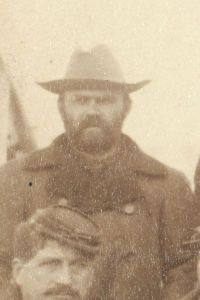
First Lieutenant Loyd S. McCormick, Regimental Adjutant, 7th Cavalry, at Pine Ridge Agency, 16 Jan. 1891. Cropped from John C. H. Grabill’s photograph, “The Fighting 7th Officers.”
[Note: In December 1890, Loyd Stone McCormick was serving as a First Lieutenant and the 7th Cavalry’s Regimental Adjutant, at Wounded Knee. McCormick wrote this unpublished manuscript in 1904 while serving as a Major in the 7th Cavalry. Some years after writing this manuscript McCormick stated, “I did this more to get the result of the investigation of General Forsyth (then Colonel of the regiment) in a tangible shape than for any other reason.” Based on that statement McCormick likely had access to and used the reports and correspondence associated with the investigation as the basis of his manuscript. However, as he did not cite sources, did not publish the manuscript in any professional journal or magazine, and wrote it fourteen years after the battle, I have categorized this account as Reminiscences. I originally posted McCormick’s account in three parts in January 2014. It is posted now in its entirety.]
WOUNDED KNEE and DREXEL MISSION FIGHTS.
December 29th and 30th, 1890
An account of the conditions and events which precede the collecting of United States forces at several places in South Dakota during the fall and winter of 1890-91, will be necessary in order that the reader may understand the peculiarities of the problem which was presented for solution, and the difficulties to be encountered in a real effort to meet the emergency.
During the late summer and fall of 1890, the Indians throughout the country, but particularly those at the agencies in North and South Dakota, had shown signs of unrest. In many cases they had refused to obey their agents and, generally, had adopted a very arrogant bearing. The cause of this change was not at first apparent, and the authorities, as a rule, were puzzled to account for it. Although it was known in a general way that the Indians were engaging in some unusual ceremonies, it was well into the fall before the more serious aspects of the matter appealed to the military authorities. By this time fanatic zeal had so possessed a large number of Indians that there was a general belief that a Messiah was soon to appear, and that with him would be a return of the buffalo, a resurrection of dead Indians, and the annihilation of the white man. A feverish excitement pervaded most of the agencies, and different Medicine Men took advantage of this condition to so play on the feelings of the savages as to convince a large percentage that the rule of the white man could easily be terminated. Such a desirable change appealed strongly to their superstitious natures, and when the Indians had been worked up to the top notch of ardor, the announcement was made that the bullets of the white men could not harm them if they would wear the “Ghost Shirt.” The material of which these were made was the unbleached muslin issued to the Indians at the agencies; but the shirt must be made up by certain squaws designated by the Medicine Men of each band. These shirts sold for five dollars each, and it was thought by not a few that the trade in shirts was sufficient stimulae to unusual efforts in convincing the deluded savages that by means of the shirt alone could they hope to reap the benefits to accrue as soon as the Messiah should appear. Continue reading →


 Sam Russell





 Army at Wounded Knee