…the bucks made a break, which at once resulted in terrific fire and a hot fight lasting about twenty minutes, followed by skirmish firing of about one hour.
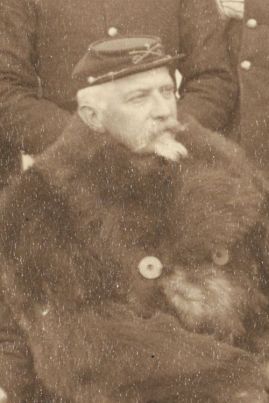
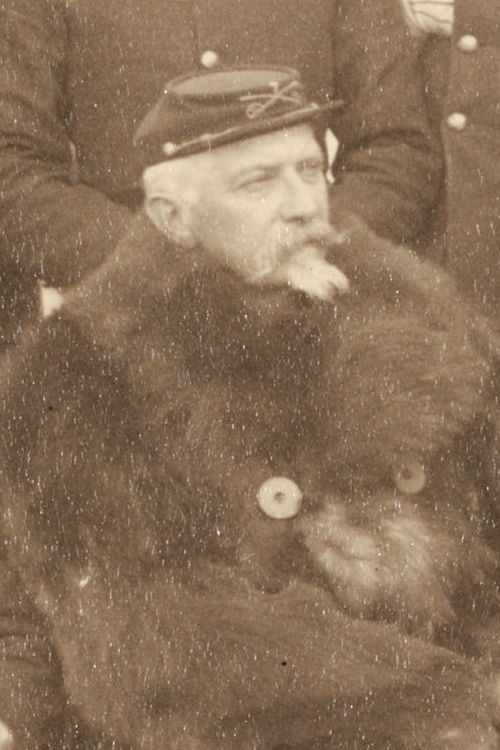
Col. James W. Forsyth, 7th Cavalry, at Pine Ridge Agency, 16 Jan. 1891, cropped from John C. H. Grabil’s “Fighting Seventh Officers.”
Colonel James William Forsyth, the fifty-six-year-old commander of the 7th Cavalry Regiment submitted three field reports concerning his actions surrounding Wounded Knee. Each of these reports were submitted as evidence during the investigation that Major General Miles convened on 6 January 1891. The first report he rendered on the eve of the battle upon reaching Major Whitside’s camp near the Wounded Knee Creek post office.
Hdqtrs. Camp 7th Cavalry,
Wounded Knee, S. D.,
December 28, 1890.
8:30 P.M.
Actg Adjt. General,
Dept. of the Platte, in the field,
Pine Ridge Agency, So. Dak.
Sir:
I have the honor to report that I reached here with my command at 8:30 P.M.
Found everything in perfect condition. The Comdg Gen’l’s orders will be carried out in the morning, or as soon thereafter as possible. I will report back to him, with the battalion I brought out with me.
Rations for 400 Indians should be sent here to-morrow as early as possible, with the forage train, the General said he intended to send. I find that Major Whitside has been obliged to call in from the troops rations to feed these Indians to-day.
I trust that the rations and forage train will be pushed here rapidly to-morrow morning.
I cannot now say at what time I will reach the agency on my return to-morrow, but no time will be lost.
Very respectfully, Your obdt servant,
James W. Forsyth,
Colonel 7th Cavalry, Commanding.
Forsyth sent a second message on 29 December following the initial melee surrounding the council circle and while his troops continued the pursuit and annihilation of Big Foot’s band up the ravine and into the hills.
Wounded Knee, S. D., December 29th, 1890.
General Brooke:
On attempting to disarm the persons of the bucks, they made a break, which resulted in a hot fight, lasting from about 9:15 until about 9:45. About 15 soldiers are wounded and a few killed. The number of Indians killed and wounded not known, but believed to exceed the loss on our side. The ones who escaped have fled up the ravines to the west, pursued by three troops.
Lieut. Garlington is shot through the arm–not a dangerous wound. This dispatch is indefinite but is as accurate as I can give, as we are still engaged clearing out the ravine.
Very respectfully, Your obdt servant,
James W. Forsyth
Colonel 7th Cavalry, Commanding.
Later: Captain Wallace is killed.
Forsyth’s third report from Wounded Knee concerned Captain Henry Jackson’s troop being attacked by Indians from the agency who came out to the sounds of the battle.
Wounded Knee, S. D., December 29th, 1890
1:30 P.M.
General Brooke:
Capt. Jackson, in pursuing the escaping Indians, overtook them and captured twenty-three. Almost immediately after five Indians approached from the direction of the agency and had the appearance of belonging to the agency police. After shaking hands with all the officers, they rode back a short distance, and evidently at a signal about 150 Indians opened fire on him, and in the running fight the captured Indians escaped.
He then returned to the command.
Am preparing to start for the agency now.
Very respectfully, Your obdt servant,
James W. Forsyth,
Colonel 7th Cavalry Comdg,
P.S.–If seven ambulances could be sent out to meet us, it would make the moving of the wounded more easy to them.
Colonel Forsyth submitted his official report of the battle on 31 December, the day after the battle on White Clay Creek and two days after Wounded Knee.
Camp Pine Ridge Agency,
December 31, 1890.
Acting Assistant Adjutant General,
Headquarters Department of the Platte,
In the field,
Sir:–I have the honor to report the following in connection with the movements of my command on the night of December 28th and during the following day.
Pursuant to verbal orders from the Commanding General of the Department, I moved my command from this point to the crossing of the Wounded Knee by the main trail to the Rosebud Agency, leaving here at 4:40 P. M., and arriving there at about 8:30 P. M. Major Whitside’s Battalion of the 7th Cavalry and Detachment Light Battery E, 1st Artillery, had that day captured Big Foot’s band of Indians and when I arrived had them in his camp. My command consisting of Regimental Headquarters and the Second Battalion detachment of Light Battery E, 1st Artillery went into camp for the night. At about 7:30 the next morning after considerable trouble the bucks of Big Foot’s band—numbering 106, were collected away from their camp and—after explaining to them that, having surrendered, they would be treated as prisoners of war, but that as such they must surrender their arms,–squads of 20 men were cut off and told to bring them to a designated place. The result of this was very unsatisfactory, but few arms being brought. Keeping the bucks collected, details of soldiers were made, under officers, to search the Indian Camp. While this was in progress, one Indian separated a little from the rest, and in Ghost Dance costume, began an address to which I paid no attention, as the Interpreter said he was telling the Indians to be quiet and submit. After a short while however, the Interpreter told me that he was talking of wiping out the whites. I then made him cease his address. Just after this, the search through their camp having proved almost fruitless, I gave orders to search the persons of the bucks—again telling them that they must do as white men always do when surrendering—that is give up their arms. At the first move to carry out the order last referred to, the bucks made a break, which at once resulted in terrific fire and a hot fight lasting about twenty minutes, followed by skirmish firing of about one hour. From the first instant the squaws started for the hills and it is my belief that comparatively few of them were injured. Some bucks succeeded in getting away, and three troops were sent in pursuit. They overtook and captured five bucks (all badly wounded), nineteen squaws and children and killed six bucks. Very soon after, the force was attacked by about 125 bucks, supposed to be from the Agency. In the fight which followed, those captured had to be dropped. One of the troops sent out became separated a short distance and killed four Indians, one a buck, the other three could not be determined. As accurate an estimate as could be made of the dead Indian bucks in and near the camp was 83, which added to the 7 before mentioned makes 90 as the number of bucks killed. The attack on the three troops by the 125 bucks—taken in connection with a message from the Department Commander to Major Henry, 9th Cavalry, who was on White River, which message was opened by me by mistake and contained the information that the Brules had left the Agency on the warpath—led me to believe that I was in danger of an attack by all the discontented Indians in the vicinity; and as my command had suffered greatly in killed and wounded, I deemed it not only prudent but obligatory in me to return to the Agency. The task of caring for the killed and wounded, and improvising as comfortable transportation as possible for them, and making the other necessary arrangements, occupied all the time, and all the men of the command. Fortunately a supply train came into camp just after the fight, which was emptied and utilized for this purpose. As I saw a night march ahead of me, an early start was of utmost importance. For this reason no time was taken to accurately count the killed and wounded Indians in and near the camp. Another reason for this omission was the fact that one buck held a sheltered ravine which commanded a great portion of the field, and all our efforts to dislodge or kill him failed, although fully half an hour was spent in the effort. He was wounded and I thought it better to leave him than to make additional sacrifices in order to take him, which loss would certainly have followed. We brought with us to the Agency six bucks badly wounded and twenty-seven squaws and children wounded.
Forty-eight guns were secured many of which were issued to citizen teamsters and reporters during the fight and some were retaken by the bucks as their first rush was in that direction. About one hundred and fifty ponies were captured and turned over to the Indian Scouts to be driven to the Agency.
Our loss was one officer (Captain Wallace), six non-commissioned officers and eighteen privates killed; and two officers (Lieuts. Garlington and Gresham, the latter slightly, 7th Cavalry, and Lieut. Hawthorne, 2d Artillery), eleven non-commissioned officers and twenty-two privates wounded.
In closing this report, I desire to express my admiration of the gallant conduct of my command in an engagement with a band of Indians in desperate condition and crazed by religious fanaticism.
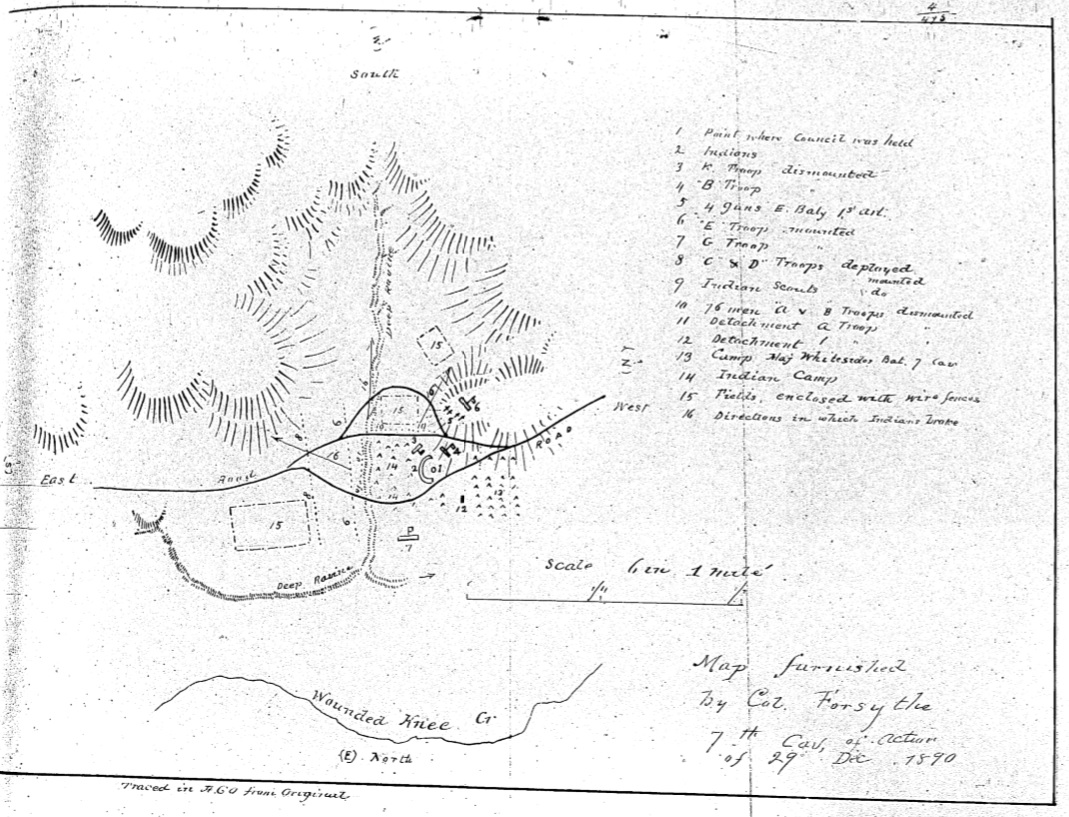
Enclosed is a sketch of the ground where the fight took place.
Very respectfully, Your obdt servant,
James W. Forsyth,
Colonel 7th Cavalry Comdg,
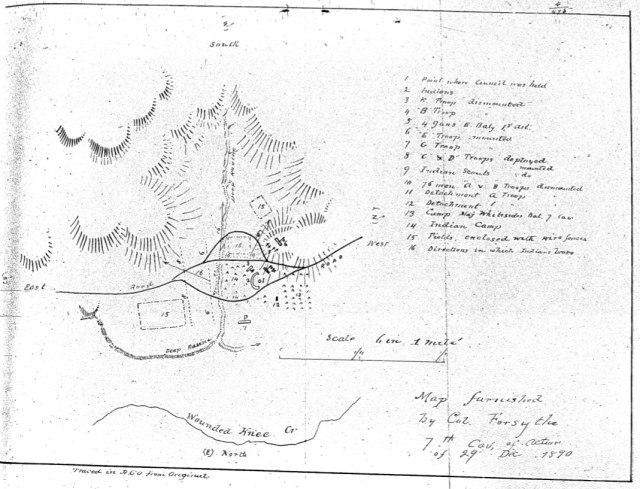
(Click to Enlarge) “Map furnished by Col. Forsyth, 7th Cav., of action of 29th Dec. 1890.” The map designates the left side of the map as “East.” It is actually South.
Recapitulation [of casualties].
Whites.
Killed.
Capt. G. D. Wallace, 7th Cavalry
6 non-commissioned officers
18 Privates.
Wounded.
1st Lieut. E. A. Garlington, 7th Cavy.
1st Lieut. J. C. Gresham, 7th Cavy.
2nd Lieut. H. L. Hawthorne, 2d Arty
11 non-commissioned officers
22 Privates.
All were of the 7th Cavalry except Lieut. Hawthorne and Hospital Steward Oscar Pollack.
Indians.
Killed.
83 bucks in and near camp
7 bucks by pursuing party.
Wounded.
6 bucks brought to the agency,
5 bucks abandoned by pursuing party,
19 squaws and children abandoned by pursuing party,
27 squaws and children brought to Agency.
Colonel Forsyth also submitted on 31 December 1890 his report of the regiment’s actions of the previous day near the Drexel Catholic Mission on White Clay Creek.
Camp Pine Ridge Agency,
December 31, 1890.
Acting Assistant Adjutant General,
Headquarters Department of the Platte,
In the field,
Sir:–I have the honor to report
that in accordance with verbal orders of the Department Commander I moved out with my command (headquarters and eight troops of the 7th Cavalry and detachment of light battery E, 1st Artillery) to the Catholic Mission, about 4 ½ miles below the agency on White Clay creek. My information from the Department Commander was that the hostile Indians had burned the Mission; but upon reaching that point I found that there had been a mistake, and that instead a small log building used for school purposes, about a mile this side of the Mission, was burning. Father Jutz at the Mission told me that the school house had been fired by a small party of Brule Indians who had gone down the valley a few hours before; but that the Mission had not been molested in any way. While at the Mission I saw two other fires down the valley, and proceeding in that direction, I developed a scattered force of about fifty Indians, who were well protected by the bluffs and ravines with which both sides of the valley are bordered. By throwing forward two or three troops I succeeded in silencing the fire of the Indians and apparently in dispersing them over the bluffs on each side of the valley. Just as one battalion was mounted and was withdrawing, a considerable number of Indians attacked us from the south toward the agency. The mounted battalion quickly stationed and for about one half hour a very brisk fire was maintained on both sides. The battalion which had been left at the first position was withdrawn to the second. The portion of the valley in which we were attacked the second time, being narrow and controlled by the bluffs, was not suitable, and one battalion was again withdrawn under support of the other. Four troops of the 9th Cavalry and detachment of light battery E, 1st Artillery now arrived under command of Major Henry, and supporting the advance battalion by his, it was withdrawn gradually up the valley. From a new position–still, however, a contracted one–a number of shots were fired from the Hotchkiss guns, but as the Indians did not attempt any further attack, and as my men and horses and those of Major Henry’s battalion were much fatigued by thirty-six hours almost constant work, I, at about one hour and a half before dark, started for the agency. Several Indians are believed from their actions to have been wounded or killed. One saddled but riderless pony was seen running across the bottom from a point where a mounted Indian had just previously been seen. The loss on our side was one private killed and one officer (Lieut. Mann) and 5 enlisted men wounded. I have since learned that the main village, containing between seven and eight hundred bucks, was located three or four miles farther down the stream than my advance troop reached, and the slight resistance I met with was undoubtedly made with the hope that a rush would be attempted down the narrow valley, when, from the bluffs on each side, my command would have been almost at their mercy.
Very respectfully, Your obedient servant,
James W. Forsyth, Colonel 7th Cavalry, Commanding.
Citation: National Archives Microfilm Publications, “Reports and Correspondence Related to the Army Investigations of the Battle at Wounded Knee and to the Sioux Campaign of 1890–1891.” (Washington: The National Archives and Records Service, General Services Administration, 1975),757-763, and 819.
Citation for this article: Samuel L. Russell, “Col. Forsyth’s Official Reports of Actions at Wounded Knee,” Army at Wounded Knee (Sumter, SC: Russell Martial Research, 2013-2015, http://wp.me/p3NoJy-1z), updated 8 Feb 2015, accessed date __________.


 Sam Russell





 Army at Wounded Knee