Private James E. Kelly, I Troop, 7th Cavalry—Dying Words


It is sure death to go down here.

For most of the enlisted soldiers killed or mortally wounded in the fighting along the creeks of Wounded Knee and White Clay the only recognition they received was their misspelled names in newspapers across the country. Some may have had the detail of a fatal wound next to their name and perhaps their rank. For most all, their last words went unrecorded. One exception was Private James E. Kelly of Captain Nowlan’s I Troop, a young man who endeared himself to many such that his dying words were often mentioned in the papers or personal letters.

On the morning of December 29, 1890, I Troop was located in two positions on the field: two thirds were dismounted as perimeter guards along the south side of the ravine and along portions of the eastern and western sides of the Indian camp; one third were held in reserve between the artillery and the first battalion’s camp.
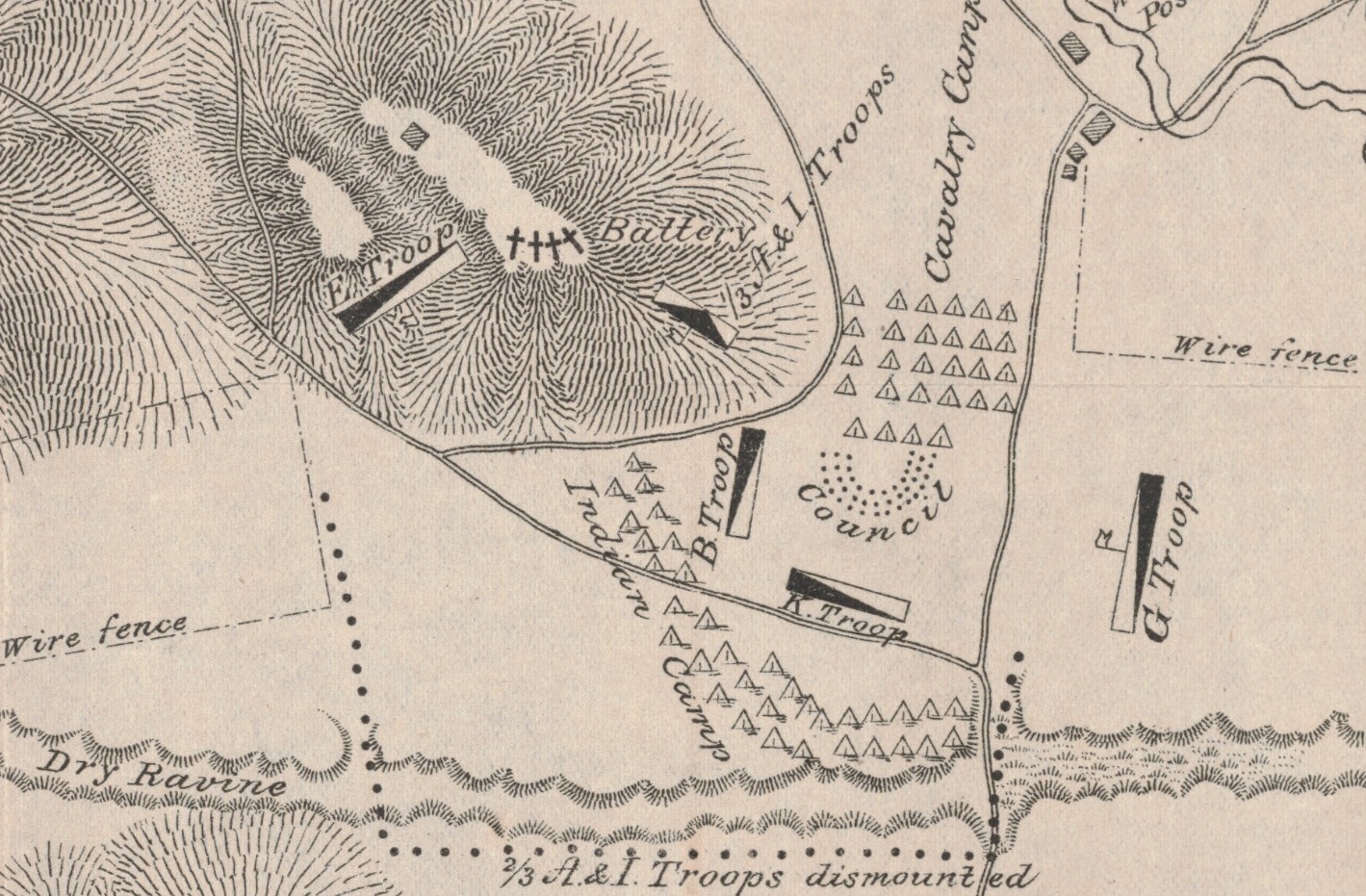
(Click to enlarge) Inset of Lieut. S. A. Cloman’s map of Wounded Knee depicting the scene of the fight with Big Foot’s Band, December 29, 1890.

The earliest account of Kelly’s death was recorded the evening of December 30 after the Drexel Mission fight long White Clay Creek. Sergt. Michael Conners of Capt. Godfrey’s D Troop scribbled out a hasty letter using the butt of his carbine as a writing surface. In the post script he listed the killed that his future wife might know; among them was “Poor Kelly.” In a follow up letter the following day, Conners elaborated on Kelly’s last words and the manner of his death, “The last words Kelly said was when we started down in the ravine, ‘it is sure death to go down here,’ and at that he was shot.” This would indicate that Kelly was on the perimeter at the ravine, and may have been combined with the D Troop detachment that Lieut. Tommy Tompkins took down into the ravine. It is interesting to note that Kelly was known to a non-commissioned officer from another troop such that his death warranted mentioning in a personal letter to that soldier’s fiancé.[1]

In that morning’s edition of the Omaha Bee, the list of soldiers killed included the misspelled name of “Kelley, private, Company I, Seventh Cavalry.” The next day’s edition included the mortal wound, but still misspelled his last name, “Company I . . . Kelley, James E., head.”[2] Continue reading

Posted in Casualties, Enlisted, Newspaper Articles | Tagged , , , , , , , , , , , , , | 4 Comments

First Sergeant Dora Sherman Coffey, B Troop, 7th Cavalry – Killed in Action


It was bitterly cold.  The warriors’ blankets covered them completely, exposing only their eyes.  My first sergeant and I, with a few men, started the search of the line.
Captain Charles A. Varnum

Calvary First Sergeant chevrons, 1872-1902.[1]

Dora S. Coffey, the young twenty-four-year-old first sergeant of Captain Charles Varnum’s B Troop, was assisting his commander with the search of the warriors at the Indian council circle the morning of December 29, 1890, when the first shots rang out at the camp along the Wounded Knee Creek. Coffey was killed by a gunshot wound to the head according to newspaper accounts, likely occurring during the opening volley. Continue reading

Posted in Casualties, Enlisted | Tagged , , , , , , , , , , , , , , , , , , | 1 Comment

Investigation of the White Horse Creek Tragedy


I then called to the captain that it was squaws, and he replied “Don’t kill the squaws.” I said – it is too late, I am afraid they are already killed.
–First Sergeant Herman Gunther

Three weeks after Wounded Knee an Indian policeman named Red-Hawk, who had been searching for his sister since the battle, found her remains and those of her children near White Horse Creek. He returned to the Pine Ridge Agency and reported his discovery of the bodies. Major General Nelson A. Miles, perhaps concerned with Captain Edward S. Godfrey’s testimony two weeks earlier that “My men had killed one boy about 16 or 17 years old, a squaw and two children,” gave Captain Frank D. Baldwin instructions to locate the bodies and determine what happened. On January 21, 1891, Baldwin submitted the following report:

Captain Frank D. Baldwin at the Pine Ridge Agency, 13 January 1891.

Captain Frank D. Baldwin at the Pine Ridge Agency, January 13, 1891.

I proceeded this morning at 7 A.M., under escort of a detachment of the 1st Infantry, mounted to White Horse Creek, about eleven miles distant, where I found the bodies of one woman, adult, two girls, eight and seven years old, and a boy of about ten years of age. They were found in the valley of White Horse Creek, in the brush, under a high bluff, where they had evidently been discovered and shot. Each person had been shot once, the character of which was necessarily fatal in each case. The bodies had not been plundered or molested. The shooting was done at so close a range that the person or clothing of each was powder-burned. The location of the bodies was about three miles westward of the scene of the Wounded Knee battle. All of the bodies were properly buried by the troops of my escort. From my knowledge of the facts, I am certain that these people were killed on the day of the Wounded Knee fight, and no doubt by the troop of the 7th Cavalry, under the command of Captain Godfrey.

Continue reading

Posted in Enlisted, Newspaper Articles, Official Reports, Wounded Knee Investigation | Tagged , , , , , , , , , , , , , , , , , , | 2 Comments