1891 Annual Report of Major General Miles – Part 4


Major General Nelson A. Miles concluded his annual report of 1891 by detailing the affairs at Wounded Knee and Drexel Mission, the effect those two incidents had on the overall campaign, and the eventual surrender of all the hostile Indians.  His narrative of the two affairs, and in particular the Mission fight, would in subsequent years draw ire from James W. Forsyth and prompt him to write the Secretary of War and correct the record.  I will post more on Forsyth’s letters later, but now, here is the final part of General Miles annual report to Secretary of War Redfield Proctor.

Wounded Knee Creek Affair.
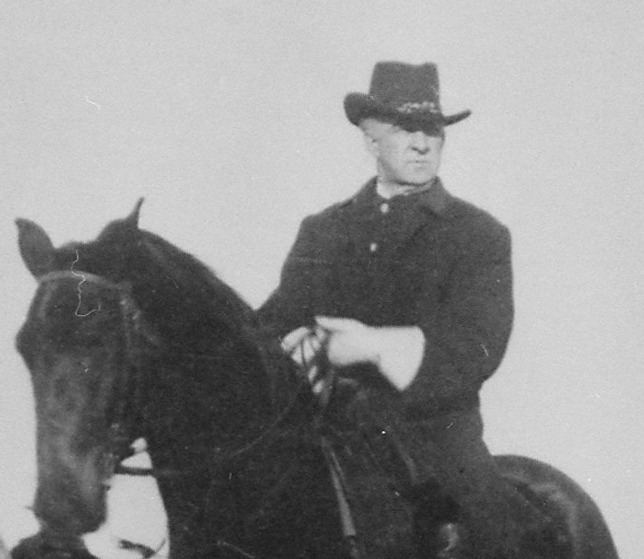
Gen. Nelson A. Miles viewing hostile Indian camp near Pine Ridge Agency, South Dakota.- Cropped from photograph by John C. H. Grabill, January 16, 1891.

Gen. Nelson A. Miles viewing hostile Indian camp near Pine Ridge Agency, South Dakota.- Cropped from photograph by John C. H. Grabill, January 16, 1891.

Although the camp of Big Foot had escaped the troops on the Cheyenne River, the troops on the south were moved so as to prevent him joining the hostile element, and orders were given to the troops under Col. Carr and Gen. Brooke not only to intercept the movement of Big Foot and party but to cause their arrest. This was accomplished by Maj. Whitside on the 28th day of December, 1890, who met Big Foot 1 ½ miles west of Porcupine Creek and demanded his surrender. The band submitted to it without resistance and moved with the troops 7 miles, where they were directed to camp, which they did in such position as the commanding officer directed. In order that no mistake might be made, and to have sufficient troops on the ground in case of resistance, Col. Forsyth was ordered by Gen. Brooke to join Maj. Whitside with four troops of cavalry, which, with the company of scouts under Lieut. Taylor, made up a force of eight troops of cavalry, one company of scouts, and four pieces of light artillery, a force of 470 fighting men as against 106 warriors then present in Big Foot’s band. A scouting party of Big Foot’s band was out looking for the hostile camp of Short Bull and Kicking Bear, but as they (Short Bull and Kicking Bear) had been started from the Bad Lands and were moving into Pine Ridge Agency they were returning to Big Foot’s band when the fight occurred on the morning of the 29th of December, 1890.
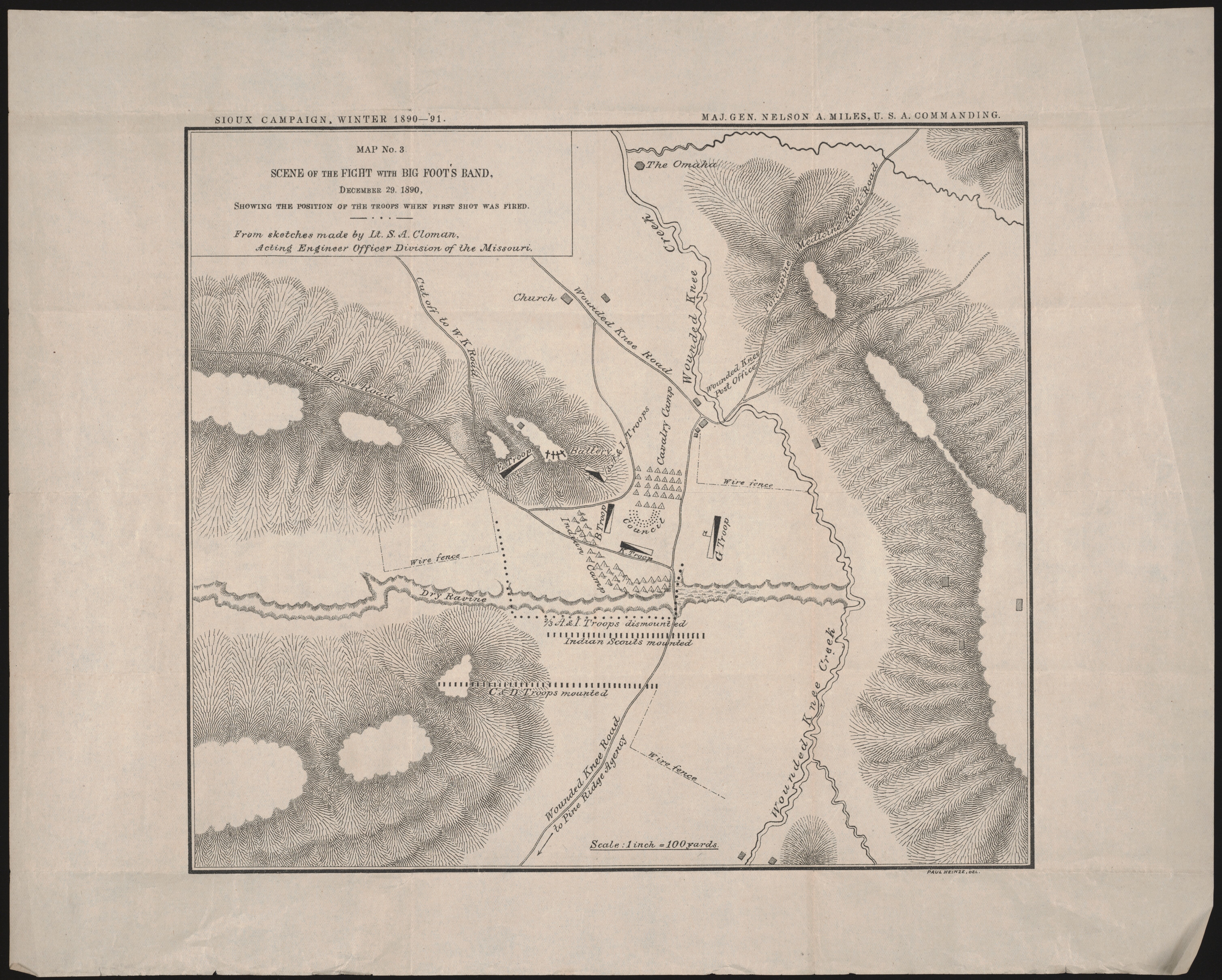
Lieut. S. A. Cloman's map of Wounded Knee depicting the scene of the fight with Big Foot's Band, Dec. 29th 1890.

Lieut. S. A. Cloman’s map of Wounded Knee depicting the scene of the fight with Big Foot’s Band, Dec. 29th 1890.

It was the intention to order Big Foot’s band to the railroad and then send it back to the reservation where it belonged, or out of the country for a time, in order to separate it from the other Indians. As they had not been within a long distance of the hostile camp in the Bad Lands it was deemed advisable to keep them as far away as possible from it.

The unfortunate affair at Wounded Knee Creek December 29, 1890, in which 30 officers and soldiers and 200 Indians (men, women, and children) were killed or mortally wounded, prolonged the disturbance and made a successful termination more difficult.

A number of the Indians that had remained peaceable at the Pine Ridge Agency became greatly alarmed on learning what had befallen the band of Big Foot, and some of the young warriors went to their assistance. These, on returning with the intelligence of what had occurred, caused a general alarm, which resulted in some 3,000 leaving the camps located about the agency to join the hostiles and assume a threatening attitude.

The Indians from the Bad Lands, under Short Bull and Kicking Bear, would have camped that night (December 29) within 4 miles of the agency, but on hearing the news of the Big Foot disaster turned back and assumed a hostile attitude on White Clay Creek about 17 miles from the Pine Ridge Agency. Thus, instead of the hostile camp under Short Bull and Kicking Bear camping within a short distance of the agency, the next day, the 30th of December, found the hostile camp augmented to nearly 4,000, and embracing more than a thousand warriors.

Affair At The Mission.

On December 30 a small band of Indians came near the Catholic Mission, 4 miles from the military camp at Pine Ridge, and set fire to one of the small buildings. Col. Forsyth, with eight troops of the Seventh Cavalry and one piece of artillery, was ordered by Gen. Brooke to go out and drive them away. He moved out, the Indians falling back before his command with some skirmishing between the two parties, until they had proceeded 6 miles from the camp at Pine Ridge. There the command halted without occupying the commanding hills, and was surrounded by the small force of Indians. Skirmishing between the two parties followed. Col. Forsyth sent back three times for reinforcements, and fortunately Maj. Henry, with four troops of the Ninth Cavalry and one Hotchkiss gun, was in the vicinity, and moved at once at the sound of the guns. Upon arriving on the ground he made proper disposition of his troops by occupying the adjacent hills and drove the Indians away without casualty, thereby rescuing the Seventh Cavalry from its perilous position. The Seventh Cavalry lost one officer (Lieut. Mann, mortally wounded) and one private killed and several wounded.

From all information that could be obtained the Indians engaged in this affair did not number more than 60 or 70 young warriors. For his conduct on that day and the previous day Col. Forsyth was relieved from command.

Result And Other Affairs.

These two affairs, namely, at Wounded Knee and what is known as the Mission fight, seriously complicated the situation and increased the difficulty of suppressing the outbreak. On the evening of the 28th of December everything indicated a settlement without a serious loss of life. The result may be summed up in the loss of nearly 200 people, delay in bringing the Indians to terms, and caused 3,000 Indians to be thrown into a condition of hostility with a spirit of animosity, hatred, and revenge. The spirit thus engendered made it more difficult to force back, or restore the confidence of the Indians, and for a time it looked as if the difficulty would be insurmountable.

On December 30,1890, the wagon train of the Ninth Cavalry was attacked by Indians and was repulsed by the troops guarding it. On January 3, 1891, an attack was made upon Capt. Kerr’s troop of the Sixth Cavalry, then in position between Col. Carr and Lieut. Col. Offley, and quickly and handsomely repulsed by that officer and his troop, aided by the prompt support of Maj. Topper’s battalion, followed by Col. Carr. These repulses had a tendency to check the westward movements of the Indians and to hold them in position along White Clay Creek until their intense animosity had to some extent subsided.

Realizing the importance of restoring confidence to those who were not disposed to assume hostilities, the division commander changed positions with Gen. Brooke and directed him to assume the immediate command of the troops encircling the hostile camp, and took station at Pine Ridge, where he could not only communicate directly with the camp but exercise a general supervision over all the commands.

Having a personal knowledge extending over many years of those Indians, most of whose prominent leaders, including Broad Trail, Little Hawk, Kicking Bear, and Short Bull, had surrendered to me on the Yellowstone ten years before, I was enabled to bring them to reason and restore confidence.

Fortunately, Congress appropriated funds necessary for complying with the obligations of the Sioux treaty, and the division commander was enabled to assure the Indians that the Government would respect their rights and necessities.

Messengers were immediately sent representing to them the injudicious policy of contending against the authorities, and assuring them that there was only one safe road, and that was toward the agency, to surrender. They were also advised that the powerful commands were so distributed in the immediate vicinity of their camps and at the most important points as to intercept them should they break through the line, but if they would comply with the directions of the division commander, they would be assured of his support in order to obtain their rights and privileges under their treaties with the Government. They were also informed at the same time that unnecessary acts of violence were disapproved by the authorities; and they must decide whether the military should be their friend or their enemy.

While the troops were exercising the utmost vigilance and constant care in inclosing the large camp of Indians, leaving as far as practicable no outlet for them to escape and steadily pressing them back toward Pine Ridge Agency, every effort was made to restore their confidence and compel them to return to their agencies. Fortunately at that time a change had been made in the administration of their affairs. Their supplies of food had been increased and properly distributed, and officers in whom they had confidence, and whom they had known for years, were placed in charge. Capt. Hurst was given general supervision at the Cheyenne River Agency; Capt. Lee at Rosebud Agency; Capt. Ewers was placed in charge of the Cheyennes, and Capts. Pierce and Dougherty in charge of Pine Ridge. Subsequently, Capt. Penney was appointed as acting Indian agent at Pine Ridge.

The Surrender.

Under these circumstances, with the assurance of good faith at the agencies and from the Government, and held by strong cordon of troops encircling them, they were gradually pressed back to the agency, and on the 15th of January, moved up White Clay Creek and encamped within easy range of the guns of the large command, under Col. Shaffer, stationed at Pine Ridge, the troops under Gen. Brooke following immediately behind them, almost pushing them out of their camps. On the next day they moved farther in and encamped under the guns of the entire command and surrendered their entire force of nearly 4,000 people. The troops were moved into three strong camps of easy communication, occupying the three points of a triangle, with the Indian camp in the center in close proximity to the troops.

While in this position they surrendered nearly 200 rifles, and were complying with every order and instruction given them; yet the information that was frequently received at the time of the finding of the bodies of Indians (men, women, and children) scattered over the prairies, and their knowledge of the number in the hospitals, the wounded in the Indian camp, and the other casualties that had occurred to them, caused a feeling of great distress and animosity throughout the Indian camp. Yet sufficient arms had been surrendered to show their good faith. These arms, together with what had been taken at other places, viz, in the Wounded Knee affair and at the Cheyenne and Standing Rock Reservation, aggregated in all between 600 and 700 guns; more than the Sioux Indians had ever surrendered at any one time before. This was a sufficient guaranty of good faith; but in order to make it doubly sure, and as they had agreed to comply with every direction given them by the division commander, they were informed that he required the persons of Kicking Bear and Short Bull, the two leaders of the hostiles, and at least twenty other warriors of the same class. As they had agreed to comply with every order given them, these men came forward and volunteered to go as hostages for the good faith of their people and as an earnest of their disposition to maintain peace in the future. These men were placed in wagons and sent 26 miles to the railroad, and thence by rail to Fort Sheridan, Ill., where it was the purpose ot the division commander to retain them until such time as it might be necessary to guarantee a permanent peace.

Knowing the Indians had well founded grievances, he requested authority to send 10 men representing the different elements of the Sioux Nation, and chiefly the loyal and well-disposed portion, to Washington, D. C., to enable them to represent their affairs to the authorities, and to tell their own story. This party included some of the best and wisest counselors, the ablest and most loyal friends of the Government living upon the Sioux reservations.

Thus ended what at one time threatened to be a serious Indian war, and the frontier was again assured of peace and safety from Indians who a few weeks prior had been a terror to all persons living in that sparsely populated country. Too much credit cannot be given the troops, who endured the hardships aud sustained the honor, character, and integrity of the service, risking their lives in their effort to restore peace and tranquillity, placing themselves between a most threatening body of savages and the unprotected settlements of the frontier in such a way as to avoid the loss of a single life of any of the settlers and establishing peace in that country with the least possible delay. In fact the time consumed in solving the most difficult problem was remarkably brief, it being but fourteen days from the time Sitting Bull was arrested to the time the Indians were moving in to surrender, and would have encamped within 4 miles of the agency had not the disaster at Wounded Knee occurred. Notwithstanding this unfortunate affair, the time occupied was only thirty-two days from the time of the arrest of Sitting Bull until the whole camp of four thousand Indians surrendered at Pine Ridge, S. Dak.

Return Of Indians To Reservations.

The Brules, the most turbulent of the hostile element, were taken by Capt. Lee (in whom they had great confidence and had great reason to respect on account of his thorough justice in the management of their affairs years previously) across the country to the Rosebud Agency, to which they belonged, without escort and during the most intense cold of the winter.

The Cheyenne Indians, who but a few weeks before were regarded as a most dangerous band, were taken by Capt. Ewers, in whom they had not only confidence and respect, but absolute affection, to the north, on one of the most perilous and difficult journeys ever accomplished in this country, a distance of about 300 miles from Pine Ridge, S. Dak., to the mouth of Tongue River, in Montana, traveling in the intense cold of winter in that desolate country, the ground covered in many places with several feet of snow, and this without an escort of troops. They finally reached Fort Keogh without a single loss of life or without an Indian committing; a single unlawful act duriug that long and perilous journey.

During the time of intense excitement, when it seemed that a serious outbreak was imminent, the governors of Nebraska and South Dakota placed troops along the line of settlements, which gave confidence to the settlers and additional protection to those exposed positions.

Although the campaign was short, it was not without serious loss. Two excellent officers were killed and one “mortally wounded. Capt. George D. Wallace, Seventh Cavalry, was killed at Wounded Knee Creek, December 29, 1890, and First Lieut. Edward W. Casey, Twenty-second Infantry, a gallant young officer of great promise, was killed January 7, 1891, near Pine Ridge, while making a reconnaissance. First Lieut. James D. Mann, Seventh Cavalry, was mortally wounded at White Clay Creek, December 30, 1890; First Lieut. Ernest A. Garlington and John C. Gresharn, Seventh Cavalry, and John C. Kinzie, Second Infantry, and Second Lieut. Harry L. Hawthorne, Second Artillery, were wounded at Wounded Knee Creek, December 29, 1890. Twenty-eight gallant soldiers were also killed and 38 wounded in the various skirmishes and affairs, some of whom have since died.

End Of The Campaign.

The troops participating in the campaign were immediately returned to their proper stations; the force at Pine Ridge was gradually reduced; Capt. Pierce, the acting Indian agent at Pine Ridge, was relieved on account of sickness by Capt. Dougherty, in turn relieved at his own request and Capt. Penney appointed. The latter has administered the affairs of that agency with great ability. Additional appropriations have been given for the support of the Indians, and they now receive nearly one-half as much more than they received a year ago.

Notwithstanding the fact that the “volcano has cooled down” the fires of discord still remain. Even while the hostages were at Fort Sheridan they received communications from their friends in the Sioux camps stating that they had not given up the conspiracy of one grand uprising of the Indians, and that the Utes were ready to join the Sioux whenever they were ready to resume hostilities. Communications have been discovered going between the different camps inciting the Indians to hostility, and even now, while this communication is being written, there is a delegation from the Indian Territory absent, ostensibly to visit relatives at the Arapahoe and Shoshone reservations in Wyoming. They have, in fact, gone across the mountains, and are now in the abodes of the supporters of the Messiah delusion near Pyramid Lake, in Nevada.

During the months following the serious disturbance of the peace, the confidence of all has been restored. Many of the settlers have gone back to their abandoned homes and ranches, and the Indians have resumed their accustomed occupations.

Advantage was taken of the return of troops to locate them in regimental posts, giving regiments to Fort Snelling, Minn.; Fort Keogh, Mont.; Fort Assinniboine, Mont.; Fort Douglas, Utah; Fort Omaha, Nebr.; Fort D. A. Russell, Wyo.; and Fort Sheridan, Ill.; and very strong garrisons of troops at Forts Meade, Niobrara, and Robinson.

Nothing of importance has occurred since the undersigned assumed command of the Department of the Missouri which requires special mention in this report. The affairs of the Indian Territory are gradually adjusting themselves after being in a state of transition for a long time. The days of large holdings of land by the Indians in common will eventually cease and the Indians take up lands in severalty.


Source: United States War Department, Annual Report of the Secretary of War, (Washington: Government Printing Office, 1892), 150-155.
Posted in Official Reports | Tagged , , , , , , , , , , , , , , , , | Leave a comment

1891 Annual Report of Major General Miles – Part 3


In Part 3 of his Annual Report of 1891, Major General Nelson A. Miles details the arrest and death of Sitting Bull, the arrest of Hump, the disposition of the troops deployed to the region, and Brigadier General John R. Brooke’s efforts to end the outbreak peacefully.

Condition Of The Troops.

Gen. Nelson A. Miles viewing hostile Indian camp near Pine Ridge Agency, South Dakota.- Cropped from photograph by John C. H. Grabill, January 16, 1891.

Gen. Nelson A. Miles viewing hostile Indian camp near Pine Ridge Agency, South Dakota.- Cropped from photograph by John C. H. Grabill, January 16, 1891.

A period of several years of peace and inactivity from serious field service had created a feeling of security on the part of the settlers and a degree of confidence on the part of the troops not warranted by the real condition of affairs. It was found that this period of peace had, to some extent, impaired the efficiency of the troops. This was noticeable in the want of proper equipment for field operations, especially in transportation. There was a reasonable amount of transportation for the ordinary post or garrison service, but it was entirely inadequate for field operations. The time to prepare them for active campaigning was so short that they were hardly equipped before their services were required in the field. While the danger and alarm was general throughout the settlements and thousands of unfortunate people, whose homes were scattered throughout that vast territory, were sacrificing what little property they had to obtain transportation to move their families out of the country, leaving much of their property uncared for and unprotected, the hostile element of the different tribes was gathering strength and hastening the time for a general outbreak. With as little delay as possible troops were being properly prepared for field service and concentrated where their services would be available.

It was the design of the division commander to anticipate the movements of the hostile Indians and arrest or overpower them in detail before they had time to concentrate in one large body, and it was deemed advisable to secure, if possible, the principal leaders and organizers, namely, Sitting Bull, and others, and remove them for a time from that country. To this end authority was given on November 25, 1890, to William F. Cody, a reliable frontiersman, who has had much experience as chief of scouts, and who knew Sitting Bull very well, and had perhaps as much influence over him as any living man, to proceed to the Standing Rock Agency to induce Sitting Bull to come in with him, making such terms as he (Cody) might deem necessary, and if unsuccessful in this, to arrest him quietly and to remove him quickly from his camp to the nearest military station. He was authorized to take a few trusty men with him for that purpose. He proceeded to Fort Yates on the Standing Rock Reservation and received from Lieut. Col. Drum, commanding, the necessary assistance, but his mission was either suspected or made known to the friends of Sitting Bull, who deceived him as to his whereabouts. This had the effect of delaying the arrest for a time.

At this time the division commander proceeded to Washington for the purpose of laying before the authorities the plans and measures to be taken to suppress the hostilities should they commence, and to supply the necessary food to keep the Indians from suffering. Authority was given to supply the necessary additional food out of the Army appropriations, as a military necessity, and the Secretary of the Interior also gave authority to issue the rations authorized by treaty of 1889. In addition, orders were given directing all the Sioux agencies to be placed practically under the control of the military, especially so far as related to the police and management of the Indians, and the civil agents were directed to comply with the orders received from the military authorities. Complying with the terms of the treaty so far as the ration was concerned went far to retaining the loyalty of a good percentage of the Indians who might otherwise have become involved. This much having been accomplished active measures were then taken to suppress the hostile element who were upon the verge of a general outbreak.

Arrest And Death Of Sitting Bull.

The first measure for the arrest of Sitting Bull having failed orders were given on December 10, 1890, directing the commanding officer, Fort Yates, to make it his personal duty to secure the arrest of Sitting Bull without delay. Accordingly the commanding officer, Fort Yates, directed that certain troops of his command under Capt. Fechét go to Sitting Bull’s camp and the remainder of the troops be held in readiness for service. Mr. McLaughlin, the Indian agent, selected a body of police (composed of Indians in whom he had confidence), who were ordered to the camp of Sitting Bull to make the arrest, to be followed and supported by the troops under Capt. Fechét. Had Sitting Bull submitted to the arrest by the lawful authorities of the Government he would have been unharmed and probably alive today. Although urged to submit quietly by the men of his own race, clothed with the authority of the Government, acting as police, he resisted, and made a determined effort to avoid going with them. In fact, he raised the cry of revolt, which gathered around him a strong force of his followers, numbering something like seventy-five warriors, who opened fire upon the police, and a desperate fight ensued, in which Sitting Bull and seven of his warriors were killed and many wounded; not, however, without serious loss to the brave Indian policemen carrying out the orders of their agent and the officers of the Government. Six of their number were killed and others seriously wounded. In fact, the whole number would have been massacred had it not been for the timely arrival of Capt. Fechét, who quickly made proper disposition of his force, and with his mounted men and one Hotchkiss gun, drove back the warriors surrounding the police and pursued them through the wooded country for several miles. The action of Capt. Fechét was gallant, judicious, and praiseworthy, and it had the effect of striking the first and most serious blow to the hostile element, and of totally destroying it on that reservation.

Regarding the death of Sitting Bull, his tragic fate was but the ending of a tragic life. Since the days of Pontiac, Tecumseh, and Red Jacket no Indian has had the power of drawing to him so large a following of his race, and molding and wielding it against the authority of the United States, or of inspiring it with greater animosity against the white race and civilization. In his earlier years he had gained a reputation by constantly organizing and leading war and raiding parties; and, although not a hereditary chief, was the recognized head of the disaffected element when the Sioux were at war, and in his person was the exponent of the hostile element around which gathered the young, ambitious warriors of the different tribes, and his death, for which he alone was responsible, was a great relief to the country in which he had been the terror for many years.

His followers who were not killed were pursued by the troops, a portion surrendered at the Standing Rock Agency, the others with the exception of thirty went to the reservation to the south, where they were intercepted and surrendering their arms were taken to Forts Bennett and Sully, where they were kept for several months under military surveillance.

Removal, Of Hump.

The next important event was the removal of Hump, who bad become disaffected on the Cheyenne River Reservation, which was accomplished without violence. For seven years Capt. Ewers, Fifth U. S. Infantry, had had charge of this chief and his followers, and had gained their confidence and respect. At the request of the division commander, Gapt. Ewers was ordered from Texas to South Dakota, and directed to put himself in communication with Hump. Hump was regarded as one of the most dangerous Indians in that part of the country. In fact, so formidable was he considered that the civil agents did not think it possible for Capt. Ewers to communicate with him. Capt. Ewers promptly acted upon his instructions, proceeded to Fort Bennett, and thence, with Lieut. Hale, without troops, 60 miles into the country to Hump’s camp. Hump at the time was 20 miles away, and a runner was sent for him. Immediately upon hearing that Capt. Ewers was in the vicinity, he came to him, and was told that the division commander desired him to take his people away from the hostiles, and bring them to the nearest military post. He replied that “if Gen. Miles sent for him, he would do whatever was desired.” He immediately brought his people into Fort Bennett, and complied with all the orders and instructions given him, and subsequently rendered valuable service for peace. Thus an element regarded as among the most dangerous was removed. All except thirty of Hump’s following returned with him and Capt. Ewers to Fort Bennett. The remaining thirty broke away and joined Big Foot’s band, which with the addition of twenty or thirty that had escaped from Sitting Bull’s camp at Standing Rock Agency, increased his following to one hundred and sixteen warriors. Orders were then given for the arrest of this band under Big Foot, which was accomplished by the troops under Lieut. Col. Sumner on the 22d of December, 1890. Under the pretense that they (the Indians) would go to their agency at the mouth of the Cheyenne River, they, on the night of the 23d of December, eluded the troops and started south toward the Indian rendezvous in the Bad Lands, near White River, about 40 miles west of Pine Ridge Agency.

Disposition Of Troops.

While this was being done, seven companies of the Seventh Infantry, under Col. Merriam, were placed along the Cheyenne River to restrain the Indians of that reservation and intercept those from Standing Rock, which had a very salutary effect upon the Indians of “both reservations. In the mean time, a strong force had been gathered at the Rosebud and Pine Ridge Agencies. Those at the Rosebud were under the command of Lieut. Col. Poland, composed of two troops of the Ninth Cavalry and battalions of the Eighth and Twenty-first Infantry; Col. Shafter, with seven companies of the First Infantry controlled the country to the south and west of the Rosebud Agency, with station at Fort Niobrara; those at Pine Ridge Agency, under the immediate command of Gen. Brooke, were eight troops of the Seventh Cavalry, under Col. Forsyth, a battalion of the Ninth Cavalry, under Maj. Henry, a battery of the First Artillery under Capt. Capron, a company of the Eighth Infantry, and eight companies of the Second Infantry under Col. Wheaton. West from Pine Ridge Agency was stationed a garrison of two companies under Col. Tilford of the Ninth Cavalry; north of that with headquarters at Oelrichs was stationed Lieut. Col. Sanford of the Ninth Cavalry, with three troops, one each from the First, Second and Ninth Cavalry; north of that on the line of the railroad at Buffalo Gap Capt. Wells, with two troops of the Eighth Cavalry and one troop of the Fifth Cavalry was stationed; north of that on the same railroad at Rapid City Col. Carr of the Sixth Cavalry, with six troops was in command; along the south fork of the Cheyenne River Lieut. Col. Offley, and seven companies of the Seventeenth Infantry was stationed, and to the east of the latter command, Lieut. Col. Sumner, with three troops of the Eighth Cavalry, two companies of the Third Infantry, and Lieut. Robinson’s company of scouts was stationed. Small garrisons were also stationed at Forts Meade, Bennett, and Sully. Most of the force was placed in position between the large hostile camp in the Bad Lands, which had gathered under Short Bull and Kicking Bear, and the scattered settlers endangered by their presence. As the line under Col. Carr was considered the most liable to be brought in contact with the hostile force, the division commander established his temporary headquarters at Rapid City, S. Dak., where this force was in close communication, and from which their movements could be directed with the least delay.

Efforts For Peace.

Every effort was made by Gen. Brooke in command at Pine Ridge and Rosebud to create dissension in the hostile camp and to induce as many Indians as possible to return to their proper reservations. At the same time, the troops to the west formed a strong cordon which had the effect to gradually force the Indians back to the agency; the object being, if possible, to avoid conflict, although at any time from the 17th day of December, 1890, to the 15th day of January 1891, the troops could have engaged the Indians and a serious engagement would have been fought. The effect would have been to kill a large number of the Indians, costing the lives of many officers and men, and unless complete annihilation resulted, those who escaped would have preyed upon the settlements, and the result might have been a prolonged Indian war.

The fact that the Indians had lost confidence in the Government was a serious embarrassment to the military. They claimed that their lands had been taken and were then occupied by white settlers, which is true; and that they had received no positive guaranty that the terms of the treaty they had made would be carried out. In order to enable the military to win the confidence of the hostiles, the division commander sent the following telegrams:

Rapid City, S. Dak., December 19, 1890.

Senator Dawes, Washington D. C:
You may be assured of the following facts that can not be gainsaid: First. The forcing process of attempting to make large bodies of Indians self-sustaining when the Government was cutting down their rations and their crops almost a failure is one cause of the difficulty.
Second. While the Indians were urged and almost forced to sign a treaty presented to them by the commission authorized by Congress, in which they gave up a valuable portion of their reservation which is now occupied by white people, the Government has failed to fulfill its part of the compact, and instead of an increase, or even a reasonable supply for their support, they have been compelled to live on half and two-third rations and received nothing for the surrender of their lands, neither has the Government given any positive assurance that they intend to do any differently with them in the future.
Congress has been in session several weeks, and could if it were disposed in a few hours confirm the treaties that its commissioners have made with these Indians, and appropriate the necessary funds for its fulfillment and thereby give an earnest of their good faith or intention to fulfill their part of the compact.
Such action, in my judgment, is essential to restore confidence with the Indians and give peace and protection to the settlements. If this be done, and the President authorized to place the turbulent and dangerous tribes of Indians under the control of the military, Congress need not enter into details but can safely trust the military authorities to subjugate and govern and in the near future make self-sustaining any or all of the Indian tribes of this country.

Rapid City, S. Dak., Dec. 19, 1890.

Gen. John M. Schofield, Commanding the Army, Washington, D. C:
Replying to your long telegram, one point is of vital importance: the difficult Indian problem can not be solved permanently at this end of the line. It requires the fulfillment by Congress of the treaty obligations in which the Indians were entreated and coerced into signing. They signed away a valuable portion of their reservation, and it is now occupied by white people, for which they have received nothing. They understood that ample provision would be made for their support; instead, their supplies have been reduced and much of the time they have been living on half and two-thirds rations. Their crops, as well as the crops of white people, for two years have been almost a total failure. The disaffection is widespread, especially among the Sioux, while the Cheyennes have been on the verge of starvation and were forced to commit depredations to sustain life.
These facts are beyond question, and the evidence is positive and sustained by thousands of witnesses. Serious difficulty has been gathering for years. Congress has been in session several weeks and could in a single hour confirm the treaties and appropriate the necessary funds for their fulfillment, which their commissioners and the highest officials of the Government have guaranteed to these people, and unless the officers of the Army can give some positive assurance that the Government intends to act in good faith with these people the loyal element will be diminished and the hostile element increased. If the Government will give some positive assurance that it will fulfill its part of the understanding with these 20,000 Sioux Indians they can safely trust the military authorities to subjugate, control, and govern these turbulent people, and I hope that you will ask the Secretary of War and the Chief Executive to bring this matter directly to the attention of Congress.

At the same time the Indians were notified that if they complied with the orders of the military their rights and interests would be protected so far as the military were able to accomplish.

The measures taken were having a most desirable effect upon the hostiles, for it was reported in their camp that Sitting Bull and his immediate following had been killed, that Big Foot had been arrested, and that Hump had returned to his allegiance. This discouraged them, and the presence of a strong cordon of troops, gradually forcing them back to the agency without actually coming in contact with them, and the strong influences brought to bear through the aid of friendly Indians from Pine Ridge, caused them to break camp on December 27, 1890, and leave their stronghold, which was a series of natural fortifications, almost impenetrable, and move toward the agency by slow marches. The troops under Col. Carr and Lieut. Cols. Offley and Sanford were slowly following in communicating and supporting distance. In fact, the fires of the Indians were still burning in their camps behind them when the troops moved in to occupy the same grounds.


Source: United States War Department, Annual Report of the Secretary of War, (Washington: Government Printing Office, 1892), 145-150.
Posted in Official Reports | Tagged , , , , , , , | Leave a comment

1891 Annual Report of Major General Miles – Part 2


After detailing the cause of Indian disaffection at each of the reservations in Part 1 of his Annual Report, Major General Nelson A. Miles went on to discuss the origins of the Messiah “Delusion” and the ghost dance, and how a peaceful message took on a militant tone among the Sioux tribes in the Dakotas.  Following is Part 2 of General Miles 1891 annual report to Secretary of War Redfield Proctor submitted in September of that year.

The Messiah Delusion.

Gen. Nelson A. Miles viewing hostile Indian camp near Pine Ridge Agency, South Dakota.- Cropped from photograph by John C. H. Grabill, January 16, 1891.

Gen. Nelson A. Miles viewing hostile Indian camp near Pine Ridge Agency, South Dakota.- Cropped from photograph by John C. H. Grabill, January 16, 1891.

In this condition of affairs, the Indians, realizing the inevitable, and seeing their numbers gradually diminishing, their strength and power weakening, very naturally prayed to their God for some supernatural power to aid them in the restoration of their former independence and the destruction of their enemies. It was at this stage of affairs, when driven to desperation, they were willing to entertain the pretensions or superstitions of deluded, fanatical people living on the western slope of the Rocky Mountains, whose emissaries first secretly appeared among the Indians prior to 1889. It was not, however, until the autumn of that year that the widespread conspiracy assumed serious character. They first aroused the curiosity of the Indians by some secret method scarcely realized by the savages themselves and persuaded delegations from different tribes of Indians to leave their reservations in November, 1889.

It is remarkable that by concerted action the delegations from the different tribes secretly left the various reservations, some starting from points a thousand miles apart from others, and some traveling 1,400 miles into a country entirely unknown to them, and in which they had never been before. The delegations from the Sioux, Cheyennes, and other tribes, secretly leaving their reservations, met at and traveled through the Arapahoe and Shoshone Reservations in Wyoming, and thence via the Union Pacific they passed into Utah, and were joined by Gros Ventres, Utes, Snakes, Piegans, Bannocks, Pi-Utes, and others, until they came to a large conclave of whites and Indians, near Pyramid Lake in Nevada, where not less than sixteen prominent tribes of Indians were represented. These delegates were then told that “those present were all believers in a new religion,” that ” they were all oppressed people.” that “the whites and Indians were all the same, and that “the Messiah had returned to them.” So well was this deception played by men masquerading and personating the Christ that they made these superstitious savages believe that the so-called Christ could speak all languages, that the whites who were not of their faith were to be destroyed, and that all who had faith in the “new religion” would occupy the earth; that the Messiah would cover the earth with dust and would then “renew everything as it used to be and make it better.” He told them also that all of their dead would be resurrected; that they were all to come back to earth again, and that as the earth was too small for them and us he would do away with Heaven and make the earth large enough to contain all of them, and that they must tell all the people they meet about those things. He (or they who were personating one being) spoke to them about fighting, and said that was bad and that they must keep from it, that the earth was to be all good hereafter, and they must all be friends to one another. He said that “in the fall of the year (1890) the youth of all the good people would be renewed so that nobody would be more than 40 years old,” and that “if they behaved themselves well after this, the youth of every one would be renewed in the spring.” He said “if they were all good he would send people among them who could cure all their wounds and sickness by mere touch and that they would live forever.” He told them “not to quarrel, nor fight, nor strike each other, nor shoot one another; that the whites and Indians there were to be all one people.” He said “if any man disobeyed what he ordered his tribe would be wiped from the face of the earth; that they must believe everything he said, and must not doubt him or say he lied;” that “if they did he would know it; that he would know their thoughts and actions in no matter what part of the world they might be.” Indian delegates who have seen the Messiah describe him in different ways, some as an Indian, others as a white man. There were, undoubtedly, several masquerading in the same robes and disguise as one person. They state that the Messiah is the one who taught them various religious ceremonies and to dance what has been termed the “ghost dance” or a sacred dance, clothed in a light garment like a shirt or hunter’s frock, which, after being sanctified, was believed to be bullet proof.

It has been learned that delegates from the different tribes were all present when the Messiah appeared or was seen by them at different times, and these all returned to their various reservations, announcing to their relatives and friends what, they had learned, fully convinced themselves, and convincing others that what they had seen and heard was true. These talks lasted sometimes for four or five days, and the warriors were initiated in the mysteries of the new faith as taught by the so-called Messiah. The Indians received the words of prophecy from the Messiah with intense enthusiasm, thinking that after years of distress and discouragement their prayers had been heard and that they were about to enter into a life of happiness for which they believed nature had originally intended them. The fanaticism and superstition of these people were taken advantage of by their disaffected and designing leaders to encourage them to assume hostilities toward the Government and white people.

Outbreak Precipitated.

Short Bull, one of the Indians who had made the pilgrimage to Nevada, and who had become one of the acknowledged leaders of the hostile element, in a public harangue announced that he would shorten the time for a general uprising, and called upon all the warriors to assemble in what is known as the Manvaises Terres or Bad Lands, on the White River, southwest of South Dakota, in November, 1890. Short Bull’s speech, interpreted, was as follows:

“My friends and relatives: I will soon start this thing in running order. I have told you that this would come to pass in two seasons, but since the whites are interfering so much, I will advance the time from what my Father above told me to do so. The time will be shorter. Therefore you must not be afraid of anything. Some of my relations have no ears, so I will have them blown away. Now there will be a tree sprout up, and there all the members of our religion and the tribe must gather together. That will be the place where we will see our relations. But, before this time, we must dance the balance of this moon, at the end of which time the earth will shiver very hard. Whenever this thing occurs I will start the wind to blow. We are the ones who will then see our fathers, mothers, and everybody. We the tribe of Indians, are the ones who are living a sacred life. God, our Father, himself has told and commanded and shown me to do these things. Our Father in Heaven has placed a mark at each point of the four winds; first, a clay pipe, which lies at the setting of the sun and represents the Sioux tribe; second there is a holy arrow lying at the north, which represents the Cheyenne tribe; third, at the rising of the sun there lies hail, representing the Arrapahoe tribe; and fourth, there lies a pipe and nice feather at the south, which represents the Crow tribe. My Father has shown me these things, therefore we must continue this dance. There may be soldiers surround you, but pay no attention to them, continue the dance. If the soldiers surround you four deep, three of you on whom I have put holy shirts will sing a song, which I have taught you, around them, when some of them will drop dead, then the rest will start to run, but their horses will sink into the earth; the riders will jump from their horses, but they will sink info the earth also; then you can do as you desire with them. Now you must know this, that all the soldiers and that race will be dead; there will be only five thousand of them left living on the earth. My friends and relations, this is straight and true. Now we must gather at Pass Creek, where the tree is sprouting. There we will go among our dead relations. You must not take any earthly things with you. Then the men must take off all their clothing, and the women must do the same. No one shall be ashamed of exposing their persons. My Father above has told us to do this, and we must do as he says. You must not be afraid of anything. The guns are the only things we are afraid of but they belong to our Father in Heaven. He will see that they do no harm. What, ever white men may tell you, do not listen to them. My relations, this is all. I will now raise my hand up to my Father and close what he has said to you through me.”

This harangue was followed by the movement of some three thousand Indians from the Rosebud and Pine Ridge reservations, to that rough, broken country of high buttes, ravines, and impassable gulches. The hostile element on the Cheyenne and Standing Rock agencies were prepared to join them. As the following of Short Bull and Kicking Bear moved to the bad lands they looted the homes of hundreds of Indians who had been trying for years to farm and in part support themselves, and carried with them many Indians who were peaceably disposed. This would have been the case on other reservations had not protection been given to the loyally disposed and decided measures been taken to suppress the hostile element.

Threatened Hostilities.

The leaders who have been constantly and persistently hostile to every measure of civilization proclaimed there could be no better way of helping the prophesy and hastening the coming of the Messiah than by aiding in the removal of the white people, and to such disaffected, turbulent, hostile spirits as Sitting Bull, Kicking Bear, Short Bull, and others, this was the time for action. Nothing could be more gratifying to them, and the false prophets and medicine men immediately took advantage of the wretched condition of the Indians to spread disaffection among the different tribes.

The runners of Sitting Bull, who for years had been the great war chief and the head center of the hostile element, traveled in various directions, but more especially to the tribes in the Northwest, carrying his messages to get ready for war and to get all the arms and ammunition possible, and for all the warriors to meet near the Black Hills in the spring of 1891. He even sent emissaries beyond the boundary line of the United States to the Indian tribes in the British Possessions, and promises of support were returned. The first serious disturbance of any kind was to be signal for the gathering of all the warriors from the different tribes.

The Indians had, in the interim of peace, succeeded in getting together a large amount of ammunition and arms, particularly their favorite weapon, the Winchester rifle. They were, consequently, far better prepared to wage a war than at any previous time in their history. As some of the delegates to the conclave in Nevada were not imbued with the peaceful teachings of the “Messiah,” but were, on the contrary, disappointed, inasmuch as they had hoped to hear him teach some incendiary doctrine, the disaffection spread by Sitting Bull and other like spirits received their hearty support, and they disseminated knowledge to the Indians not strictly conforming to the Messiah’s teachings, but more to their own, and the Indians were wrought up to a frenzy of wild excitement.

The above information and much more was gained from various sources chiefly while the division commander was engaged with the Northern Cheyenne Commission, visiting the various Indian reservations during the latter part of October and the early part of November, 1890, and through the department commanders and staff officers ordered to investigate the subject. As the control of Indian affairs was in the hands of Indian agents the military could not and did not take action until the conspiracy had spread over a vast extent of country, and the most serious Indian war of our history was imminent. In fact, the peace of an area of country equal to an empire was in peril. The States of Nebraska, the two Dakotas, Montana, Wyoming, Colorado, Idaho, and Nevada, and the Territory of Utah, were liable to be overrun by a hungry, wild, mad horde of savages. The old theory that the destruction of a vast herds of buffalo had ended Indian wars, is not well-founded. The same country is now covered with domestic cattle and horses and the Indians would have, in what they believed to be a righteous crusade, looted the scattered homes and lived and traveled upon the domestic stock of the settlers. Pillage would have been followed by rapine and devastation.

So general was the alarm of the citizens, the officials of the General Government, the governors of the States, and the press of that part of the country, that all earnestly appealed for aid and protection for the settlements.

Appeals For Troops.

In a letter dated October 29, 1890, from P. P. Palmer, Indian agent, Cheyenne River Agency, to the Interior Department, he says of Hump and his following that the best means of preventing an outbreak among the Indians would be to take these leaders entirely out of the reach of their followers.

In a letter dated October 30, 1890, D. F. Royer, Indian agent at Pine Ridge Agency, informs the Commissioner of Indian Affairs that—

“Some of the disadvantages originating from this ghost dance is the believers in it defy the law, threaten the police, take their children out of school, and if the police are sent after the children, they simply stand ready to fight before they will give them up. When an Indian violates any law the first thing they do is to join the ghost dance, and then they feel safe to defy the police, the law, and the agent.”

And further—

“I have carefully studied the matter for nearly six weeks and have brought all the persuasion through the chiefs to bear on the leaders that was possible, but without effect, and the only remedy for this matter is the use of military, and until this is done, you need not expect any progress from these people; on the other hand, you will be made to realize that they are tearing down more in a day than the Government can build up in a month.”

In transmitting the reports of Agents Palmer and Royer, the Secretary of the Interior says:

“It may be best to have a force of soldiers sufficient to arrest and watch these Indians for a time, but if it is attempted, it should be done with firmness and power so great as would overwhelm the Indians from the beginning.”

Under date of November 12, 1890, the Acting Commissioner of Indian Affairs, upon receipt of additional reports from the Indian agents, says that the agent at Pine Ridge reports “that the craze has steadily increased until now it has assumed such proportions both in the number and spirit of adherents that it is entirely beyond the control of the agent and police force, who are openly defied by the dancers,” and as a means of stopping the dances, the agent suggests sending a body of troops sufficient to arrest the leaders therein and imprison them and disarm the balance of the reservation. And on the 13th he transmits a telegram from Agent Royer, showing that two hundred participants in the ghost dance, all armed and ready to fight, had overpowered the Indian police, and that the agency is at the mercy of these “crazy dancers,” and says:

“I deem the situation at said agency arising from the ghost dance as very critical, and believe that an outbreak may occur at any time, and it does not seem to me to be safe to longer withhold troops from the agency. I therefore respectfully recommend that the matter be submitted to the honorable Secretary of War with the request that such instructions as may be necessary be given to the proper military authorities to take such prompt action as the emergency may be found by them to demand, to the end that any outbreak on the part of the Indians may be averted and the Indians be shown that the authority of this Department and its agent must be respected and obeyed by them.”

Not until the civil agents had lost control of the Indians and declared themselves powerless to preserve peace, and the Indians were in armed hostility and defiant of the civil authorities was a single soldier moved from his garrison to suppress the general revolt. To prevent the threatened murder of the civil agents and employes at the Rosebud and Pine Ridge Agencies and the destruction of the public property at those places, as well as to give protection to and encourage the loyal and peaceful Indians, troops were ordered to those points under command of General Brooke, commanding the Department of the Platte, on November 17, 1890.


Source: United States War Department, Annual Report of the Secretary of War, (Washington: Government Printing Office, 1892), 140-145.
Posted in Official Reports | Tagged , , , , , , , , | 1 Comment