Sergeant Arthur C. Dyer, A Troop, 7th Cavalry – Killed in Action


Killed by “Gunshot wound of chest, penetrating” during engagement with Big Foot Band, hostile Sioux Indians, at Wounded Knee Post Office, S. D. Dec. 29, ’90.

Inset of Lieut. S. A. Cloman’s map of Wounded Knee depicting the scene of the fight with Big Foot’s Band, December 29, 1890.

Inset of Lieut. S. A. Cloman’s map of Wounded Knee depicting the scene of the fight with Big Foot’s Band, December 29, 1890.

Sergeant Dyer had been with the A Troop for over eight and a half years when he stood to post at Wounded Knee Creek.  He likely formed part of the sentinel cordon surrounding the Indian village and was probably killed while preventing the Indians from escaping up the dry ravine.  He was the ranking soldier in A Troop killed that day, and according to his commander, Captain Myles Moylan, Dyer suffered a penetrating gunshot to his chest.

Arthur C. Dyer was born at Ottawa, La Salle County, Illinois in October 1860, the eldest of two sons of Jonathan G. Dyer (b. 1837 – d. 1928) and Jane Ann Whitman (b. 1835 – d. 1911).  Jonathan was a carpenter and native New Yorker living with his wife and her family in Ottawa in 1860 when Arthur was born.  There was a strong military tradition in the family on the Whitman side.  Arthur’s grandfather, Martin Cole Whitman (b. 1789 – d. 1865), served as a sergeant in the 30th New York Volunteer Infantry Regiment in the War of 1812, and Martin’s father, Daniel Whitman (b. 1745 – d. 1829), had served as a private during the American Revolution in Mitchell’s Regiment of Massachusetts troops.  That Arthur was aware of his ancestors’ service to the country was evident, as his younger brother, Edgar Martin, became a member of the Sons of the American Revolution a few years after Arthur was killed at Wounded Knee.  Jonathan Dyer registered for the draft in 1863, listing himself as a twenty-five-year-old cabinet maker, but apparently did not serve during the Civil War.[1]

Picking up the trade from his father, Arthur listed himself as a carpenter when he enlisted in the Army for five years in June 1882 at Chicago.  He stood over five feet eight, had grey eyes, dark brown hair and a light complexion.  After processing through Jefferson Barracks, Missouri, for about three weeks, Dyer was assigned to Captain Moylan’s A Troop, 7th Cavalry, the only unit with which he served.

He spent his first five-year-term in the Dakota and Montana territories, and in 1887 reenlisted at Fort Keogh as a private, remaining in A Troop.  His service under Moylan’s command was not without pit falls.  Just a month before departing Fort Riley for the Pine Ridge Agency, and exactly two months before the battle at Wounded Knee Creek, Sergeant Dyer was found guilty at a summary court martial.  The unit muster roll does not indicate the charges and specifications but details that Dyer forfeited $15 deducted from his November pay.  He did, however, retain his sergeant stripes.[2]

On New Years Eve, 1890 his regiment paid their final respects to Dyer and twenty-nine other 7th Cavalry troopers that gave their last full measure.  As with most of the troopers buried in the Episcopal cemetery at the Pine Ridge Agency, his remains were removed and reburied at Fort Riley in October 1906.[3]

Sergeant Arthur C. Dyer is buried in the Fort Riley Post Cemetery.[4]

Endnotes

[1] Ancestry.com, 1870 United States Federal Census [database on-line], Year: 1870, Census Place: Chicago Ward 12, Cook, Illinois, Roll: M593_206, Page: 276B, Image: 555, Family History Library Film: 545705; National Cemetery Administration. U.S. Veterans Gravesites, ca.1775-2006[database on-line], Provo, UT, USA: Ancestry.com Operations Inc, 2006; Ancestry.com, U.S. Army, Register of Enlistments, 1798-1914 [database on-line], Provo, UT, USA: Ancestry.com Operations Inc, 2007, Original data: Register of Enlistments in the U.S. Army, 1798-1914, (National Archives Microfilm Publication M233, 81 rolls), Records of the Adjutant General’s Office, 1780’s-1917, Record Group 94, National Archives, Washington, D.C.; National Archives and Records Administration (NARA), Washington, D.C., Consolidated Lists of Civil War Draft Registration Records (Provost Marshal General’s Bureau; Consolidated Enrollment Lists, 1863-1865), Record Group: 110, Records of the Provost Marshal General’s Bureau (Civil War), Collection Name: Consolidated Enrollment Lists, 1863-1865 (Civil War Union Draft Records), ARC Identifier: 4213514, Archive Volume Number: 1 of 5.
[2] Ancestry.com, U.S. Army, Register of Enlistments, 1798-1914 [database on-line], Provo, UT, USA: Ancestry.com Operations Inc, 2007, Original data: Register of Enlistments in the U.S. Army, 1798-1914, (National Archives Microfilm Publication M233, 81 rolls), Records of the Adjutant General’s Office, 1780’s-1917, Record Group 94, National Archives, Washington, D.C.; National Archives and Records Administration (NARA), Washington, D.C., Returns from U.S. Military Posts, 1800-1916, Microfilm Serial: M617, Microfilm Roll: 548; Adjutant General’s Officer, “7th Cavalry, Troop A, Jan. 1885 – Dec. 1897,” Muster Rolls of Regular Army Organizations, 1784 –  Oct. 31, 1912Record Group 94, (Washington: National Archives Record Administration).
[3] Burial Registers for Military Posts, Camps, and Stations, 1768-1921, (National Archives Microfilm Publication M2014, 1 roll).
[4] Jana Mitchell, photo., “Sgt. Arthur C. Dyer,” FindAGrave, http://www.findagrave.com/cgi-bin/fg.cgi?page=gr&GRid=59111366 accessed 11 Oct 2013.
Posted in Casualties, Enlisted | Tagged , , , , , , , , , , , , , , , , | Leave a comment

Private Adam Neder, A Troop, 7th Cavalry – Distinguished Bravery


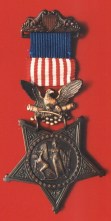
1862 MOH…for distinguished bravery on December, 1890, while serving with Company A, 7th U.S. Cavalry, during the Sioux Campaign.

Adam Neder was a twenty-five-year-old private in Captain Moylan’s A Troop and four years into his first enlistment when he found himself positioned as a sentinel around the Indian camp along the Wounded Knee Creek.  He formed part of Lieutenant Garlington’s party that took up position in the dry ravine southwest of the camp to block the Lakota Sioux from escape once they broke through B and K Troops.  One account states that Neder was wounded while fighting shoulder to shoulder with his platoon leader. Another indicates that despite being wounded himself, Neder assisted in carrying the wounded Lieutenant Garlington from the field.

Inset of Lieut. S. A. Cloman’s map of Wounded Knee depicting the scene of the fight with Big Foot’s Band, December 29, 1890.

(Click to enlarge) Inset of Lieut. S. A. Cloman’s map of Wounded Knee depicting the scene of the fight with Big Foot’s Band, December 29, 1890.

(Click to enlarge) Captain Moylan recommended Private Neder for the Medal of Honor 28 March 1891.

(Click to enlarge) Captain Moylan recommended Private Neder for the Medal of Honor 28 March 1891.[1]

The following March Captain Moylan recommended Neder, who had subsequent to the battle been promoted to the rank of corporal, for the Medal of Honor writing, “Corporal Neder was wounded while fighting gallantly on the skirmish line.”  Despite clearly being recommended  for actions specifically at Wounded Knee, Neder’s citation states that his award was for the Sioux campaign, one of two soldiers in the regiment decorated for conduct throughout the campaign.  He was awarded the medal on 25 April 1891.
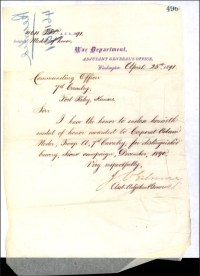
(Click to enlarge) The War Department mailed Corporal Neder's medal to the regimental commander on 25 April 1891.

(Click to enlarge) The War Department mailed Corporal Neder’s medal to the regimental commander on 25 April 1891.[2]

As with all of the Medal of Honor recipients from that winter campaign, Neder also received honorable mention from the Commanding General of the Army, Major General John M. Schofield, in December 1891 in General Order No. 100.

December 29, 1890. Sergeant (then Private) Adam Neder, Troop A, 7th Cavalry: For bravery in action against hostile Sioux Indians, at Wounded Knee Creek, South Dakota, where he was wounded.[3]

Colonel Forsyth in a letter dated March 7, 1893, in which he  recommended Garlington for a Medal of Honor, provided some detail of Neder’s actions at the Ravine.

     He [Lieutenant Garlington] was finally led away, very weak from loss of blood. Sergt. Adam Neder, Troop A, Seventh Cavalry, who, in this same list with Lieut. Hawthorne, is granted a medal of honor, was a member of this party and was kneeling shoulder to shoulder with Capt. Garlington at the time he (Neder) was wounded.[4]

Little is known of Adam Neder’s background or family life other than what is recorded in his military records.  Born in Bavaria, Germany in 1865, by the age of about twenty-one Neder was working in St. Louis, Missouri as a carpenter when he enlisted in the Army for five years in June 1886.  Tall for a soldier of that era, he stood almost five feet, eleven inches, had a ruddy complexion, light hair and blue eyes. He was assigned to A Troop of the 7th Cavalry and joined them at Fort Riley, Kansas.[5]

Neder was still serving at the rank of Private four years later at Wounded Knee.  Perhaps due to his actions at Pine Ridge that winter, Neder was promoted to Corporal in the subsequent months following the campaign.  He held the rank of Sergeant by the following June when he reenlisted for another five years.  During his second enlistment while still serving as a Sergeant in A Troop, Neder played a ceremonial role in the dedication of the Wounded Knee Memorial at Fort Riley.  His participation in that ceremony was detailed in an article that appeared in The Kinsley Graphic in July 1893.
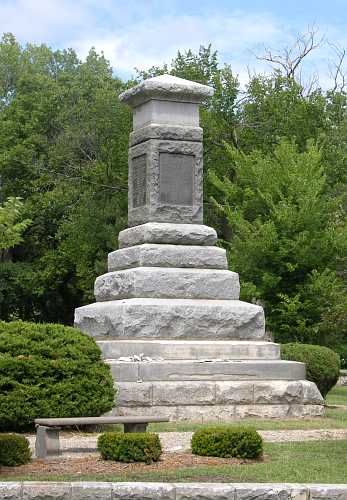
The Wounded Knee Monument at Fort Riley, Kansas, was erected by the surviving members of the Seventh Cavalry and dedicated on 25 July 1893 to an audience of over 5,500 spectators.

FORT RILEY, Kan., July 26.–The Wounded Knee monument of the Seventh Cavalry was dedicated here this morning in the presence of thousands….
     The duty of unveiling the monument was assigned to four veteran soldiers, three of the Seventh cavalry, and one, a member of the hospital corps, formerly of the Seventh cavalry.  Saddler Sergeant Otto Voit, Seventh cavalry, has been in the regiment since 1866, and wears a medal of honor for gallantry in action in the battle of the Little Big Horn in 1876.  Sergeant Adam Neder, Troop A, Seventh cavalry, distinguished himself at Wounded Knee and wears a medal of honor.  Private Daniel McMahon, Troop I, Seventh cavalry, was wounded at Wounded Knee, and Private Frank Lohmitler, hospital corps, U. S. A., served in Capt. Wallace’s troop.
     The monument was covered with two large garrison flags and as these were drawn aside and the monument disclosed a salvo of salutes was fired by the artillery, while eight troops of cavalry, drawn about the monument in a semi-circle, presented sabers.[6]

Being a Non-commissioned officer, an Army veteran with nine years of service, and a decorated war hero, Adam Neder became a naturalized citizen of the United States in April 1895 using his discharge papers from his first enlistment as supporting documentation. Over the next year he moved with his unit to Fort Grant, Arizona where he completed his second five-year enlistment exiting the Army at the rank of sergeant with an excellent characterization of service.[7]

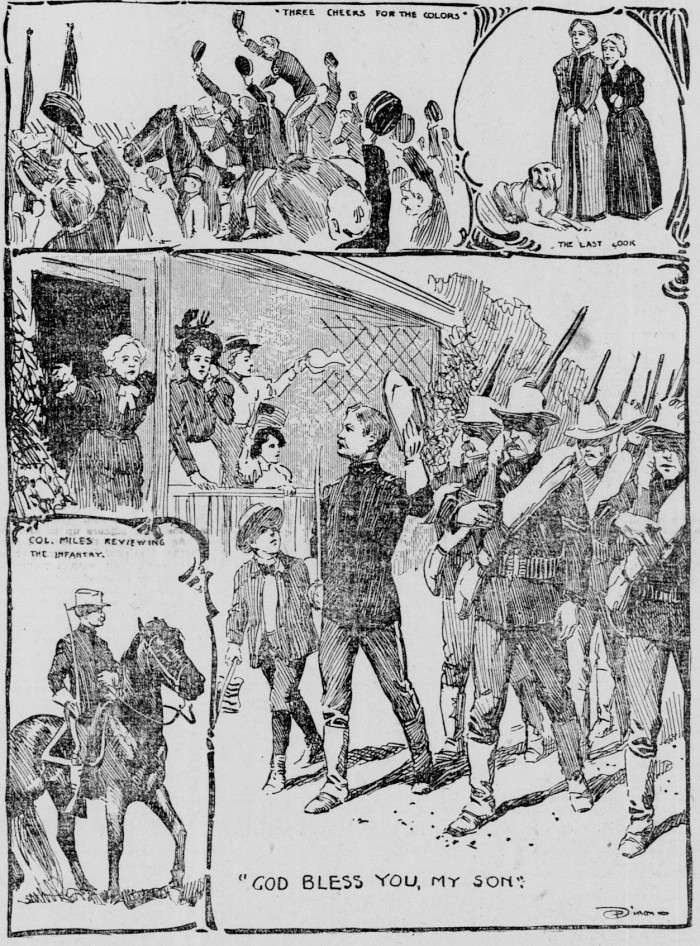
Neder spent two months out of the Army before showing up at Fort Riley to enlist for a three-year-term in September 1896.  His break in service cost him his rank, and he was assigned as a Private initially to the 5th Artillery.  He went to the Army Depot in California and was transferred to the 1st Infantry Regiment the following month where he was assigned to Captain John O’Connell’s Company E at the Presidio of San Francisco.  The following year he served with his company on temporary duty at Alcatraz Island until the outbreak of war with Spain.  Neder was listed in the roster of soldiers assigned to the 1st Infantry when that regiment ceremoniously marched off to war through the streets of San Francisco to awaiting steam ships.  The martial affair was captured in a two-page spread in the San Francisco Call.[8]

1st Infantry Regiment marching through the streets of San Francisco

1st Infantry Regiment marching through the streets of San Francisco

Yesterday will long linger in the memory as the golden day when the First United States Infantry marched forth from quiet, woody places in picturesque Presidio to fight for the principles of government announced by an American President and backed by an American Congress.
From the moment the soldiers strapped on their haversacks and canteens and marched to the parade grounds to the wild, inspiring music of war until they reached the ferries they were greeted with cheers from thousands of patriotic men, women and children.[9]

Private Neder saw action with the 1st Infantry in Cuba where the regiment was credited with storming the San Juan heights and participated in the capture of Santiago.  Neder completed his enlistment in 1899 while serving on occupation duty on the Caribbean island at which time he took a job working for the Quartermaster Department.  He served his nation in that capacity for the next decade.  The details of his career were written up in an article that appeared in the Bismarck Daily Tribune when Adam Neder died on 17 September 1910 while serving in the Philippine Islands.

     At the Davison hospital in Manila, on September 17, occurred the death of Adam Neder, for the past nine years an employee of the quartermaster’s department in the Philippines, and with a record as a soldier in the army rarely equaled, he having been awarded a congressional medal of honor for conspicuous bravery in the Indian campaigns.  He was born in Bavaria in 1865 , but came to the United States when a young man.  He first entered the army as a carpenter in troop A, Seventh cavalry, and was successfully promoted until he reached the grade of sergeant.  He was wounded in the right shoulder in the engagement against the Big Foot band of Sioux at Wounded Knee Creek, S. D., on December 29, 1890, and for his gallantry in that fight was awarded a medal of honor.  He was then a corporal.  Sergeant Neder carried a wounded officer off the battlefield under heavy fire and when he himself was severely wounded.  The officer was First Lieut. Ernest A. Garlington, Seventh cavalry, now inspector general of the army with the rank of brigadier-general.  Lieut. Garlington was shot through the right elbow.  Capt. Geo. D. Wallace, troop K, and twenty-one enlisted men, including one hospital steward, were killed in that fight.  Garlington also wears a medal of honor for this gallantry in that action.  In 1893 Neder entered the Fifth artillery, and in 1896 reenlisted in Company E, First infantry, with which command he was sent to Cuba at the beginning of the Spanish war, participating in the battles at El Caney and San Juan Hill, and in the Santiago fight.  In 1899 he was discharged and entered the service of the quartermaster’s department as wagon-master, and in 1900 was sent to China with the American relief expedition.  His service there won the praise of his superiors, and after the withdraw all of the troops he was transferred to Manila on July 1, 1901, as forage master.  Soon after he was promoted to chief coal stevedore in the army transport service, which position he occupied until his death.[10]

Following twenty-four years of service to his adopted nation, thirteen years in uniform in the cavalry and infantry and eleven years as a civilian in the Quartermaster Department, Adam Neder’s body was eventually returned to the United States where he was buried on 1 November 1911 at the San Francisco National Cemetery.[11]

Native German Adam Neder is buried in the San Francisco National Cemetery.[12]

Endnotes:

[1] Adjutant General’s Office, Medal of Honor file for Marvin C. Hillock, Principal Record Division, file 3466, Record Group: 94, Stack area: 8W3, Row: 7, Compartment 30, Shelf: 2. Research conducted by Vonnie S. Zullo of The Horse Soldier Research Service.
[2] Ibid.
[3] Adjutant General’s Office, “General Order No. 100, Headquarters of the Army, December 17, 1891,” General Orders and Circulars – 1891, (Washington: Government Printing Office, 1892), 5.
[4] United States Congress, 66th Congress, 1st Session, May 19 – November 19, 1919, Senate Documents, Volume 14, (Washington: Government Printing Office, 1919), 455-456.
[5] Ancestry.com,U.S. Army, Register of Enlistments, 1798-1914 [database on-line], Provo, UT, USA: Ancestry.com Operations Inc, 2007, Original data: Register of Enlistments in the U.S. Army, 1798-1914, (National Archives Microfilm Publication M233, 81 rolls), Records of the Adjutant General’s Office, 1780’s-1917, Record Group 94; National Archives, Washington, D.C.
[6] The Kinsley Graphic., (Kinsley, Kan.), July 28, 1893, page 1.
[7] The National Archives at Kansas City, Kansas City, Missouri, Naturalization Index for the Western District of Missouri, compiled 1930 – 1950, documenting the period ca. 1848 – ca. 1950, Record Group Title: Records of the District Courts of the United States, Record Group Number: RG 21; U.S. Army, Register of Enlistments, 1798-1914.
[8] National Archives and Records Administration (NARA), Washington, D.C.; Returns from Regular Army Infantry Regiments, June 1821 – December 1916, Microfilm Serial: M665; Roll: 9.
[9] Associated Press, “Flowers and Cheers Mark the Soldiers’ Farewell,” San Francisco Call, (Vol. 83, No. 142), 21 April 1898, pages 3-4.
[10] Bismarck Daily Tribune, (Bismarck, N. D.), November 11, 1910, page 5.
[11] National Cemetery Administration, U.S. Veterans Gravesites, ca.1775-2006 [database on-line]., Provo, UT, USA: Ancestry.com Operations Inc, 2006, Original data: National Cemetery Administration. Nationwide Gravesite Locator.
[12] George Bacon, photo., “Adam Neder,” FindAGrave, http://www.findagrave.com/cgi-bin/fg.cgi?page=gr&GRid=3537123 accessed 8 Oct 2013.

Citation for this article: Samuel L. Russell, “Private Adam Neder, A Troop, 7th Cavalry – Distinguished Bravery,” Army at Wounded Knee (Sumter, SC: Russell Martial Research, 2013-2015, http://wp.me/p3NoJy-bK), updated 1 Mar 2015, accessed date __________.

Posted in Award Recipients, Enlisted | Tagged , , , , , , , , , , , , , , | 1 Comment

Immigrant Soldiers – Saddler Frey and Privates Johnson, Logan, and Regan, A Troop, 7th Cavalry – Killed by Gunshot Wounds to the Head


I lost only four men in my Troop, and they were of the guard across and in the vicinity of the ravine to the south and west…

Captain Myles Moylan testified to the casualties in his troop on the first day of the Wounded Knee investigation.  Moylan was mistaken in his testimony, as he recorded a week earlier in his company muster roll that five of his troopers were killed in action and one died of wounds. Of those five, four were killed by gunshots to the head, and likely were shot while preventing the Indians from escaping west in the dry ravine.  All of them were foreign born soldiers.[1]

Inset of Lieut. S. A. Cloman’s map of Wounded Knee depicting the scene of the fight with Big Foot’s Band, December 29, 1890.

Inset of Lieut. S. A. Cloman’s map of Wounded Knee depicting the scene of the fight with Big Foot’s Band, December 29, 1890.

Writing to the Adjutant General in 1893 in support of an award recommendation, Colonel James Forsyth described the action in the ravine that resulted in the deaths of at least three of A Troop’s soldiers.

A line of sentinels were thrown around the Indian village, behind which ran a deep ravine. Capt. Garlington [then first lieutenant] was in command of a small portion of this line, and in order to prevent escape into the high grass up this ravine leading into the foothills he ordered his party, in case the Indians made a break, to immediately gather behind the cut banks of a road crossing the ravine and to hold it at all hazards….
There was gathered with him there one officer, four noncommissioned officers, and five privates, but the shelter behind the banks of the road was of such a character that only about four men at a time could avail themselves of it and fire, whilst every time they fired they were partially exposed….
Of the 11 men composing his party, 3 were killed and 3 wounded…[2]

Garlington received due recognition for his actions that day, and history records his name and deeds.  But, who were the other members of his party in the dry ravine that fed into the Wounded Knee Creek?  Likely four of them were immigrant soldiers of A Troop that died of gunshot wounds to the head.

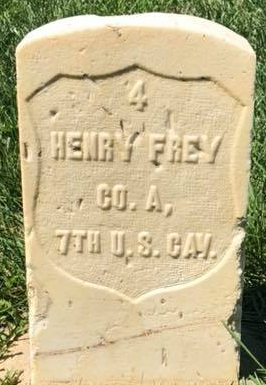
Switzerland native Saddler Henry Frey’s final resting place is at the Fort Riley Post Cemetery.[4]

Two months shy of his twenty-seventh birthday, Henry Frey enlisted in the army at Detroit, Michigan, on 16 June 1890.  Born around August 1863 in Schaffhausen, Switzerland, Frey stood just over five feet four inches tall and had a light complexion with blue eyes and light brown hair.  His civilian occupation of harness maker suited him well to serve as the Saddler of A Troop.  He had been in the Army just over six months and in the regiment less than three.  Frey was twenty-eight and unmarried when he was killed at Wounded Knee. History records little else of the Swiss saddler, who he counted as his friends and family, or when he left his homeland and came to America.  Like most of his fellow troopers killed that day, Frey was initially buried in the Episcopal Cemetery at the Pine Ridge Agency on New Years Eve, 1890, and was later re-interred at the Fort Riley Post Cemetery in October 1906.[3]

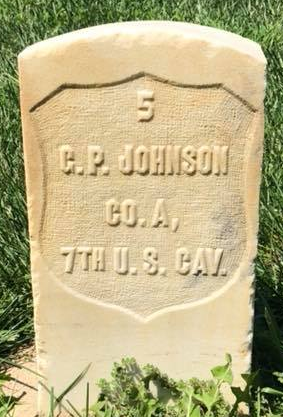
German native Private George P. Johnson is buried in the Fort Riley Post Cemetery.[6]

George P. Johnson was twenty-two when he enlisted at Chicago, Illinois on 6 August 1887.  He was born in the town of Svanninge, Germany, now part of Denmark. He was a teamster just under five and a half feet, had blue eyes and brown hair, and was fair complected. Having served almost three and half years of his five-year enlistment, Johnson was a twenty-five-year-old private in A Troop when he was killed at Wounded Knee.  He too was laid to rest in the Pine Ridge Cemetery and later disinterred and reburied at Fort Riley. Unlike most enlisted soldiers of the day, Johnson was married.  His wife, Matilda, likely still living at Fort Riley filed for a widow’s pension the following April.[5]

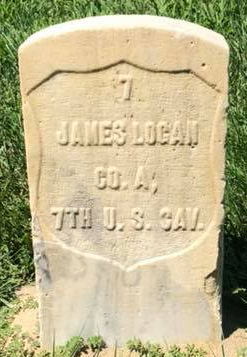
English native Private James Logan is buried at the Fort Riley Post Cemetery.[8]

James Logan was a twenty-four-year-old laborer born in Lancashire, England, when he enlisted at Newark, New Jersey, for five years on 21 August 1888.  He was just over five feet and eight inches tall and had a fair complexion, blue eyes, and light hair.  Logan had been sick in quarters at Pine Ridge with a boil on his right thigh, but was apparently well enough to join his troop on 26 December when they departed for the Wounded Knee Creek Post Office in pursuit of Big Foot’s band.  Initially buried along side of his fellow troopers at Pine Ridge, his remains also are now at Fort Riley.  Like Johnson, Private Logan was one of the few enlisted soldiers that was married.  His wife, Mary, filed for a pension the following March from the state of Massachusetts. James and Mary Logan also had a child whose name is unrecorded.  A guardian, Arba N. Lincoln from Fall River, Massachusetts, filed for a pension on behalf of the child eleven years after Private Logan was killed.[7]

Ireland native Private Michael Regan is buried in the Fort Riley Post Cemetery.[10]

The final trooper that Captain Moylan recorded as “killed by ‘gunshot wound of head’” was twenty-eight-year-old Michael Regan, a carpenter from Sligo, Ireland. He enlisted at Brooklyn, New York, on 18 September 1890.  He stood five feet eight inches tall, had blue eyes, brown hair and a sallow complexion.  Regan had been in the Army just over three months and with the regiment barely three weeks. He was one of nine new recruits that joined A Troop at Pine Ridge on 6 December.  Like the other troopers killed in the ravine at Wounded Knee, Private Regan was buried at Pine Ridge and later re-interred at Fort Riley.  Regan’s mother, Elizabeth, still living in Ireland, filed for a pension on 21 November 1891.[9]

Endnotes:

[1] National Archives, “Sioux Campaign, 1890-91,” 664 – 665 (Moylan’s testimony dated 7 Jan 1891); Adjutant General’s Officer, “7th Cavalry, Troop A, Jan. 1885 – Dec. 1897,” Muster Rolls of Regular Army Organizations, 1784 –  Oct. 31, 1912, Record Group 94, (Washington: National Archives Record Administration).
[2] United States Congress, 66th Congress, 1st Session, May 19 – November 19, 1919, Senate Documents, Volume 14, (Washington: Government Printing Office, 1919), 455-456.
[3] Ancestry.com, U.S. Army, Register of Enlistments, 1798-1914 [database on-line], Provo, UT, USA: Ancestry.com Operations Inc, 2007; Adjutant General’s Office, Final Statements, 1862-1899 at Fold3, http://www.fold3.com/image/1/271303441/ accessed 26 Aug 2013; National Archives and Records Administration, Burial Registers of Military Posts and National Cemeteries, compiled ca. 1862-ca. 1960, Archive Number: 44778151, Series: A1 627, Record Group Title: Records of the Office of the Quartermaster General, 1774-1985, Record Group Number: 92.
[4] Samuel L. Russell, photo., taken 25 Aug 2018.
[5] Ancestry.com, U.S. Army, Register of Enlistments, 1798-1914 [database on-line], Provo, UT, USA: Ancestry.com Operations Inc, 2007; Adjutant General’s Office, Final Statements, 1862-1899 at Fold3, http://www.fold3.com/image/1/271303460/ accessed 26 Aug 2013; National Archives and Records Administration, Burial Registers of Military Posts and National Cemeteries, compiled ca. 1862-ca. 1960, Archive Number: 44778151, Series: A1 627, Record Group Title: Records of the Office of the Quartermaster General, 1774-1985, Record Group Number: 92; National Archives and Records Administration, U.S., Civil War Pension Index: General Index to Pension Files, 1861-1934 [database on-line], Provo, UT, USA: Ancestry.com Operations Inc, 2000.
[6] Samuel L. Russell, photo., taken 25 Aug 2018.
[7] Ancestry.com, U.S. Army, Register of Enlistments, 1798-1914 [database on-line], Provo, UT, USA: Ancestry.com Operations Inc, 2007; Adjutant General’s Office, Final Statements, 1862-1899 at Fold3, http://www.fold3.com/image/271303477/ accessed 26 Aug 2013; National Archives and Records Administration, Burial Registers of Military Posts and National Cemeteries, compiled ca. 1862-ca. 1960, Archive Number: 44778151, Series: A1 627, Record Group Title: Records of the Office of the Quartermaster General, 1774-1985, Record Group Number: 92; Adjutant General’s Officer, “7th Cavalry, Troop A, Jan. 1885 – Dec. 1897,” Muster Rolls of Regular Army Organizations, 1784 –  Oct. 31, 1912, Record Group 94, (Washington: National Archives Record Administration); National Archives and Records Administration, U.S., Civil War Pension Index: General Index to Pension Files, 1861-1934 [database on-line], Provo, UT, USA: Ancestry.com Operations Inc, 2000.
[8] Samuel L. Russell, photo., taken 25 Aug 2018.
[9] Ancestry.com, U.S. Army, Register of Enlistments, 1798-1914 [database on-line], Provo, UT, USA: Ancestry.com Operations Inc, 2007; Adjutant General’s Office, Final Statements, 1862-1899 at Fold3, http://www.fold3.com/image/271303525/ accessed 26 Aug 2013; National Archives and Records Administration, Burial Registers of Military Posts and National Cemeteries, compiled ca. 1862-ca. 1960, Archive Number: 44778151, Series: A1 627, Record Group Title: Records of the Office of the Quartermaster General, 1774-1985, Record Group Number: 92; Adjutant General’s Officer, “7th Cavalry, Troop A, Jan. 1885 – Dec. 1897,” Muster Rolls of Regular Army Organizations, 1784 –  Oct. 31, 1912, Record Group 94, (Washington: National Archives Record Administration); National Archives and Records Administration, U.S., Civil War Pension Index: General Index to Pension Files, 1861-1934 [database on-line], Provo, UT, USA: Ancestry.com Operations Inc, 2000.
[10] Samuel L. Russell, photo., taken 25 Aug 2018.

Citation for this article: Samuel L. Russell, “Immigrant Soldiers – Saddler Frey and Privates Johnson, Logan, and Regan, A Troop, 7th Cavalry – Killed by Gunshot Wounds to the Head,” Army at Wounded Knee (Sumter, SC: Russell Martial Research, 2013-2015, http://wp.me/p3NoJy-as), Published 23 Sep 2013, accessed date ________.

Posted in Casualties, Enlisted | Tagged , , , , , , , , , , , , , , | 4 Comments