At The Dance


Big Foot, ordered all the Indians belonging to the ghost dance to procure all the guns and cartridges possible to obtain and to stay together in one camp. There is no longer any doubt that the Indians are all well supplied with the best make of guns and cartridges, and in addition to rifles a large majority of them have revolvers.
–Indian Agent P. P. Palmer
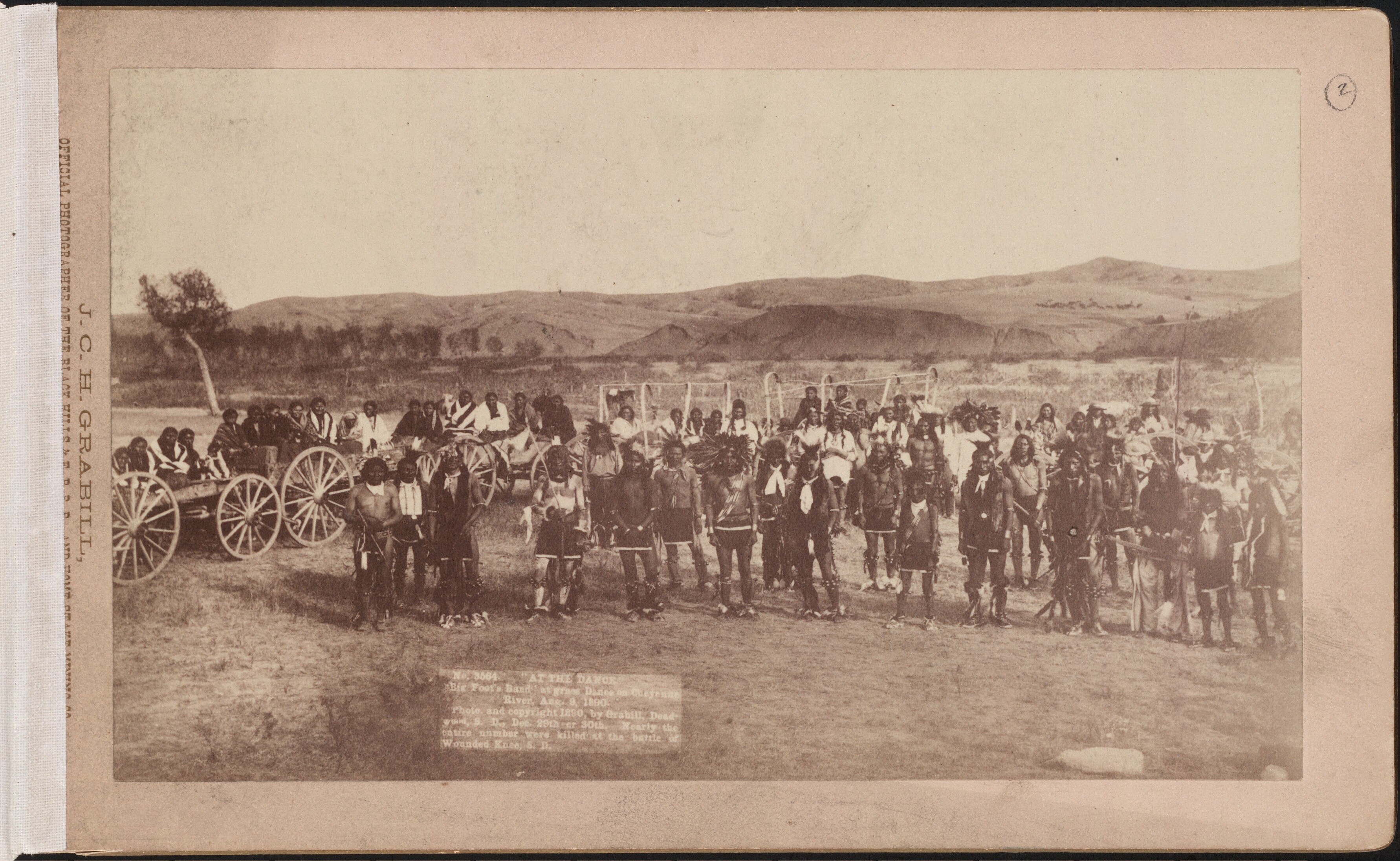
At The Dance - J. C. H. Grabill Photographer John C. H. Grabill, who captured the image of the majority of officers that fought at Wounded Knee, also captured the image of Chief Spotted Elk, commonly known as Big Foot, and his band of Miniconjou Lakota a few months prior to the majority of that clan falling to the guns of the 7th Cavalry and 1st Artillery.  Grabill labeled the photograph, “At the Dance: Bigfoot’s Band at grass Dance on Cheyenne River, Aug. 9, 1890. Photo and copyright 1890, by Grabill, Deadwood, S. D., Dec. 29th or 30th. Nearly the entire number were killed at the battle of Wounded Knee, S. D.”[1]

In early December 1890, the Secretary of the Interior, John W. Noble, responded to a Senate resolution inquiring about the alleged armament of Indians.  Noble included in his response several letters from the Indian agent at the Cheyenne River Agency in the Northern part of South Dakota.  Two of these letters are included in their entirety with this photograph, as they address Chief Big Foot’s role in arming his band of Miniconjous.

United States Indian Service,
Cheyenne River Agency, S. Dak., October 11, 1890.
Sir: I have the honor to report that a number of Indians living along the Cheyenne River and known as Bigfoot’s Band are becoming very much excited about the coming of a messiah. My police have been unable to prevent them from holding what they call ghost dances. These Indians are becoming very hostile to the police. Some of the police have resigned. Information has been received here that the same excitement exists at other agencies.
Nearly all of these Indians are in possession of Winchester rifles, and the police say they are afraid of them, being armed only with revolvers.
The Christian Indians are all quiet and well behaved. Requesting instructions in regard to this matter,
I remain, very respectfully, your obedient servant,
Perian P. Palmer,
United States Indian Agent.[2]

United States Indian Service,
Cheyenne River Agency, S. Dak., December 1, 1890.
Sir: In compliance with instructions contained in office letter L, November 22, 1890, I have the honor to report the situation now existing at the ghost dancing Indian camp at the mouth of Cherry Creek, having just returned from a visit of all the camps where the Indians are affected by the dance.
The Indians are dancing continually; had been dancing six days previous to arrival of agent. This camp is about 60 miles from the agency headquarters, and notwithstanding the journey of the entire distance was made in one day, and every precaution taken to prevent anyone knowing where the agent was going, the Indians were informed of his coming more than an hour before his arrival at the camp, and the dancing had stopped and many of the Indians had gone home on the 25th instant. There were 348 Indians dancing at one time. This number includes men, women, and children. About 200 more were present, but not dancing.
All the camps on Cherry Creek were visited by agent on the 27th instant and the Indians were all dressed in citizen’s clothing and had no paint on their faces. There are two Indians at the camp called Yellow Owl’s Camp, who have not been dancing, but have been helping the farmer. These Indians said that very few of the Indians have worn citizen’s clothing for more than a month, they also said that at a council, held on the 25th instant, Big Foot, ordered all the Indians belonging to the ghost dance to procure all the guns and cartridges possible to obtain and to stay together in one camp. There is no longer any doubt that the Indians are all well supplied with the best make of guns and cartridges, and in addition to rifles a large majority of them have revolvers. There is positive proof that some of the traders have been supplying the Indians with guns. The friendly Indians say that the dancers want to fight and will fight soon, but will not let them know anything. At all these camps the Indians all appeared friendly to the agent, were very anxious to talk, asked many questions, but appeared uneasy and suspicious about something. The white settlers in the village at the mouth of Plumb Creek number seven men, four women, and three children. There is also a mixed-blood missionary and family. These people are very much excited and said they would leave the village soon, but hope to dispose of their goods. It is believed they have guns to deliver to Indians and are only awaiting their arrival. One of the policemen is watching their movements, but it is very difficult to tell what Indian can be trusted.
The friendly Indians apprehend trouble and are suspicious of the interpreters. They say Indians all lie and interpreters all lie; when they talk on important matters, they want several interpreters present. It is impossible to tell at this time what the dancing Indians intend to do, but they are, no doubt, preparing for an outbreak in some direction; they are closely watched, and the agency is in daily communication with the dancing camp. Bigfoot, Hump, Low Dog, and other leaders of the ghost dance were reported to have refused to see the agent or talk with him. This is believed to be true, as none of these leaders could be found at the camps. The latest report from the farmer Narcesse Marcelle is to the effect that the Indians are still dancing, are suspicious of him and will not talk with him. Says none of the Indians have gone away and there are few visitors among them.
Very respectfully, your obedient servant,
Perian P. Palmer,
United States Indian Agent.[3]

Endnotes:

[1] Grabill, J. C. H. (John C. H.), and L. T Butterfield. “At the Dance”: Bigfoot’s Band At Grass Dance On Cheyenne River, Aug. 9, 1890. Nearly the Entire Number Were Killed At the Battle of Wounded Knee, S.D., Yale University Library, Beinecke Rare Book Room and Manuscript Library, http://brbl-dl.library.yale.edu/vufind/Record/3519307 accessed 29 Nov 2013.
[2] United States Congress, “Letter from The Secretary of the Interior, 11 December 1890, page 4, from The Executive Documents of the Senate of the United States for the Second Session of the Fifty-first Congress. (Washington: Government Printing Office, 1891).
[3] Ibid., 46-47.
Posted in Casualties, Official Reports | Tagged , , , , , , , , | 1 Comment

Major Garlington’s History of the Seventh Regiment of Cavalry


Major Ernest A. Garlington wrote a history of the Seventh Cavalry Regiment that was published in 1896 along with historical sketches of other regiments across the Army.  Following is an extract from Garlington’s regimental history describing of the events surrounding the Battle of Wounded Knee.

On the 26th December, Forsyth, under orders from Brooke, sent Whitside‘s squadron, and two Hotchkiss guns under Lieutenant H. L. Hawthorne, 2d Artillery, to the Wounded Knee Post Office, the purpose being to capture Big Foot’s band if he should come that way. Brooke informed Whitside on the 27th that Big Foot must be in his front, and directed him to “find him, to move on him at once and with rapidity, to capture him, and if he fought to destroy him.”

Whitside did capture him on the 28th, without a fight, about six miles from Wounded Knee Post Office. The Indians were conducted to the camp which had been left standing on the Wounded Knee. They were assembled, counted, and rations issued to three hundred and fifty persons; one hundred and twenty bucks, the rest women and children.
Whitside reported his successful capture and requested reinforcements, that the disarmament, which was to be consummated on the morrow, be accomplished without bloodshed.

In response to his request Forsyth arrived during the night of the 28th with Regimental Headquarters and the second squadron; two Hotchkiss guns under Captain A. Capron, 1st Artillery; and Lieutenant Taylor, 9th Cavalry, with his troop of scouts, to which was attached Lieutenant Preston, 9th Cavalry. Forsyth’s instructions were to “disarm the Indians where they were camped, to, under no circumstances allow any of them to escape, and to destroy them if they resisted;” and as soon as the disarmament was completed to leave Whitside in charge and return at once to the agency.

Early the next morning Monday, the 29th of December, Forsyth made his dispositions to disarm the Indians, peaceably if possible, by force if necessary.

The bucks were invited into council between their own village and the camp; nearly all of them, one hundred and six, came wrapped in blankets. Big Foot remained in his tent.

General Forsyth, kindly and pleasantly, yet firmly, demanded the surrender of their arms. While the negotiations were progressing, a young buck fired into the soldiers. The others threw aside their blankets which concealed their weapons, and poured a murderous fire into the troops, which had been posted between them and their village, following it up as rapidly as their repeating rifles could belch forth the lead. The fight raged on the flat about one hour before it was cleared entirely of Indians. Here Captain George D. Wallace, commanding Troop K, and twenty-one enlisted men, including one hospital steward, were killed; Lieutenant Ernest A. Garlington was shot through the right elbow; Lieutenant John C. Gresham received an abrasion on the nose from a passing bullet; Captain Charles A. Varnum had his pipe knocked from his mouth by a bullet; Captain John Van R. Hoff, Assistant Surgeon, received several bullets through his clothing, and twenty-one enlisted men were wounded. Father Craft, Catholic priest, who was present using his good offices to persuade the Indians to submit to the demands made of them by General Forsyth, received a vicious stab in the back which penetrated his lung. Scout Wells had his nose nearly cut off. Lieutenant John Kinzie, 2d Infantry, who was present as a spectator, was shot through the foot.

Some of the Indians, many of them wounded, escaped to a ridge of hills lying just west of camp, and secreted themselves in stump holes and inaccessible ravines. It was while attempting to dislodge a party which was doing considerable execution that Lieutenant. H. L. Hawthorne, 2d Artillery, received a very severe wound. The fighting in the hills was done by Troops C, D, E and G, which were mounted at the beginning of the engagement. They lost four men killed and four wounded; Lieutenant Donaldson was struck by a bullet with sufficient force to penetrate his leather belt and his clothing. There were many acts of individual bravery and gallantry, but every man showed himself a soldier—with the nerve born of disciplined courage.

Although a very small percentage of the enlisted men had ever been under fire before—sixty recruits having joined at Pine Ridge—and the attack was sudden, there was no undue excitement. Each man obeyed orders, stood his ground, and shot to hit, and proved himself worthy of the number he wore upon his cap. One hundred and forty-six Indians were subsequently buried on the field; and there was undoubted evidence that many bodies had been removed; thirty-three Indians, nearly all wounded, were captured. The “hostiles” reported seven Indians as having escaped to their camp—all wounded except one.
The fight was over about three o’clock in the afternoon.

In view of the possible effect, of this fight upon the other Indians, and for the better care and protection of his wounded, Forsyth moved his command to the agency, arriving there about eleven o’clock at night.

At six o’clock on the morning of the 30th he was called to go to the assistance of Major Henry’s wagon train which had been attacked near the agency. One hour after his return to camp he was ordered to go the Drexel Mission, four miles from the agency which was reported attacked by the hostiles. It proved to be a false alarm.

When about to return, Little Bat, a scout, reported that he had heard the “firing of big guns” down the White Clay. Knowing that troops were located in that direction on the other side of the supposed position of the hostile camp, Forsyth determined to make a reconnaissance in force down the stream, to either confirm or demonstrate the error of the report. To guard against emergencies he sent couriers to General Brooke and Colonel Henry, asking that the latter join him at once.

The scouts, under Lieutenant Preston, 9th Cavalry, developed a small force which was pushed back by the advance guard. The number of Indians rapidly increased until the hills were full of them—at least three or four hundred opposed the advance of the troops. Forsyth’s instructions did not contemplate a general engagement which he knew would be precipitated if he pushed matters, and as soon as he became convinced that there was no heavy firing down the White Clay he decided to withdraw.

He was in the act of withdrawing his troops when Henry’s squadron of the 9th Cavalry arrived, having promptly responded to Forsyth’s request. These troops were placed in position, under Forsyth’s direction, and assisted in the completion of the movement.

The loss in this engagement was one enlisted man killed; Lieutenant James D. Mann, and six enlisted men wounded. Lieutenant Mann died of his wound, at Fort Riley, Kansas, on the 15th January, 1891. The loss among the Indians is unknown.

On the 30th December, 1890, the Major General commanding the army telegraphed to the Major General commanding the forces at Pine Ridge, asking him to thank the “Brave Seventh Cavalry for their splendid conduct.”

In the latter part of January the Indian problem at Pine Ridge was settled to the satisfaction of the Major General commanding. The prompt and drastic punishment awarded treachery at Wounded Knee contributed in no small measure towards bringing the hostile Indians to a realizing sense of their obligation to comply with the demands of the Government. The troops were relieved and sent to their stations.

The train carrying the second squadron of the Seventh Cavalry, and Capron’s battery of the 1st Artillery, collided with a passenger train, running at full speed, when within a short distance of Fort Riley. The wreck was complete; the escapes from death and injury miraculous. A sergeant of artillery and a private of cavalry were killed, and Captain E. S. Godfrey, 7th Cavalry, sustained a painful and permanent injury.

Source: Major E. A. Garlington, “Seventh Regiment of Cavalry,” The Army of the United States: Historical Sketches of Staff and Line with Portraits of Generals-in-Chief, Theodore F. Rodenbough and William L. Haskin, eds., (New York: Maynard, Merrill & Co., 1896), 265-267.
Posted in Professional Journal | Tagged , , , , , , , , , , , , , , , , , , , , | Leave a comment

Private William S. Mezo, B Troop, 7th Cavalry – Killed in Action


Private William S. Mezo was one of the new recruits that joined Captain Charles A. Varnum’s B Troop at Pine Ridge on 6 December three weeks prior to the battle at Wounded Knee Creek.  He was twenty-five years of age and had joined the army at Saint Louis just three months earlier.  According to one newspaper listing of the casualties at Wounded Knee, Mezo was killed by a gunshot wound to the head, likely suffered during the opening minutes of the initial volley.[1]

Inset of Lieut. S. A. Cloman’s map of Wounded Knee depicting the scene of the fight with Big Foot’s Band, December 29, 1890.

Inset of Lieut. S. A. Cloman’s map of Wounded Knee depicting the scene of the fight with Big Foot’s Band, December 29, 1890.

Born in 1865 in Franklin County, Illinois, William Mezo was the oldest of four children of Cornelius and Malinda (nee Odle) Mezo.  Cornelius Mezo, born May 1842 at Hamilton, Illinois, was the son of Constant and Polly Ann (nee Reno) Mezo.  He was a farmer and served in the Civil War as a private in Company A, 40th Illinois Infantry and Battery D, Missouri Light Artillery.  Cornelius was married three times.  He married his first wife, Malinda Odle, on 29 December 1864 in Franklin County.  She was born in 1841 in Franklin County, the daughter of Harvey W. and Milley (nee Smith) Odle.  Cornelius and Melinda had four children: William, the subject of this post; Millie was born 22 May 1867, married Newton J. Clampet 6 October 1886, and died 8 October 1935; Lucy Catherine was born 27 December 1868 at Jefferson County, Illinois, married first Nehemiah Harland about 1888, married second Peter Rufus Harrison on 21 October 1898, married third Harrisburg Pennsylvania Galloway on 27 March 1920, and died 9 April 1939; and Henry L. was born 7 December 1870 at Jefferson County, married in 1897 Martha Isabella Coffel, and died 15 September 1967 at Warrenton, Missouri.  Malinda Odle Mezo died on 8 September 1872.[2] Cornelius next married Mary Jane Hamilton on 17 July 1873 in Jefferson County.  Cornelius had five children by his second wife: Constant was born 1877, married Mary E. Skelton, and died 1917; Frank was born 1878, married first Hulda E. Hanna, and married second Ina; Arthur James was born 1881, married first Sarah, married second Ora Johnson, and died 1953; Scott was born 1883, married Maggie, and died 1937; and Maude was born 1885.  Cornelius Mezo’s third wife was Nancy W. Short whom he married in 1889.  With her he had two more children: Elza was born 1889, married Bertha Fred in 1910, and died 1959; and Myrtle was born 1893, married Thomas N. Hall and died 1973.  Cornelius Mezo died at the age of seventy-eight in 1920 at Bald Hill, Illinois.[3]

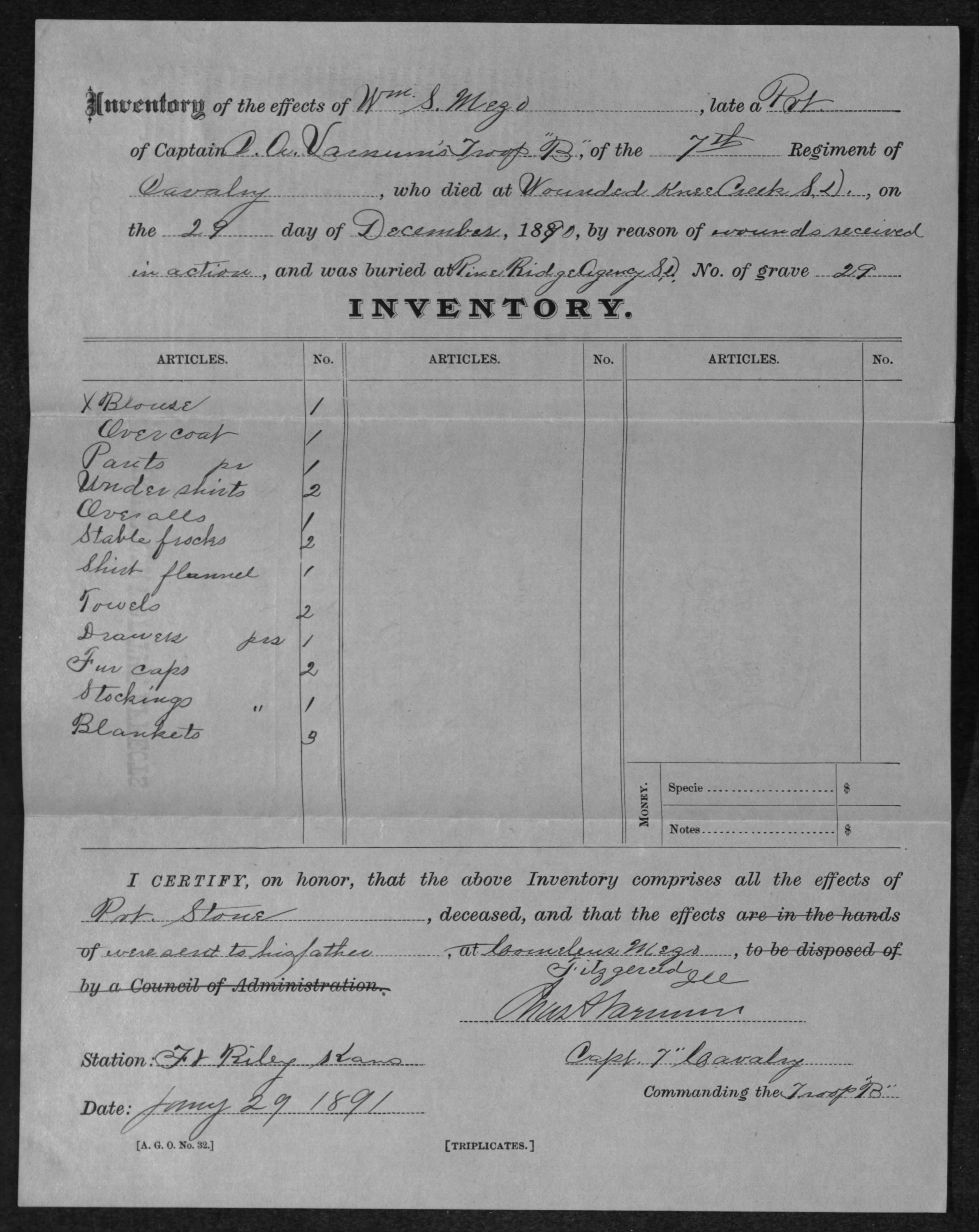
Captain Varnum completed an inventory of Private William S. Mezo's personal effects at the end of January 1891 and forwarded them to Mezo's father at Fitzgerald, Illinois

Captain Varnum completed an inventory of Private William S. Mezo’s personal effects at the end of January 1891 and forwarded them to Mezo’s father at Fitzgerald, Illinois.[5]

William Mezo made his way to Saint Louis, Missouri, a year after his father married his third wife, and enlisted in the Army for five years in September 1890.  He was recorded as being a twenty-five-year-old farmer standing just under five feet seven inches, with dark brown eyes, brown hair and a fair complexion.  Three months later Mezo along with other recruits from Jefferson Barracks were sent to the Pine Ridge Agency, South Dakota, to bring the under-strength cavalry units closer to their authorized level of personnel.[4]

Private Mezo was buried along with thirty of this fellow cavalrymen on New Years Eve, 1890 at the Episcopal Cemetery at the Pine Ridge Agency.  As with the majority of those soldiers, Mezo’s remains were disinterred in October 1906 and reburied in the Fort Riley Post Cemetery.  William Mezo was survived by his father, Cornelius Mezo, six brothers, three sisters, and three nieces.[6]

Private William S. Mezo is buried at the Fort Riley Post Cemetery in Kansas.[7]

Endnotes

[1] Ancestry.com, U.S. Army, Register of Enlistments, 1798-1914 [database on-line], Provo, UT, USA, Ancestry.com Operations Inc, 2007, Original data: Register of Enlistments in the U.S. Army, 1798-1914, (National Archives Microfilm Publication M233, 81 rolls), Records of the Adjutant General’s Office, 1780’s-1917, Record Group 94, National Archives, Washington, D.C.; Omaha daily bee., January 01, 1891, Part One, Image 1,http://chroniclingamerica.loc.gov/lccn/sn99021999/1891-01-01/ed-1/seq-1/ accessed 4 Nov 2013.
[2] Ancestry.com, United States Federal Census [database on-line], Provo, UT, USA: Ancestry.com Operations, Inc., 2009; Year: 1850, Census Place: District 10, Hamilton, Illinois, Roll: M432_108, Page: 211B, Image: 429; Year: 1850, Census Place:  Franklin, Illinois, Roll: M432_106, Page: 17B, Image: 235; Year: 1860, Census Place: Township 6 Range 5 E, Hamilton, Illinois, Roll: M653_183, Page: 36, Image: 36, Family History Library Film: 803183; Year: 1870, Census Place: Township 4 Range 1, Jefferson, Illinois, Roll: M593_233, Page: 430B, Image: 78, Family History Library Film: 54573; National Park Service, U.S. Civil War Soldiers, 1861-1865 [database on-line], Provo, UT, USA: Ancestry.com Operations Inc, 2007; Historical Data Systems, comp., U.S., Civil War Soldier Records and Profiles, 1861-1865 [database on-line], Provo, UT, USA: Ancestry.com Operations Inc, 2009.
[3] Ancestry.com and The Church of Jesus Christ of Latter-day Saints, United States Federal Census [database on-line], Provo, UT, USA: Ancestry.com Operations Inc, 2010; Year: 1880, Census Place: Bald Hill, Jefferson, Illinois, Roll: 215, Family History Film: 1254215, Page: 418D, Enumeration District: 045, Image: 0600; Year: 1900, Census Place: Bald Hill, Jefferson, Illinois, Roll: 308, Page: 9B, Enumeration District: 0065, FHL microfilm: 1240308; Year: 1910, Census Place: Ball Hill, Jefferson, Illinois, Roll: T624_294, Page: 1A, Enumeration District: 0092, FHL microfilm: 1374307; Year: 1920, Census Place: Bald Hill, Jefferson, Illinois, Roll: T625_376, Page: 4A, Enumeration District: 115, Image: 259; National Archives and Records Administration, U.S., Civil War Pension Index: General Index to Pension Files, 1861-1934 [database on-line], Provo, UT, USA: Ancestry.com Operations Inc, 2000.
[4] Ancestry.com, U.S. Army, Register of Enlistments, 1798-1914 [database on-line], Provo, UT, USA.
[5] Ancestry.com, U.S. Military Burial Registers, 1768-1921 [database on-line], Provo, UT, USA: Ancestry.com Operations Inc, 2007, Original data: Burial Registers for Military Posts, Camps, and Stations, 1768-1921, Microfilm Publication M2014, 1 roll, ARC ID: 4478153, Records of the Office of the Quartermaster General, Record Group 92, National Archives in Washington, D.C.
[6] Adjutant General’s Office, Final Statements, 1862-1899, “Haselwood, Alvin H.,” at Fold3, http://www.fold3.com/image/271303501/ accessed 5 Nov 2013.
[7] Samuel L. Russell, photo., taken 25 Aug 2018.
Posted in Casualties, Enlisted | Tagged , , , , , , , , , , , , , , | Leave a comment