It was the bravest thing I ever saw done. There wasn’t a chance for the Indians from the start. We had about six hundred men where they had only one hundred and fifty, and besides they were hindered with their squaws and papooses.
George R. Brown wrote the following account of the battle at Wounded Knee Creek, which was published in the El Paso Daily Herald on July 23, 1900, a decade after the battle, as the seventh in a series titled “Stories Of the Old Southwest. Told By the Men Who Made Paths Through the Impassible, Who Risked Their Lives That We Might Live, and Who Have Done and Dared Much–the Pioneers of the West.”
A review of the 7th Cavalry Regiment’s Muster Rolls for December 1890 reveals only one George Brown, a Private in Captain E S. Godfrey’s D Troop. Based on the author’s positioning next to Big Foot’s tent in his account, he would likely have been in B Troop, K Troop, or the Field and Staff. The only other name on the rolls that is similar is James R. Brown, a private in K Troop. There were two other Browns listed on the muster rolls: Sergeant James H. Brown of B Troop and Corporal Charles Brown of K Troop. Unfortunately, the author of this account does not provide enough specificity, such as names of comrades, to pinpoint to which unit he was assigned, or verify if he was even at the battle. There are several historical errors in the account, for example Whitside is referred to as a captain rather than a major and the author states that there were Gatling guns present on the field, which there were not.
Following is George R. Brown’s account in its entirety as originally published including the title and subtitles.
The Battle Of Wounded Knee
A Plain Narrative Of a Memoriable Fight, By a Trooper Of the Famous Seventh.–Hand To Hand. It was a Fight To Annilation.–The Wonderful Bravery Of the Sioux.
Written Especially for the Herald.
In his tepee on the creek,
Lay old Big Foot, dying, weak.
Big Foot, Indian chief, and brave,
Racked with pain, and near the grave–
Near the Happy Hunting Grounds.
Troops and Indians hand to hand,
Struggled on the prairie sand;
Shots and curses, moans and yells,
Noises of a thousand hells.
Through the tepee came the sounds.
Sprang old Big Foot from his bed.
Then fell over backward, dead;
Pierced through by twenty holes,
(Curses on as many souls)
Murdered, in a leaden hail.
Crouching at the chieftain’s feet,
Was his squaw Wa-la-go-lite,
O’er his body took her stand,
Loaded Winchester in hand;
Then with bullet through her breast,
Went to her eternal rest.
Rose the plaintive death chant wail.
–Tales of a Sioux Chief.
I look like I had money now, and to tell the truth I have. I ain’t blowing about it, and ain’t ashamed to admit that for ten years I was worse than dead broke. I didn’t have a cent nor a friend on earth. The years were between ’85 and ’95. I’ve made my little pile now and I can’t count my friends. I’ve found that to be the way of the world.
When I got desperate I did what lots of other boys have done, I enlisted in the army, and I served my time, and I’ve got an honorable discharge, and am proud of it. But I hated the service worse than anything when I found that I had to go in it or starve. What makes me proud of it? Well, I’ll tell you. I was in the 7th cavalry in 1890. Do you know now? Well, I’ll tell you the story.
I was in the battle of Wounded Knee Creek, in the winter of ’90, and I think that’s enough for any man to be proud of. It hasn’t been a long while ago now, and people don’t know much about it, but it was one of the hardest battles that was ever fought in any Indian war In this country. It was after the death of Sitting Bull, and the Indians were crazy with fear and almost demoralized.
When Sitting Bull was arrested, and shot when trying to escape, there were a good many redskins on the warpath, but his death frightened most of them, and there were only about twelve hundred of them who took to the Bad Lands and defied the troops. The rest of them went back to their reservation. The prospect was that there would be another long and bloody war with the Sioux, and the army was considerably worried.
Red Cloud was an old man, and he wanted peace. An officer had been murdered by some Indians of his band, and he was afraid there was going to be another war. He came back to the reservation in the dead of winter, when the snow was on the ground, to escape from his own tribe. They were inclined to go on the warpath with those of Sitting Bull’s warriors who had taken to the Bad Lands when the old chief died. Red Cloud was almost blind, and he had to be led the whole distance by his daughter.
Sitting Bull’s braves had started to join the other Indians on the warpath, but for some reason they came back, and one morning along in the middle of December Little Bat, an Indian scout, came in with the news that the Sioux band under Big Foot were only eight miles away on Porcupine creek, and that Big Foot wanted to speak with Captain Whiteside, who was in command of the Seventh cavalry. If he had gone to the Bad Lands the war would have lasted maybe for years.
We started for Porcupine creek, and the Sioux were drawn up in a line. There were more than a hundred and fifty, and they were heavily armed. It was on a Sunday morning, I think, and though it had been pretty cold up to that time, it was clear and warm. When we got near to the Indians Big Foot came out alone from his side, and Captain Whiteside went out to meet him. Big Foot offered to surrender. He had gotten tired, he said, of being hunted around, and he couldn’t fight with two hundred and fifty squaws and papooses.
As soon as Big Foot surrendered we closed in on the Indians and marched them to our old camping grounds on the Wounded Knee creek. We formed a cordon around them and sent for reinforcements. We could see that the Indians were suspicious and uneasy, but we didn’t think there was going to be any trouble with them, as they were worn out and hungry. They were a pitiable sight. Their blankets were dirty and full of holes, their leggings were worn out, and they had absolutely nothing to eat. I never did understand how they had held out so long as they did.
The next morning Colonel Forsyth came over and took command of the troops. Then the order came to disband Big Foot’s warriors. We had a Gatling and a Hotchkiss gun mounted to command the valley where we were camped, and the boys were dismounted. Big Foot was lying in his tent. The Indians said he had bad medicine and that he had the white man’s disease. I guess he meant consumption, though I know it was something the matter with his lungs.
The Indians were told to come out of their tents and we were formed into a hollow square with the Indians in the center. Colonel Forsyth ordered them to go back into their tents and get their guns. Twenty of them started, and when they came back there were two guns among them.
Captain Whiteside was a quick and impetuous man, and he didn’t like the way the Indians were doing. He ordered a squad to search the tepees and bring out every weapon, and all the ammunition that was found in them. The rest of the troop closed up closer on the Indians.
The search had hardly begun when the Indians raised their death chant. They all of them took it up and it was the most peculiar sound I had ever heard. It was almost ghastly and sounded uncanny and just like some body was really dead. You could almost draw a picture of it: The Indians kept this up while they squatted on the grass, and then all of a sudden, before any body knew what was happening it changed to the war song.
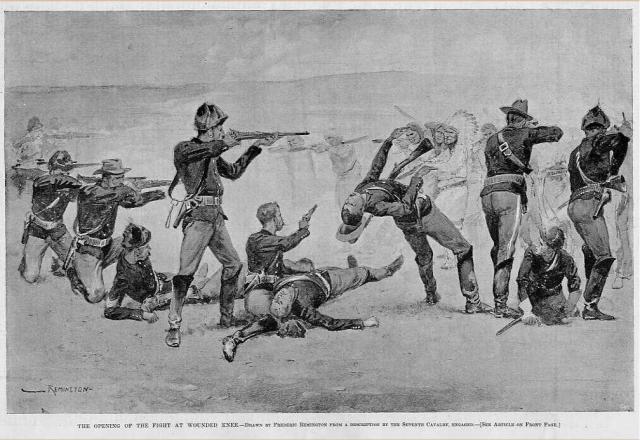
The Indians were on their feet before we knew anything was wrong, and the next minute they pulled their guns from under their blankets and opened fire at close quarters. Those that didn’t have guns rushed us with scalping knives and tomahawks and before we could realize it the fight was on.
It is going to be history some day. A thing like that seems grand and awful to me. I look back on it now and I don’t blame the Indians. They thought they were going to be deprived of their arms and then murdered, and white men would have thought the same thing under the same circumstances, and would have tried to survive as dearly as the Indians did.
After the first volley had been fired the troops recovered from their surprise, and after that there was the greatest possible order and discipline. We clubbed our guns and fought with six shooters. The Indians were completely hemmed in on all sides. It was the bravest thing I ever saw done in my life and it deserves to be remembered as long as bravery is honored.
The fact that they were Indians doesn’t make any difference to me. It was the bravest thing I ever saw done. There wasn’t a chance for the Indians from the start. We had about six hundred men where they had only one hundred and fifty, and besides they were hindered with their squaws and papooses. They intended to die fighting rather than be butchered, and any brave people in the same position would have done what they did. We didn’t understand each other. That’s all.
Those Sioux fought like fiends, and that little handful of them almost cut their way through and escaped. Some of them did.
We were in such close quarters that it was a hand to hand fight from the start. Indians and soldiers lay on the ground locked in each other’s arms, Indian knife against revolver butt, and that’s the way they were found after the fight.
There wasn’t any mercy shown on either side. As soon as the Indians made the first rush the troops met it with a cheer, and above the noise of the fight you could hear some cavalry man yelling as loud as he could: “Remember Custer.” It was taken up and we cheered while we fought. The men lost all control of themselves. I can only speak for myself, but I know that the only thing I wanted was to kill as many redskins as I could. It was the excitement of the battle.
I’ve heard it said that the cavalry didn’t make any distinction between the braves and their squaws. It isn’t so. It’s a lie. I don’t believe a single man knowingly shot a woman. There were lots of them found dead after the fight, but it was because they had gotten right into the thick of it. Those squaws fought like fiends. They can use a rifle and so can the Indian boys ten and twelve years old. Several times during the fight I heard some body shout out, “Don’t shoot, It’s a woman.” That’s a lie, that women and children were shot, though I know it has been charged.
When the fight commenced I was standing near the tepee where Big Foot the chief was lying. I had seen him, and I knew he was sick. The fight started right by his tent. When the noise reached him Big Foot staggered to his feet, wavering and unsteady. He had barely gotten up when he pitched over backwards with more than twenty bullet holes through his body.
His squaw was with him, and when he dropped she sprang to her feet with a loaded Winchester in her hands. She looked like a mountain lion that’s been wounded, standing at bay over old Big Foot’s body. The next instant she leaped convulsively into the air, and dropped dead at the old chief’s feet, riddled with bullets, and covered with blood.
The rest is history, or will be someday. The Sioux couldn’t stand the terrible odds very long, and some of them broke and ran. Then the field guns were trained on them, and they were hunted down like wild animals. It had turned into a war of extermination.
That’s why I’m proud of my discharge from the Seventh cavalry. Mark my word. Wounded Knee will yet become one of the historic names in American history. I’ve served my time in the army, and I can talk. Most of the trouble with the Indians was provoked by white men. They haven’t given the Indian a chance.
After I obtained my discharge I took what money I had saved and started out again. I’ve made all kinds of money, though as I say, I’m not boasting of it, and I’m not ashamed to admit that I have been down on my luck. I started out prospecting again, and I struck it rich. What are you going to have, gentlemen?
George R. Brown.[1]
A follow up note on the possible authors:
The logical assumption is that the author of this article must have been the only soldier in the 7th Cavalry at the Battle of Wounded Knee with the name the author provides. George Brown enlisted at New York City on Christmas Eve 1886. He indicated on his enlistment record that he was twenty-one years and seven months of age, born in Bohemia, Austria, and previously employed as a teamster. Brown stood five feet seven and a half inches tall, had blue eyes, light hair, and a fair complexion. He was assigned to D Troop for all five years of his enlistment, and the December 1890 muster roll indicates that he was present with his troop at the battle. However, Captain Godfrey and his troop were mounted and positioned as an outer cordon south of the ravine at least half a kilometer from the council circle. If present with his troop at the battle, as the muster roll indicates, not only would Private George Brown not be located next to Big Foot’s tent, he likely wouldn’t be able to see it or any activity near it with much detail from the troop’s location south of the ravine. Brown was discharged at the end of his five-year enlistment on December 23, 1891 at Fort Riley, Kansas, with the rank of Private and a characterization of service of Excellent. A review of the invalid pension application that Brown submitted in 1927 revealed that his real name was Joseph Jandacek.[2]
![This 1949 application for a flat granite grave marker for Joseph Jandacek indicates that he was the Private George Brown of D Troop, 7th Cavalry, and was present at the Battle of Wounded Knee.[3]](https://armyatwoundedknee.com/wp-content/uploads/2013/12/joseph-jandacek-application-for-headstone-or-marker.jpg?w=576&h=363)
This 1949 application for a flat granite grave marker for Joseph Jandacek indicates that he was the Private George Brown of D Troop, 7th Cavalry, and was present at the Battle of Wounded Knee.[3]
A more remote possibility is that the author of the article was one of the other three enlisted soldiers present at the battle with the last name of Brown. James R. Brown initially enlisted in the army on July 19, 1888 at Jefferson Barracks, Missouri. He was listed as a twenty-four-year-old laborer born at Chicago, Illinois, with brown eyes, dark brown hair, a ruddy complexion and stood five feet eight inches tall. He was assigned to 7th Cavalry’s K Troop and was discharged on October 18, 1891 at Fort Riley, Kansas, per General Order #80, Adjutant General’s Office 1890, a Private, characterization: Very Good. Based on annotations on the K Troop Muster Roll, James R. Brown was present at the battle. A review of pension applications reveals that James R. Brown was an alias for William Beck. William Beck subsequently enlisted under his real name first in G Company, 21st Infantry, then C Company, 6th Infantry and later H Company, 6th Infantry. In all he served from 1888 to 1899. If George R. Brown was in fact William Beck, alias James R. Brown, then his claim in this article that he only served because he was destitute and starving, and later struck it rich as a prospector, would appear to be false.[4]
![William Beck's pension application indicates that he served under the alias James R. Brown with K Troop 7th Cavalry.[5]](https://armyatwoundedknee.com/wp-content/uploads/2013/12/william-beck-pension-application.jpg?w=576&h=381)
William Beck’s pension application indicates that he served under the alias James R. Brown with K Troop 7th Cavalry.[5]
![Charles Brown's pension application shows that he served in G, L and K Troops during his decade with the 7th Cavalry.[8]](https://armyatwoundedknee.com/wp-content/uploads/2013/12/charles-brown-pension-application.jpg?w=576&h=392)
Charles Brown’s pension application shows that he served in G, L and K Troops during his decade with the 7th Cavalry.[7]
The fourth and final soldier with the same last name as the author of this article was James H. Brown who enlisted on April 21, 1886 at Cincinnati, Ohio. He was a twenty-two-year-old farmer from Brown County, Ohio, with grey eyes, brown hair, a fair complexion, and stood five feet seven and a quarter inches in height. He was assigned to B Troop, 7th Cavalry Regiment and served his entire five year enlistment with that troop, being discharged on May 20, 1891 at Fort Riley, Kansas, with the rank of sergeant and a characterization of service of Excellent. He was serving as a twenty-six-year-old sergeant with his troop at the battle, and based on B Troop’s position around the council circle, he too was likely in the heat of the fight at the opening volley.[8]
Because there is no way to verify that Geroge R. Brown, the author of his article, was actually at the Battle of Wounded Knee, this first person account must be treated as a dubious source at best. The failure to mention any names other than Colonel Forsyth and Major Whitside, the mention of the presence of Gatling guns, the cheer to “Remember Custer,” all indicate that this story is more fiction than fact and that the author likely was not a member of the 7th Cavalry and was not at the Battle of Wounded Knee.
Endnotes:
[2] Ancestry.com, U.S. Army, Register of Enlistments, 1798-1914 [database on-line], Provo, UT, USA: Ancestry.com Operations Inc, 2007, Original data: Register of Enlistments in the U.S. Army, 1798-1914, (National Archives Microfilm Publication M233, 81 rolls), Records of the Adjutant General’s Office, 1780’s-1917, Record Group 94, National Archives, Washington, D.C.
[3] National Archives and Records Administration, Washington, D.C.; Applications for Headstones for U.S. military veterans, 1925-1941, National Archives Microfilm Publication: A1, 2110-C, Record Group Title: Records of the Office of the Quartermaster General, Record Group Number: 92.
[4] Ancestry.com. U.S. Army, Register of Enlistments, 1798-1914, 1885-1890, A-D, image 97, line 407.
[5] National Archives and Records Administration, U.S., Civil War Pension Index: General Index to Pension Files, 1861-1934 [database on-line], Provo, UT, USA: Ancestry.com Operations Inc, 2000, Original data: General Index to Pension Files, 1861-1934, Washington, D.C.: National Archives and Records Administration. T288, 546 rolls,
[6] Ancestry.com. U.S. Army, Register of Enlistments, 1798-1914, 1885-1890, A-D, image 79, line 347.
[7] Fold3.com, National Archives Catalog Title: Organization Index to Pension Files of Veterans Who Served Between 1861 and 1900, compiled 1949 – 1949, documenting the period 1861 – 1942, Publication Number: T289, Record Group: 15, Roll Number: 703, http://www.fold3.com/image/29556248/ accessed 13 Dec 2013.
[8] Ancestry.com. U.S. Army, Register of Enlistments, 1798-1914, 1885-1890, A-D, image 58, line 241.

![This 1949 application for a flat granite grave marker for Joseph Jandacek indicates that he was the Private George Brown of D Troop, 7th Cavalry, and was present at the Battle of Wounded Knee.[3]](https://armyatwoundedknee.com/wp-content/uploads/2013/12/joseph-jandacek-application-for-headstone-or-marker.jpg)
![William Beck's pension application indicates that he served under the alias James R. Brown with K Troop 7th Cavalry.[5]](https://armyatwoundedknee.com/wp-content/uploads/2013/12/william-beck-pension-application.jpg)
![Charles Brown's pension application shows that he served in G, L and K Troops during his decade with the 7th Cavalry.[8]](https://armyatwoundedknee.com/wp-content/uploads/2013/12/charles-brown-pension-application.jpg)
![Final statement of Private Ralph Cook as reported by Captain Varnum on 31 December 1890 at the Pine Ridge Agency.[2]](https://armyatwoundedknee.com/wp-content/uploads/2013/12/cook-ralph-l-final-statement.jpg)

 Sam Russell





 Army at Wounded Knee