Corporal Harry Wadsworth Capron, B Troop, 7th Cavalry – Extraordinary Gallantry


…rushing forward and saving the life of a wounded sergeant of his troop by disabling his assailant.

B Troop 7th Cavalry Pine Ridge - 18 Jan 1891

Corporal Capron, who was uninjured at the Wounded Knee and White Clay fights, was likely in L. T. Butterfield’s photograph of B Troop taken on 18 January 1891.[1]

Harry W. Capron had turned twenty-four just a few short weeks prior to the battle at Wounded Knee Creek where he served as a corporal in Captain Varnum’s B Troop. During the melee that followed the opening volley at the council circle, Corporal Capron’s sergeant, James H. Ward, was stabbed in the shoulder, and the corporal appears to have killed, or at least incapacitated, the sergeant’s attacker.  While Sergeant Ward’s determination to continue fighting despite his wound would earn him a Medal of Honor, the corporal that saved his life earned the lesser known Certificate of Merit.  Writing a recommendation on 17 March 1891, Captain Varnum detailed Capron’s actions at Wounded Knee, requesting the trooper be awarded a certificate:

Corporal Capron at the risk of his own life saved that of Sergeant James Ward, Troop B 7th Cavalry.
The sergeant had fallen and had been dangerously stabbed by a powerful Indian who was again about to assault him when Corporal Capron ran some ten yards to the sergeant’s assistance and killed the Indian with his pistol.  Corporal Capron being on signal duty was armed with pistol only.  To be certain of his aim the corporal ran up within two or three feet of the Indian to deliver his fire.
This occurred immediately following a hand to hand conflict between the man and Indian and after they had separated to some extent and the act of Corporal Capron of again risking a hand to hand conflict in addition to the storm of bullets, to save his comrade’s life, is in my opinion well worthy of the distinction asked for.[2]

The War Department established the Certificate of Merit in 1847 to recognize the heroic actions of enlisted soldiers during the Mexican-American War.  Although field commanders continued to recommend soldiers from that date, the War Department did not approve recommendations again until 1876 following the battle of the Little Bighorn.  A soldier recognized for such distinction received a certificate signed by the President of the United States and received $2 a month extra pay while in the service.  Ironically, the Certificate of Merit was more exclusive than the better known and more prestigious Medal of Honor, for only sixty-one certificates were awarded to soldiers during the Indian Wars period compared to 383 Medals of Honor awarded to enlisted men during the same era. The Pine Ridge Campaign of 1890-1891 exemplified this disparity with twenty-three enlisted soldiers receiving the Medal of Honor and only five receiving a Certificate of Merit.  The 1889 Army Regulation specified that the certificates of merit were awarded for “extraordinary acts of gallantry performed by private soldiers in the presence of the enemy.”  It also stated that the recommendation must originate with an eyewitness account.[3]

The Adjutant Generals’ Office returned Varnum’s recommendation requesting he detail who witnessed the act of bravery and include an endorsement from the regimental commander.  Varnum provided additional detail on 3 June and Colonel Forsyth endorsed the request two days later.

Sergeant Ward was assisting in taking ammunition from an Indian belt when the hostiles drew their rifles and commenced firing.  Maj. S. M. Whitside 7th Cavalry & myself were within a few feet at this time of Sergt. Ward.  Sergt. Ward was then assaulted by an Indian with a knife.  I did not see the act described in the written communication but I have carefully investigated the facts.  Sergt. Willis R. Dupree Troop B saw the encounter between Sergt. Ward and the Indian & tried to kill the Indian but was afraid of shooting Ward.  He saw that Ward got away but did not see exactly how.
Private [sic: Wagoner] Firrio E. Zeck was close behind Corporal Capron and saw what was done he having also fired at the Indian.  Sergt. Ward says he was getting tired out and must have lost his life but for Corporal Capron’s assistance.  He called to Capron to “give it to him” and came up immediately to his assistance.[4]

Corporal Capron was issued a Certificate of Merit in June 1891.[2]

Corporal Capron was issued a Certificate of Merit in June 1891.[5]

As with all of the soldiers from the campaign that received medals or certificates, Capron also received honorable mention from the commanding general of the Army in General Order No. 100 issued a year after the battle.

Sergeant Harry W. Capron, Signal Corps (then corporal, Troop B, 7th Cavalry): For gallantry in action against hostile Sioux Indians at Wounded Knee Creek, South Dakota, rushing forward and saving the life of a wounded sergeant of his troop by disabling his assailant.[6]

Born Harold Wadsworth Capron on 9 December 1866 at Waverly, Iowa, he was perhaps the only child of Willard and Susan Capron.  Willard was the son of the Reverend Benjamin Wing Capron and Hannah Capron, born in 1823 likely at Cayuga County, New York.  By 1860 he was working as a tailor at Rockford, Illinois. Willard married Susan Drew Wadsworth on 15 May 1865 at Lynn, Iowa.  She was the daughter of Abner and Jeanette (Towers) Wadsworth, born on 8 June 1842 at Calais, Maine.  By 1870 Willard had moved his family back to Illinois where he was working as an express messenger at Rockford.[7]

In the summer of 1888, Harry Capron enlisted at Jefferson Barracks, Missouri on 3 August. He stated that he was twenty-two, a cook by occupation, with blue eyes, sandy hair, a ruddy complexion, and stood five and a half feet tall.  He was assigned to B Troop, which was then commanded by Lieutenant John C. Gresham.  Capron was appointed a corporal at about the time the regiment arrived at Pine Ridge at the end of November 1890.  He apparently ran into trouble during the campaign as he was tried by court martial and fined one dollar in the middle of December; he did however retain his rank.[8]

A month after receiving the Certificate of Merit, Capron transferred to the Signal Corps and was shortly after promoted to the rank of Sergeant. He served for the next two decades in that field rising to the rank of Master Signal Electrician.  In 1893, he married thirty-year-old Ethel Agnus Dillingham.  She was born on 19 April 1863 at Camden, Maine, the daughter of Leander and Mary (Spear) Dillingham.  Together they had one child, Jessie, born in 1895.[9]

During the Spanish-American War Capron was serving as a First Sergeant at Fort Apache when he embarked on the China Relief Expedition of 1899 – 1900 under Major General Adna R. Chaffee. He was commissioned a Second Lieutenant in the U.S. Volunteers and was mentioned by the Chief Signal Officer for his work during what became known as the Boxer Rebellion.

Lieutenants Bartsch, Hastings, and Capron also contributed materially to the efficient operation and construction of the line. The United States military telegraph line was operated from the Taku forts to Pekin from August, 1900, to March 15, 1901, when the American forces withdrew from China…[10]

Upon return to the United States in 1901, Capron was mustered out of the Volunteers and returned to his non-commissioned officer rank.  He retired from the Army in October 1911 while serving at Manila in the Philippine Islands.  Returning with his family to California, he worked for a time as a fruit farmer in Sonoma, and later settled in San Francisco where he took a job as a clerk for the government.[11]

Certificate of Merit Medal was issued on 1905 to all soldiers still on active duty that had previously been awarded a presidential certificate of merit.

In 1905, the Army created a Certificate of Merit Medal that it issued to all soldiers that had received a Certificate of Merit during the Indian Wars.  Upon creation of the Distinguished Service Medal in 1918, the War Department discontinued the Certificate of Merit Medal and converted all previous awards to the Distinguished Service Medal.  In the early 1930s these medals were upgraded to the Distinguished Service Cross.

The Distinguished Service Cross was issued in 1931 to all soldiers still living that had previously been awarded a Certificate of Merit Medal

The President of the United States of America, authorized by Act of Congress, July 9, 1918, takes pleasure in presenting the Distinguished Service Cross in lieu of a previously issued Certificate of Merit and Distinguished Service Medal, to Corporal Harry W. Capron, United States Army, for extraordinary gallantry while serving as a member of Troop B, 7th Cavalry Regiment, in action at Wounded Knee Creek, South Dakota, 29 December 1890.[12]

Harry W. Capron’s military accolades did not end there.  In 1932, Congress promoted him from the retired list to the rank of First Lieutenant.  His wife, Ethel, died in 1940, and he joined her on 20 October 1943.  They were both buried in the San Francisco National Cemetery and were survived by their daughter, Mrs. Jessie Alano, of San Francisco.[13]

First Lieutenant Harry W. Capron joined his wife in death in 1943 and was laid to rest at the San Francisco National Cemetery.[14]

Endnotes

[1] L. T. Butterfield, photo., “749. B. Troop, 7th Cavalry, Pine Ridge, S.D., Jan. 18th, 1891, which was in the battle of Wounded Knee Dec. 29th, 1890, and lost 7 men killed and 6 men wounded,” archived with the James W. Forsyth Papers, Western Americana Collection, Beinecke Rare Book and Manuscript Library, Yale University.
[2] Adjutant General’s Office, Certificate of Merit file for Harry W. Capron, Principal Record Division, file 3466, Record Group: 94, Stack area: 8W3, Row: 7, Compartment 30, Shelf: 2. Research conducted by Vonnie S. Zullo of The Horse Soldier Research Service.
[3] Spencer Tucker, ed., The Encyclopedia of North American Indian Wars, 1607-1890: A Political, Social, and Military History, Vol. 1, (Santa Barbara: ABC-CLIO, 2011), 879.
[4] Cerificate of Merit file for Harry W. Capron.
[5] Rock Island Daily Argus, Rock Island, Ill., 27 Jun 1891.
[6] Adjutant General’s Office, “General Order No. 100, Headquarters of the Army, December 17, 1891,” General Orders and Circulars – 1891, (Washington: Government Printing Office, 1892), 5.
[7] Ancestry.com, California, Death Index, 1940-1997 [database on-line], Provo, UT, USA: Ancestry.com Operations Inc, 2000, Place: San Francisco, Date: 20 Oct 1943; Frederic A. Holden, Genealogy of the Descendants of Banfield Capron, from A.D. 1660 to A.D. 1859, (Boston: Geo. C. Rand & Avery, 1859), 172; Ancestry.com, 1850 United States Federal Census [database on-line], Provo, UT, USA: Ancestry.com Operations, Inc., 2009, Year: 1850, Census Place: Genoa, Cayuga, New York, Roll: M432_483, Page: 66B, Image: 137; Year: 1850, Census Place: Calais, Washington, Maine, Roll: M432_273, Page: 162A, Image: 318; Year: 1860, Census Place: Rockford, Winnebago, Illinois, Roll: M653_240, Page: 173, Image: 173, Family History Library Film: 803240; Year: 1870, Census Place: Rockford Ward 4, Winnebago, Illinois, Roll: M593_294, Page: 124A, Image: 540, Family History Library Film: 545793;
[8] Ancestry.com, U.S. Army, Register of Enlistments, 1798-1914 [database on-line], Provo, UT, USA: Ancestry.com Operations Inc, 2007, Register: 1885-1890 A-K, Image: 202, Line: 417; Adjutant General’s Officer, “7th Cavalry, Troop B, Jan. 1885 – Dec. 1897,” Muster Rolls of Regular Army Organizations, 1784 –  Oct. 31, 1912, Record Group 94, (Washington: National Archives Record Administration).
[9] U.S. Army, Register of Enlistments, 1798-1914 [database on-line], Provo, UT, USA: Ancestry.com Operations Inc, 2007, Register: 1885-1890 A-K, Image: 202, Line: 417; Ancestry.com, California, Death Index, 1940-1997 [database on-line], Provo, UT, USA: Ancestry.com Operations Inc, 2000, Place: San Francisco; Date: 5 Aug 1940; Ancestry.com, 1870 United States Federal Census [database on-line], Provo, UT, USA: Ancestry.com Operations, Inc., 2009, Year: 1870, Census Place: Camden, Knox, Maine, Roll: M593_548, Page: 75A, Image: 153, Family History Library Film: 552047; Year: 1900, Census Place: Peoria, Peoria, Illinois, Roll: 333, Page: 9A, Enumeration District: 0084, FHL microfilm: 1240333.
[10] U.S. Army Signal Corps, Annual Report of the Chief Signal Officer, U.S.A., for the Fiscal Year Ending June 30, 1901, (Washington: Government Printing Office, 1901), 10.
[11] U.S. Army, Register of Enlistments, 1798-1914 [database on-line], Provo, UT, USA: Ancestry.com Operations Inc, 2007, Register: 1908-1909 A-K, Image: 243, Line: 2771; Ancestry.com. 1920 United States Federal Census [database on-line]. Provo, UT, USA: Ancestry.com Operations Inc, 2010, Year: 1920, Census Place: Mendocino, Sonoma, California, Roll: T625_150, Page: 6A, Enumeration District: 138, Image: 893; Year: 1930, Census Place: San Francisco, San Francisco, California, Roll: 201, Page: 7A, Enumeration District: 0197, Image: 1084.0, FHL microfilm: 2339936.
[12] Military Times, “Valor Awards for Harry W. Capron,” Hall of Valorhttp://projects.militarytimes.com/citations-medals-awards/recipient.php?recipientid=15810 accessed 1 Jan 2014.
[13] Ancestry.com, California, San Francisco Area Funeral Home Records, 1895-1985[database on-line], Provo, UT, USA: Ancestry.com Operations, Inc., 2010, Funeral Home: Halstead and Company, Month and Year: October 1943, Image: 192.
[14] William Watt, photo., “Harry W Capron,” FindAGravehttp://www.findagrave.com/cgi-bin/fg.cgi?page=gr&GRid=110300610 accessed 31 Dec 2013.

Citation for this article: Samuel L. Russell, “Corporal Harry Wadsworth Capron, B Troop, 7th Cavalry – Extraordinary Gallantry,” Army at Wounded Knee, updated 13 Nov 2014, accessed date __________, http://wp.me/p3NoJy-kE.
Posted in Award Recipients, Enlisted | Tagged , , , , , , , , , , , , , , , | 1 Comment

Lakota Casualties at Wounded Knee


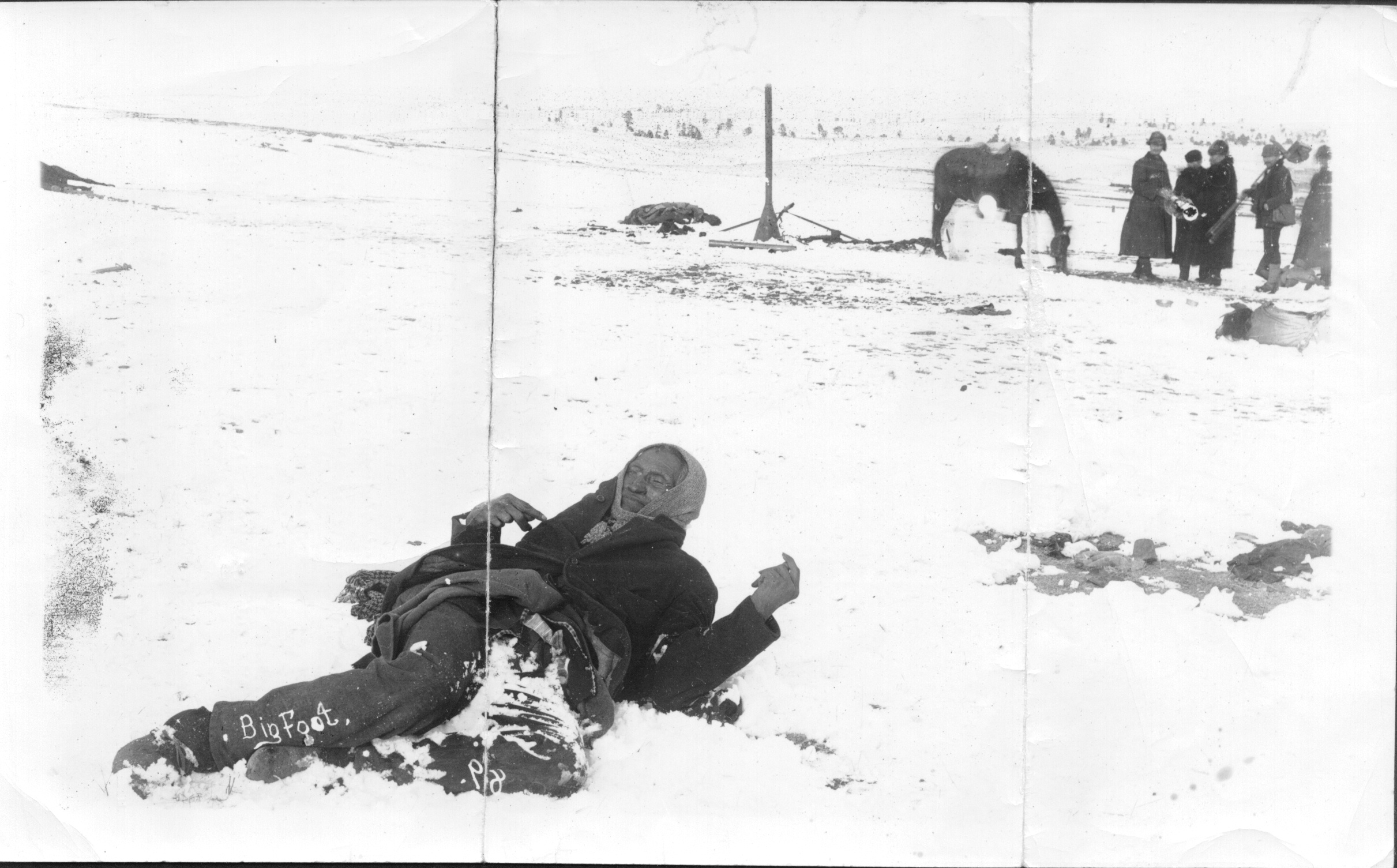
Chief Big Foot's frozen body on 3 January 1891. Major Whitside is pictured in the background, third from the left accompanied by Lieutenant Cloman and a surveying party. Source: Photograph donated by Ann S. Russell of Cornwall, New York.

Chief Big Foot’s frozen body on 3 January 1891. Major Whitside is pictured in the background, third from the left accompanied by Lieutenant Cloman and a surveying party.  Photograph from author’s private collection.

The number of Lakota that were killed as a result of Wounded Knee has remained an unknown question that the Army, reporters, historians, and, perhaps most importantly, the survivors and their relatives have wrestled with since the day of the engagement.  The first accounting of the number of Indians present at Wounded Knee was provided by Major Samuel M. Whitside on 28 December 1890 when he reported, “I have just arrested Big Foot and 120 Indians, all well armed and plenty of ammunition in their belts.  About 250 women and children are in the party.”[1]

On the evening following the battle, Brigadier General Brooke sent a telegram to Major General Miles in response to the commanding general’s request for accurate information regarding how many of Big Foot’s people may have escaped.

Forsyth says there were one hundred and six bucks and about two hundred and fifty squaws and children.  The bucks were accurately counted, the squaws and children were estimated.  Six badly wounded bucks are here, six wounded bucks were with a party of twenty-three bucks and squaws which Captain Jackson had to drop when attacked by the Brules.  Sixty-two dead bucks were counted on the plain where the fight commenced and on other parts of the ground were eighteen more.  This does not include those killed in ravines where dead bucks were seen but not counted.  This accounts for ninety-two bucks without taking into consideration those which were not counted, and leaves but few alive and unhurt.  The squaws and children broke for the hills when the fight commenced and comparatively few of them were hurt and few brought in.  Thirty-nine are here, of which number twenty-one are wounded.  Had it not been for the attack of the Brules an accurate count would have been made, but the ravines were not searched afterwards.  I think this shows that there is little to apprehend from Big Foot’s band in the future.[2]

Colonel James W. Forsyth’s report of 31 December 1890 provided the first estimate of the numbers regarding Indian casualties.  He was focused on male Lakota warriors and thus made no mention of the number of woman and children that fell in the engagement.

Killed.
83 bucks in and near camp.
7 bucks by pursuing party.
Wounded.
6 bucks brought to agency,
5 bucks abandoned by pursuing party,
19 squaws and children abandoned by pursuing party,
27 squaws and children brought to agency.[3]

On 1 January 1891 Captain F. A. Whitney of the 8th Infantry was dispatched to the scene of the battle to determine the number of Lakota casualties.  He provided the following report two days later.

…I have examined the ground where the fight with Big Foot’s band occurred, and counted the number of Indians killed and wounded, also number of ponies and horses, with the following result:
82 bucks and 1 boy killed, 2 bucks badly wounded, 40 squaws killed, 1 squaw wounded, one blind squaw unhurt; 4 small children and 1 papoose killed, 40 bucks and 7 women were killed in camp; 25 bucks, 10 women and 2 children in the canon near and on one side of the camp; the balance were found in the hills; 58 horses and ponies and 1 burro were found dead.
There is evidence that a great number of bodies have been removed.  Since the snow, wagon tracks were made near where it is supposed dead or wounded Indians had been lying.  The camp and bodies of the Indians had been more or less plundered before my command arrived here.  I prohibited anything being removed from the bodies of the Indians or the camp.[4]

When added up, Whitney accounts for 128 Lakota killed.  That number is 18 short of the 146 bodies that the Army paid a contractor to bury in the trench on the hill overlooking the battlefield.

Major S. M. Whitside wrote to his wife on 5 January and provided an estimate of Lakota casualties.  Like Forsyth, he focused his numbers only on male Indians.

Eighty four Buck Indians were buried yesterday, ten are wounded in the hospital and nine were taken away and buried by friendly Indians. 8 are at the Catholic Mission wounded. So out of 120 present at the beginning of the fight we know of 111 that were either killed or wounded, leaving nine unaccounted for….[5]

On 5 February 1891 in a letter to Major General Miles’s headquarters, Captain Frank D. Baldwin of the 5th Infantry provided perhaps the most comprehensive accounting of Lakota casualties from the engagement at Wounded Knee.

                From the most reliable information obtainable, I collected the following relative to Big Foot’s band of Indians:–
January 4, 1891, there were buried on the battle field at Wounded Knee Creek, eighty-two men and sixty-four women and children.  Captain Whitney, who was in command of the troops near battle field January 4, 1891, states that there was undoubted evidence of the removal of twenty-six bodies of dead Indians, and there was no doubt in his mind but that at least forty bodies of dead Indians had been moved from battle field between December 29th, 1890 and January 4th, 1891.
I proceeded January 20th, 1891, with a small detachment of troops up White Horse Creek, to a point three miles west of the battle field and buried one Indian woman, two girls and one boy, who had been killed on the day of the battle at Wounded Knee.  A day or two prior to this, an Indian scout reported as having found the bodies of two warriors who had been shot.  These were buried by the scouts.  About the same time, reliable reports through Captain Ewers was received, that the body of one warrior had been found and buried by a party of scouts.
There was received in the post hospital, Pine Ridge up to January 25th, 1891, eight adult males, twelve children males, eleven adult females, five children females.  Seven of the foregoing died in hospital of wounds and two adult females were cared for at Gennies’ ranch.
Captain Ewers reports that he has trace of some seventy surviving members of Big Foot’s band, but is unable to give positive information as to their whereabouts, condition or sex.  As soon as he secures the information it will be furnished.

SUMMARY.

Killed on the battle field,
or died of wounds, warriors…                                     85
Killed on the battle field,
or died of wounds, non-combatants…                       68
Killed on the battle field,
or died of wounds, sex and age not known…            47                                                                                                              200

Wounded and received in Hospital at Pine Ridge,

Adults, males…                                                 8
Children, males…                                            12
Adults, females…                                            11
Children, females…                                          5……… 36
seven of the foregoing died in hospital.

Scattered among other bands of Indians, exact whereabouts, condition or sex not known, although the major portion of whom are believed to be wounded…                 70
Grand total…   306 [6]

Based on Baldwin’s estimates he accounts for 207 Lakota killed or later died of wounds and another 99 that survived, which is significantly larger than the 146 buried in the trench and the 128 listed by Whitney.  Baldwin’s total number of 306 Indians is still 64 short of the 370 that Whitside estimated captured on 28 December 1890.

Judge Eli S. Ricker in his interviews with Indian survivors compiled a list that he attributed to Joseph Horn Cloud of both killed and survivors.  His list included the names of 185 Lakota killed at Wounded Knee, still twenty-two short of Baldwin’s estimate.  Ricker further provided names of 104 survivors of Big Foot’s band, which puts the total number of the band at 289, still eighty-one short of the total number that Whitside reported captured.  Part of the discrepancy in numbers may be the Hunkpapa and Brule Lakota from Sitting Bull and Hump’s bands that joined Spotted Elk’s group during their trek to Pine Ridge. Joseph Horn Cloud’s list of Lakota casualties as compiled by Ricker follows.  It is a sobering identification of lives lost.

Chief Big Foot
Mrs. Big Foot
Horned Cloud
Mrs. Horned Cloud
William Horned Cloud, son
Sherman Horned Cloud, son
Pretty Enemy, niece
Mrs. Beard, daughter-in-law
Thomas Beard, grandson
Shedding Bear
Trouble-in-Front, son
Last Running
Red White Cow, daughter
Mother-in-law of Shedding Bear
High Hawk
Mrs. High Hawk
Little boy, son
Little girl, daughter
Whirl Wind Hawk
Mrs. Whirl Wind Hawk
Young lady, daughter
Young girl, daughter
Little girl, daughter
Little boy, son
Little boy, son
He Crow
Pretty Woman, daughter
Buckskin Breech Clout
Running In Lodge, son
White Feather, son
Little boy, son
Bear Woman (the oldest woman in the band)
Crazy Bear
Elk Creek
Mrs. Elk Creek
Spotted Chief, son
Red Fish
Mrs. Red Fish
Old Good Bear
Young Good Bear
Mrs. Good Bear
Little boy, son
Pretty Hawk
Mrs. Pretty Hawk
Baby Pretty Hawk
Mrs. Lap
Shoots The Right
Bad Wound, son
Bear Parts Body
Little boy, son
Brown Beaver
White Beaver Woman
Black Coyote  (The one who made the trouble)
Red Water Woman
Sun In Pupil
Mrs. Sun In Pupil
Henry Three, or Pretty Bald Eagle
Iron Eyes (Big Foot’s brother)
Mrs. Iron Eyes
Has A Dog
Red Shirt Girl
Pretty Woman
Albert Iron Eyes
White Day
Little Boy, son
Charge At Them
Old Woman, mother
Mrs. Iron American
Mrs. Yellow Buffalo Calf
Louis Close To Home
Cast Away And Run
Bad Braves
Red Horn
Winter
Strong Fox
Mrs. Strong Fox
Little boy, son
One Feather
Little boy, son
Without Robe
Old Man Yellow Bull
Mrs. Old Man Yellow Bull
Brown Woman
Shakes The Bird
Red Ears Horse
Shoots With Hawk Feather (Shot with Hotchkiss)
His mother
Ghost Horse
Little boy, son
Chief Woman
Mrs. Trouble In Love
Hat
Baby boy
Mrs. Stone Hammer
Little baby
Wolf Ears
Good Boy, son
Edward Wolf Ears
Little girl
Shoots The Bear
Kills Senaca Assiniboine
George Shoots The Bear
Mrs. Shoots The Bear
Kills Crow Indian
Little Body Bear
Mrs. Little Body Bear
Little boy, son
Baby girl
Red Eagle (This man was in the tent & killed by the cannon)
Eagle Body, daughter
Little girl
Little Elk
Mrs. Little Elk
Black Shield’s little girl
White Wolf
Red Ears Horse, sister
Old Woman, her mother
Wood Shade
Mrs. Wood Shade
Running Standing Hairs
Mrs. Running Standing Hairs
Young lady, daughter
Scabbard Knife
Mrs. Scabbard Knife
He Eagle
Mrs. He Eagle
Edward He Eagle, son
Young girl, daughter
Young boy, son
Log
Mrs. Log
Really Woman, son
Brown Hoops
Little boy, son
Young girl, daughter
Mule’s daughter, young lady
Red Other Woman
Black Flutes, young boy
Takes Away The Bow
Gray In Eye
Mrs. Drops Blood
Young boy, son
Little boy, son
Old Woman
Mrs. Long Bull
Young girl, daughter
Spotted Thunder
Swift Bird
Mrs. Swift Bird
Boy, son
Boy, son
Strike Scatter
Boy, son
Wolf Skin Necklace
Last Talking, old woman
Not Go In Among, son of Hailing Bear, and Her Good Medicine
Wounded Hand
Comes Out Rattling, wife
Big Voice Thunder
Mercy To Others
Long Medicine
Broken Arrow
Mrs. Broken Arrow
Young man
Young woman
Brown Turtle
Old woman, mother
Bird Wings
Not Afraid Of Lodge
Bear Comes And Lies
Wears Calf’s Robe
Yellow Robe
Wounded In Winter, son
Mrs. Black Hair
Bad Spotted Eagle (a Cree Indian)
Mrs. Bad Spotted Eagle
White American
Long Bull
Courage Bear
Mrs. Courage Bear
Fat Courage Bear
George Courage Bear
Black Hawk
She Bear, wife
Weasel Bear, daughter[7]

Endnotes
[1] Historical Society of Pennsylvania, Sioux Campaign 1890-91, vols. 1 and 2 (Philadelphia: Historical Society of Pennsylvania, 1919), 604.
[2] Ibid., 656.
[3] James W. Forsyth, letter to Adjutant General, Department of the Platte dated 31 Dec 1890, from National Archives Microfilm Publications, Reports and Correspondence Relating to the Army Investigations of the Battle at Wounded Knee and to the Sioux Campaign of 1890-1891, Roll 1 “Sioux Campaign, Jan. 1891,” p. 760-763.
[4] F. A. Whitney, letter to Adjutant General, Department of the Platte dated 3 Jan 1891, from National Archives Microfilm Publications, Investigations of the Battle at Wounded Knee, Roll 1 “Sioux Campaign, Jan. 1891,” p. 824.
[5] Samuel M. Whitside, letter to Carrie Whitside dated 5 Jan 1891, from Samuel L. Russell, “Selfless Service: The Cavalry Career of Brigadier General Samuel M. Whitside from 1858 to 1902,” thesis (Leavenworth: Command and General Staff College, 2002), 144.
[6] Frank D. Baldwin, letter to Adjutant General, Division of the Missouri dated 5 Feb 1891, from National Archives Microfilm Publications, Investigations of the Battle at Wounded Knee, Roll 2 “Sioux Campaign, Jan. – Oct. 1891,” pp. 1075-1076.
[7] Eli S. Ricker, Voices of the American West, The Indian Interviews of Eli S. Ricker, 1903-1919, (Lincoln: University of Nebraska Press, 2005), 204-206.

Citation for this article: Samuel L. Russell, “Lakota Casualties at Wounded Knee,” Army at Wounded Knee, updated 7 Sep 2015, accessed date _________, http://wp.me/p3NoJy-kP.

Posted in Casualties, Official Reports | Tagged , , , , , , , , , , , , , , , , , , , , , | 16 Comments

Corporal Horace Ross Forrest, B Troop, 7th Cavalry – Killed in Action


Harry R. Forrest was a twenty-four-year-old corporal in Captain Varnum’s B Troop at Wounded Knee with two and a half years of experience in the Army and that unit.  As with the other six soldiers in B Troop that were killed in action or later died of wounds, Forrest likely suffered his fate early in the battle during the melee surrounding the Indian council circle.  According to the Omaha Daily Bee, he was killed by a head wound.[1]

Inset of Lieut. S. A. Cloman’s map of Wounded Knee depicting the scene of the fight with Big Foot’s Band, December 29, 1890.

Inset of Lieut. S. A. Cloman’s map of Wounded Knee depicting the scene of the fight with Big Foot’s Band, December 29, 1890.

Born Horace Ross Forrest about 1866 in Bucks County, Pennsylvania, he was the second of six children and the only son of Barclay and Jane Forrest.  Barclay was a twenty-six-year-old carpet weaver from Philadelphia, Pennsylvania, in 1863 when he married thirty-one-year-old Jane Krewson Hansberry, the daughter of Josiah and Mary (Krewson) Hansberry.  In addition to their son, Horace, Barclay and Jane had five daughters: Mrs. Lizzie Bowers, born about 1864, Mrs. Della Bowers, born on 14 June 1867, Elnora born about 1872, Carrie born about 1874, and Mary born in April 1882.[2]

Captain Varnum completed the inventory of Corporal Forrest's personal effects upon the unit's return to Fort Riley.  He forwarded them onto the corporal's parents at Ambler, Pennsylvania.

Captain Varnum completed the inventory of Corporal Forrest’s personal effects upon the unit’s return to Fort Riley. He forwarded them onto the corporal’s parents at Ambler, Pennsylvania.[4]

Horace, or Harry, was enlisted on 9 April 1888 by Lieutenant Hoyle at Camden, New Jersey.  He indicated that he was twenty-one years of age and a farmer from Bucks County.  Standing at five feet six inches, Harry had a fair complexion, blue eyes and brown hair.  He joined B Troop at Fort Riley, which was then under the command of First Lieutenant Gresham.[3]

Corporal Forrest was buried along with his fallen comrades in the Episcopal Cemetery at the Pine Ridge Agency on New Year’s eve, 1890.  Shortly after he was killed in battle, his sister, Mrs. Della Bowers, gave birth to a son on 18 February 1891.  She named him Horace Ross in memory of her recently deceased brother. Captain Varnum inventoried Corporal Forrest’s personal effects and forwarded them to his parents along with $8.70 of pay the Army was required to retain and $10.77 for clothing not drawn.[5]

Barclay Forrest filed for a pension for his son’s service related death in March 1893.  Jane Forrest died ten years later on 4 April 1903; she was not alive when in October 1906, the corporal’s remains were removed from Pine Ridge and reburied at Fort Riley, Kansas.  The fallen cavalry trooper’s father died on 20 August 1910.[6]

Corporal Harry R. Forrest is buried in the Fort Riley Post Cemetery.[6]

Endnotes

[1] Adjutant General’s Officer, “7th Cavalry, Troop B, Jan. 1885 – Dec. 1897,” Muster Rolls of Regular Army Organizations, 1784 –  Oct. 31, 1912, Record Group 94, (Washington: National Archives Record Administration); Associated Press, Omaha daily bee., January 01, 1891, Part One, Image 1, http://chroniclingamerica.loc.gov/lccn/sn99021999/1891-01-01/ed-1/seq-1/ accessed 4 Nov 2013.
[2] Ancestry.com,  United States Federal Census [database on-line],  Provo, UT, USA: Ancestry.com Operations, Inc., 2009, Images reproduced by FamilySearch; Year: 1850, Census Place: Penn, Philadelphia, Pennsylvania, Roll: M432_820, Page: 157A, Image: 322; Year: 1860, Census Place: Philadelphia Ward 23 Precincts 11-12, Philadelphia, Pennsylvania, Roll: M653_1174; Page: 987, Image: 555, Family History Library Film: 805174; Year: 1870, Census Place: Philadelphia Ward 23 District 76, Philadelphia, Pennsylvania, Roll: M593_1410, Page: 227B, Image: 459, Family History Library Film: 552909; Year: 1880, Census Place: Churchville, Bucks, Pennsylvania, Roll: 1106, Family History Film: 1255106, Page: 504B, Enumeration District: 157; Year: 1900, Census Place: Ambler, Montgomery, Pennsylvania, Roll: 1444, Page: 2A, Enumeration District: 0255, FHL microfilm: 1241444.
[3] Adjutant General’s Office, Final Statements, 1862-1899, “Forrest, Harry R.,” at Fold3, http://www.fold3.com/image/271303437/ accessed 28 Dec 2013.
[4] Ibid., http://www.fold3.com/image/271303439/.
[5] Ancestry.com. 1900 United States Federal Census, Year: 1900, Census Place: Philadelphia Ward 37, Philadelphia, Pennsylvania, Roll: 1478, Page: 3A, Enumeration District: 0953, FHL microfilm: 1241478;
[6] Ancestry.com, U.S. Military Burial Registers, 1768-1921 [database on-line], Provo, UT, USA: Ancestry.com Operations Inc, 2007, Original data: Burial Registers for Military Posts, Camps, and Stations, 1768-1921, Microfilm Publication M2014, 1 roll, ARC ID: 4478153, Records of the Office of the Quartermaster General, Record Group 92, National Archives in Washington, D.C.; National Archives and Records Administration, U.S., Civil War Pension Index: General Index to Pension Files, 1861-1934 [database on-line], Provo, UT, USA: Ancestry.com Operations Inc, 2000, Roll Number: T288_158, Image: 2428.
[6] Jana Mitchell, photo., “Corp Harry R Forrest,” FindAGrave, http://www.findagrave.com/cgi-bin/fg.cgi?page=gr&GRid=59152739 accessed 23 Dec 2013.

Citation for this article: Samuel L. Russell, “Corporal Horace Ross Forrest, B Troop, 7th Cavalry – Killed in Action,” Army at Wounded Knee, last updated 29 January 2014, accessed date ____________, http://wp.me/p3NoJy-k5.

Posted in Casualties, Enlisted | Tagged , , , , , , , , , , , , , , | 2 Comments