The Letters of First Sergeant John B. Turney, C Troop, 7th Cavalry


You asked if any of the “friendlies” took the warpath.  I should think they did.  There were two thousand “Bucks” went out of here the day we had the fight at Wounded Knee.  It was them we had the second days pitched battle at White Clay where they lost another batch.

1st Sgt John B Turney

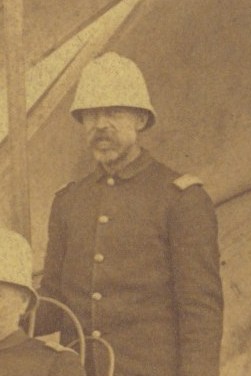
Sergeant John B. Turney at Fort Riley, Kansas, circa 1890.[1]

John Bartholomew Turney was the thirty-four-year-old first sergeant of Captain Henry Jackson’s C Troop at Wounded Knee.  He is pictured above likely at Fort Riley before being promoted to First Sergeant in late August 1890.  A native of Bridgeport, Connecticut, Turney was an experienced non-commissioned officer with over eight years in C Troop since first enlisting in New York City in August 1882.  He stood almost six feet tall with blue eyes, brown hair, and a fair complexion.  During the Pine Ridge Campaign, Turney wrote to his wife, the former Miss Mary Ellen Maloney, whom he called Mollie.  Of his campaign letters only three are still in existence.  The first letter was written just days after Brigadier General John R. Brooke canceled the 7th Cavalry’s orders to advance on Chief Two Strikes’ band in the Stronghold in the Bad Lands on 15 December following the notification of Sitting Bull’s death.[2]

Pine Ridge Agency, S. D.
Dec’br 18, 1890

Dear Mollie:

Your letter received today. I was about to send you a sheet of paper and an envelope. We are still in the same place. We were all packed up ready to head to the Badlands on Tuesday morning but the order was countermanded so we settled down again. There were eight hundred lodges of Indians came in the next day and camped near us. That is the reason we did not have to go out, but there are a plenty of them left yet who do not seem inclined to come in. Sitting Bull and his son and five more Indian chiefs were killed the other day in a fight up the country. “Bull” was the principal chief of all the tribes in the northwest.  I went to a war dance the other day and it was about the finest thing in a wild sense that I ever saw. The warriors were all sitting in a large circle and although it was the 15th of December, they were all stark naked except for a “breach clout,” a beautiful headdress or war bonnet and other ornaments. Their bodies were all painted, some of them one color and some another and some half a dozen different colors. Some looked hideous, and some positively beautiful. They were all splendidly formed Indians, and some of them were painted a rich, dark cream color with green feet and hands and spots of green on the legs over the cream, as though they had been put on by rubbing the finger down like fringe. They all wore a headdress of bright hue and eagle feathers. Some of them reaching to the ground. Then came a beautiful beaded belt of some kind to which was fastened an enormous “bustle” of eagle feathers, sticking out a yard behind and touching the ground. To this was fastened on each side a string of small sleigh bells, the end of each string coming down and fastening to the ankle of the leg on its respective side by a band of silver or some bright metal. They also wore armlets and bracelets of some sort. You could not buy one of these rigs for $100 cash. When I arrived at the place where the “pow-wow” was held and saw this circle of brilliant colors and painted bodies, I thought it was the finest thing I had ever seen.  There was some big talk and acting on the part of the Big Chief, showing past experiences on the war path, and then the circle of braves rose up and commenced their dancing, and with the fearfull yelling and the merry sleighbells ringing and weapons flashing, my horse got wild and I had all I could do to keep him from carrying me into the midst of the howling mob. They kept it up for about five hours and they were still at it when I left. The only music for “Buck dance” is a big drum which was beaten by several of the old chiefs who sit in a circle around it on the ground with each a stick. I have one of the headdresses and a war club which I will show to you when I come back. I will also bring you a pretty pair of moccasins for Sunday. Those I sent you I got because they were more truly Indian style than the fancy ones.  Thompson was at the glorious pow wow and he said he was quite gone on one of the braves that we picked out from the crowd. He was perfectly handsome in his paint and feathers and had no paint on his face except that pretty cream color, while most of them had all sorts of figures in different colors painted on their faces.  One old devil had a black mustache painted on his red mug, curling away up to the side of his ears.

I send you a clipping from the Globe Democrat which tells you as much about when we will get back as I know. I hope it is true.  I should like to be discharged in New Mexico or Texas. I think I could do better there, but in any case, I shall not forget to apply for discharge when the time comes, and if we can’t do better, we will go to Denver. I wish I could be there for Christmas, as you say, but I suppose there is no use. Tell Mrs. N. that I did not dare send her a pair of moccasins on account of you being there, but I will bring her a pair when I come anyway. I am so sorry that I am not prepared to send you any money now, but I shall be pretty well fixed when I get back and can make everything right. I am going to get little Roy a fur robe or cloak before I leave here. You had better enquire for letters for me at the post office and if you get any, forward them to me.  We received 10 new men from the 62 assigned to the Regiment. They came from [Fort] Robinson some days ago, and they had a rather rough induction to soldier’s life joining the troops in the field on an Indian campaign. “C” Troop started away with 45 men present and it now has 56 present which is the full allowance for a cavalry troop now. Sergt. Murray of “G” Troop was reduced at his own request and transferred to “C” Troop. Sergt. McCallum who was acting Q. M. of C Troop has been reduced at his own request on account of some racket he had with some other troop officers. Sergt. Thompson is acting Q. M. again. He did not want to have the position but I would not let the old man let him off. Sergt. Dolan of “L” Troop is assigned to “C” Troop and we are happy. Let the Indians yell. Tell Mrs. N. to see that you take good care of that Boy.

John

Love to Ella, Ha Ha.

My partner, the last fellow who was down there with me won two hundred and seventy-five dollars over in one of the tepees the other night.

Love to all the kids.[3]

The next of First Sergeant Turney’s letters that still exist came a month later and two weeks after the battle at Wounded Knee.  His view of the Lakota is harsh and exemplifies the contemporary feelings that many soldiers held toward their Sioux adversaries.

P. R. Agency, S. D.
January 13th, 1891.

Dear Mary:

     The latest report tonight is that the war is over, that the reds have expressed their willingness to surrender to General Miles, and that the 7th Cavalry will soon be on the road home.  I think I told you in my last letter that we are encamped on the hill overlooking our old camp, and near the agency buildings.  Our old camp is now occupied by “friendlies” as thick as bees.  The hostile camp is over the next hill north of us about a mile off, at the same place where they attacked the 9th Cavalry wagon train.  We have a strong guard overlooking their camp from the hill where there are earthworks and fortifications thrown up. They came into the place where they are yesterday and have been held there since.  There are about 400 lodges of them. Surrounding them at different points in the surrounding country are troops of the 6th and 8th Cavalry and lots of infantry and artillery, so that their case is a hopeless one.  You asked if any of the “friendlies” took the warpath.  I should think they did.  There were two thousand “Bucks” went out of here the day we had the fight at Wounded Knee.  It was them we had the second days pitched battle at White Clay where they lost another batch.

     The eastern papers are giving the 7th a terrible roasting.  They call us “murderers,” “butchers” &c. &c., but the boys only laugh at them.  They don’t care a straw what they say. They have done nothing they are sorry for, and if they were to get another rap at the red heathen they would do them up worse you can bet.  No one knows better what the red devils deserve than the soldiers, and they are mad enough to give them the full amount.  If some of the fools in the east who are making this talk about the “slaughter” at Wounded Knee had been with us in the field for the past 6 or 7 weeks, I warrant they would be delighted to see every Indian in the northwest blown to kingdom come with one volly [sic].  I must tell you of one funny thing that happened at Wounded Knee.  It was the 3rd fight for “C” Troop that day, when we were attacked by Brule and lost our prisoners.  Sergt. Dolan who used to belong to “L” troop was next to me on the line when the Brules came over the bluff and attacked us.  The first shot broke Dolan’s pipe into [sic], and left part of the stem in his mouth.  He plugged the red who fired it, just as the Capt. hollered to him not to shoot.  He looked around at the capt. and said, “but the son of a gun broke me pipe!” We did not have time to laugh just then but those who heard it had a good laugh afterward. Well dear hoping latest report is true & with best love, to yourself & Roy and all the folks.

Yours as ever,
John[4]

First Sergeant Turney wrote his wife again a week later, the third and final letter that still survives.

Pine Ridge Agency, S. D.
January 19, 1890.

Dear Mollie:

     Your letter received today and I was sorry to hear of Roy’s trouble, but hope he will be all right.  The red curses came in the other day and camped down on the flat near our old camp. The head of the column appeared around the bluff to our left about 9 o’clock in the morning and the end of them did not get into camp until about 4 in the afternoon.  So you can imagine there were a crowd of them to keep up a steady stream all day.  Their camp is a sight.  The teepes are as thick as corn stacks in a good field and reach as far as we can see.  We hope the devils will quiet down after a few days and admit of our being sent home. If they get well settled in their camp, I think they will be all right, but it will take some days for them to do so.

If we don’t get orders for home soon I will send you a P. O. order for some cash.  You must need some by this time, I should think, but I am hoping to see orders for our return every day, and I will have a big Iron dollar for you.

     Did you get the little moccasins I sent for Roy the other day?  I got them at a deserted ranche when we were out on a scout.  You ought to see my collection of curiosities from the Wounded Knee fight.  I have quite a lot of them.  Baus has quite a collection.  He was back at the battle field afterwards with the detachment who went to bury the dead bucks.  He is going to be discharged the 25th but is going to take on again and we have got it made up to have our Christmas dinner when we get back. That is if Mrs. Newman is willing to entertain us,  and you will laugh to hear Baus tell about some of the picnics we had.

     The Indians are scrapping among themselves occasionally. They killed two of each other night before last.  This suits the soldiers perfectly.  It is after taps so I will close with love to yourself & Roy.  Remember me to Mr. & Mrs. N. and all the children, especially to my sweetheart little Mary.

J. B. T.[5]

First Sergeant Turney was one of nineteen soldiers injured, including two killed, in a train wreck on the return trip from the campaign to Fort Riley, Kansas.  He was discharged three months later in April 1891.  A year later he enlisted again in Captain Jackson’s C Troop, but at the rank of Private.  His military career ended ingloriously the following year when he was found guilty at a court martial for being drunk and disorderly while assigned at Camp Carrizo, Texas. He was discharged on 20 March 1893 still a private with no characterization of service.  He returned to Junction City, Kansas, where Mollie gave birth to a second son, John Francis, in November 1894, but John Turney never met his name sake.  He had returned to his home town of Black Rock, Connecticut, where he lived briefly with his sister, Mary Eliza Turney, and worked as a hotel bookkeeper in 1895.  All record of John Bartholomew Turney ends at that point. When or where he died, and where he is buried remain a mystery.  Mollie moved with her family to Durango, Colorado, where she married Levin P. Logan in 1898.[6]

Endnotes:

[1] This photograph of Sergeant John B. Turney was graciously donated by John F. Turney of Alamogordo, New Mexico, with express permission to post to this website.  Further copies of this photograph are not permitted.
[2] Ancestry.com, U.S. Army, Register of Enlistments, 1798-1914 [database on-line], Provo, UT, USA: Ancestry.com Operations Inc, 2007, Register: 1878-1884 P-Z, Image: 320, Line: 157; Register: 1885-1890 L-Z, Image: 484, Line: 16.  Photograph image courtesy Elizabeth Turney Schellman of Lawrence, Kansas.
[3] John F. Turney, John B. and the 7th Cavalry, (Copyright by John F. Turney, 2012), 225-228.  John F. Turney is the grandson of John B. Turney and in possession of the photograph and letters.  In 2012, J. F. Turney published a historical novel of the life of his grandfather.  While much of the book is fictional, it is based on historical record and demonstrates a thorough research of 7th Cavalry muster rolls and monthly reports. J. F. Turney changed some of the names of his characters, but left most unchanged.  In the opening of the book he states, “the letters included are quoted almost word-for-word from the original missives.”  Mr. Turney and his wife and daughter were gracious to share with me images of the original letters.  First Sergeant Turney’s first child, Roy Michael, was born just six weeks before the Regiment departed for Pine Ridge. Sergeant Murray refers to John J. Murray.  According the the C Troop muster roll, he was reduced to Private in G Troop at his own request on 30 November 1890 and transferred to C Troop on 3 December.  Sergeant McCullum refers to Donald McCullum. He was reduced to Private at his own request on 12 December. Sergeant Thompson refers to Adolf J. Tompson and Sergeant Dolan refers to John Dolan.
[4] Ibid., 257-258.
[5] Ibid., 260-261.  Baus refers to Corporal Jacob Baus whose five-year enlistment was due to expire on 26 January 1891.
[6] Omaha Daily Bee, Wednesday Morning, 28 January 1891; U.S. Army, Register of Enlistments, 1798-1914, Register: 1891-1892 A-Z, Page: 458, Line: 81; Ancestry.com, U.S. City Directories, 1821-1989 [database on-line], Provo, UT, USA: Ancestry.com Operations, Inc., 2011, Publication Title: Bridgeport, Connecticut, City Directory, 1895, Page: 365.

Citation for this article: Samuel L. Russell, “The Letters of First Sergeant John B. Turney, C Troop, 7th Cavalry,” Army at Wounded Knee (Sumter, SC: Russell Martial Research, 2013-2014, http://wp.me/p3NoJy-pl), posted 29 Jan 2014, accessed __________.

Posted in Enlisted, Personal Letters | Tagged , , , , , , , , , , , , , , , , , | 1 Comment

Private Jan De Vreede, C Troop, 7th Cavalry – Killed in Action


Private Jan DeVreede, a thirty-two-year-old Belgium immigrant, was the only soldier from Captain Henry Jackson’s C Troop that was killed at Wounded Knee.  By December 1890 he had over four years experience with the unit and the regiment.  Like many enlisted soldiers of that period, he ran afoul of his chain of command often enough to keep him from rising to higher rank and responsibility.  Just two weeks prior to the battle DeVreede was found guilty by a summary court martial in camp at the Pine Ridge Agency and sentenced to forfeit 75¢ of his pay.  This was less than a month after he was sentenced to forfeit $3.00 at a previous court martial at Fort Riley.  DeVreede was killed at Wounded Knee when he was shot in the chest late in the battle when his unit was attempting to round up any prisoners and eliminate any remaining resistance from the ravine.[1]  He was one of the few casualties who were singled out for description by his commander during testimony at the investigation when Captain Jackson stated:

I started due west, up the bluffs, and had to travel over 2 miles to the head of the ravine. Just as we headed it, at the point where the road came in, as we were turning at the head of the ravine, I saw an Indian slide down the bank into it; I had 34 men with me of C Troop. I dismounted them to fight on foot and surrounded the head of the ravine; after we closed up on it, the firing began both from my men and some Indians, and we fought there, gradually closing in, and I sent Lieut. Donaldson and some men to cut off their retreat down the ravine. The Indians were in a hole under the bank, and we could only see the points of their guns, and I thought, from the looks of the place, that it held only one or two Indians. In the fight one of my men was killed.[2]

Captain Jackson's inventory of Private DeVreede's personal effects states that he died from a gunshot wound to the chest.

Captain Jackson’s inventory of Private DeVreede’s personal effects states that he died from a gunshot wound to the chest.

Jan DeVreede enlisted on Dec. 2, 1886 at Jersey City, New Jersey, by Lt. Vroom for a five-year term. Born at Antwerp, Belgium, he was a twenty-eight-year-old laborer with blue eyes, fair hair, a fair complexion, and stood five and a half feet in height.  Little else is recorded of Jan DeVreede in military, census or immigration records.  His personal effects were disposed of by a council of administration, likely by selling the items to fellow soldiers, and the $8.25 collected was turned over to the paying agent.  Captain Jackson made no mention of any family, and DeVreede’s only personal belongings other than clothing items was a deck of cards and poker chips.[3]

Private Jan DeVreede was buried in the cemetery adjacent to the Episcopal Church at the Pine Ridge Agency on New Year’s Eve two days after the battle.  In October 1906, his remains along with those of twenty-seven of his comrades from the 7th Cavalry Regiment were moved to Fort Riley and buried in the post cemetery.[4]

Private Jan DeVreede is buried in the Fort Riley Post Cemetery.[5]

Endnotes

[1] Adjutant General’s Officer, “7th Cavalry, Troop C, Jan. 1885 – Dec. 1897,” Muster Rolls of Regular Army Organizations, 1784 –  Oct. 31, 1912, Record Group 94, (Washington: National Archives Record Administration).
[2] National Archives Microfilm Publications, “Reports and Correspondence Related to the Army Investigations of the Battle at Wounded Knee and to the Sioux Campaign of 1890–1891.” (Washington: The National Archives and Records Service, General Services Administration, 1975), Roll 1, Target 3, Jan. 1891, 687-689.
[3] Ancestry.com, U.S. Army, Register of Enlistments, 1798-1914 [database on-line], Provo, UT, USA: Ancestry.com Operations Inc, 2007, Record Year Range: 1885-1890, Surname Letter Range: A-D, Image: 281, Line: 430; National Archives, Final statements of deceased soldiers of the U.S. Infantry during and after the Civil War, Digitized from NARA textual records, Record Group 94.
[4] National Archives and Records Administration, Burial Registers of Military Posts and National Cemeteries, compiled ca. 1862-ca. 1960, Archive Number: 44778151, Series: A1 627, Record Group Title: Records of the Office of the Quartermaster General, 1774-1985, Record Group Number: 92.
[5] Jana Mitchell, photo., “Jan DeVreede,” FindAGrave, http://www.findagrave.com/cgi-bin/fg.cgi?page=gr&GRid=59153005 accessed 27 Jan 2014.

Citation for this article: Samuel L. Russell, “Private Jan De Vreede, C Troop, 7th Cavalry – Killed in Action,” Army at Wounded Knee (Sumter, SC: Russell Martial Research, 2013-2014, http://wp.me/p3NoJy-p7), posted 27 Jan 2014, accessed __________.

Posted in Casualties, Enlisted, Muster Rolls | Tagged , , , , , , , , , | Leave a comment

Captain Henry Jackson, Commander, C Troop, 7th Cavalry


Captain Henry Jackson in camp at a target range at Fort Riley, Kansas, in 1888.

Captain Henry Jackson in camp at a target range at Fort Riley, Kansas, in 1888.[1]

Immediately after the volley, from 100 to 150 Indians rode up on three sides and opened fire on us.  We fell back about 400 yards to a good position and stood them off.

At fifty-three years of age, Captain Henry Jackson, was one of the most experienced company commanders in the 7th Cavalry at Wounded Knee.  He had been the commander of C Troop for over fourteen years since being promoted to fill the vacancy created by Captain Thomas Custer’s death at the Little Big Horn.  Jackson had been on active duty almost continually since December 1863 and claimed to have served as an officer in the British army in the 1850s.

C Troop was one of four company sized elements of the regiment’s 2nd Battalion, which during the Pine Ridge Campaign was commanded by the senior captain in the regiment, Charles S. Ilsley.  As a part of the 2nd Battalion, Captain Jackson and his C Troop arrived at Wounded Knee with Colonel Forsyth on the night of 28 December, after the Lakota had set up their village on the south side of Major Whitside’s camp.  Captain Ilsley filled the battalion commander role because Colonel Forsyth had only one of his field grade officers, Major Whitside, present during the campaign, the others being stationed at Fort Sill or on detached service in other capacities. As one of the senior captains in the regiment, Colonel Forsyth used Captain Jackson in the old cavalry role of a squadron commander, that is, he was in charge of two troops, C and D, that were tactically dispersed from their battalion commander.  Captain Ilsley’s other two troops, E and G, were positioned on the north side of the ravine with Ilsley positioning himself at the council circle near Forsyth and Whitside.  Jackson was in charge of his C Troop and Captain E. S. Godfrey’s D Troop on the south side of the ravine.  Interestingly, Jackson makes no mention of being in charge of Lieutenant Taylor’s Indian Scouts that were also positioned in that proximity.

As with all ten line companies at Wounded Knee–eight troops from the 7th Cavalry, one battery from the 1st Artillery, and one troop of Indian Scouts–Captain Jackson had only one of his two officers present.  First Lieutenant Luther R. Hare deployed with the regiment to Pine Ridge, but returned to Fort Riley on 15 December suffering from muscular rheumatism, a common ailment among cavalry officers that spent a lifetime in the saddle. Jackson’s Second Lieutenant, Thomas Q. Donaldson, was present and on duty with C Troop at Wounded Knee.  The senior non-commissioned officer of C Troop that morning was First Sergeant John B. Turney, a thirty-four year old seasoned soldier with eight years experience with his troop and regiment. A review of the C Troop muster roll for the month of December 1890 indicates that Jackson had five sergeants, two of four corporals, his farrier, blacksmith, saddler, and wagoner, and as many as forty-two privates at Wounded Knee, nine of whom were new recruits that joined the regiment at Pine Ridge just weeks before the battle.  The new recruits did not increase Jackson’s available strength however, as he had discharged seven soldiers in the weeks preceding the battle and had several absent either on furlough, sick in hospitals, or in confinement.[2]  Concerning the fighting strength of the unit on the campaign in December, First Sergeant Turney detailed the following in a letter to his wife back at Junction City, Kansas.

We received 10 new men from the 62 assigned to the Regiment. They came from [Fort] Robinson some days ago, and they had a rather rough induction to soldier’s life joining the troops in the field on an Indian campaign. “C” Troop started away with 45 men present and it now has 56 present which is the full allowance for a cavalry troop now.[3]

Captain Jackson detailed his role at Wounded Knee when he was called to testify on 9 January 1891 at Major General Miles’s investigation into Colonel Forsyth’s management of the Wounded Knee affair.  After being sworn in by the board, Jackson responded to a series of questions from Major Kent and Captain Baldwin beginning with, “Did you command C Troop during the engagement on the Wounded Knee on the 29th of December, 1890?”

I commanded C and D Troops, located as shown on the map (referred to), but C Troop extended more to the right and not so far to the left, and D Troop was on my left.[4]

Inset of Lieut. S. A. Cloman’s map of Wounded Knee depicting the position of C and D Troops, December 29, 1890.

(Click to enlarge) Inset of Lieut. S. A. Cloman’s map of Wounded Knee depicting the position of C and D Troops, December 29, 1890.

The board’s next question regarded friendly fire.  “Did these Troops, in the position indicated, receive the fire from other Troops?”

I could not tell; we received a heavy fire, coming from the northwest; one man was injured in this fire.  I did not fire in the direction of any other of our Troops.[5]

Kent and Baldwin next inquired about the killing of noncombatants.  “What precautions did you take, in the pursuit of the Indians, to prevent unnecessary killing of Indian women and Children?”

The only women I noticed was in the break out of the Indians.  I saw a party of 8 or 9 women and children, who kept bunched together; I saw they were women because they had their children with them; and, right there, cautioned the men not to fire on them; a party of my Troop conducted them to a place of safety.[6]

The board followed up with, “What people were killed in rear of your first position?” To which Jackson provided a lengthy response that detailed a shift in the fight from the ravine to pursuit of the surviving Miniconjou to prevent their escape.

I saw several bodies lying on the ground, and I know that two of them were bucks at least.  While the firing was going on, Major Whitside rode up to me and gave me an order, pointing to a herd of ponies some 2 miles in a northwesterly direction, and told me to take my Troop up to the Hills and to round up anything I found there and to bring in those ponies.  I started due west, up the bluffs, and had to travel over 2 miles to the head of the ravine.  Just as we headed it, at the point where the road came in, as we were turning at the head of the ravine, I saw an Indian slide down the bank into it; I had 34 men with me of C Troop.  I dismounted them to fight on foot and surrounded the head of the ravine; after we closed up on it, the firing began both from my men and some Indians, and we fought there, gradually closing in, and I sent Lieut. Donaldson and some men to cut off their retreat down the ravine.  The Indians were in a hole under the bank, and we could only see the points of their guns, and I thought, from the looks of the place, that it held only one or two Indians.  In the fight one of my men was killed.  Lieut. Taylor, with two Indian scouts, came up about that time, and I thought I heard children crying, and I told Lieut. Taylor to send one of his scouts to say that if the squaws came out they would not be harmed.  It took half an hour’s talking with them, and I had to withdraw my men before they would come out.  We got 19 women and children there.  There was one woman badly hurt and one or two others had been hit.  We got 5 bucks at the same time, 4 badly wounded, and one shot through the ankle; we dressed the wounds of all as far as the dressings reached.  I sent word in to General Forsyth that I had them and asked for a wagon to bring them in.  While waiting, six Indians rode down to me from the direction of the agency and shook hands with me, also Captain Godfrey and Lieut. Donaldson.  Godfrey had joined a while before with 14 men.  One of the Indians wore a policeman’s shield.  They said “How,” turned round and rode their ponies back up this road.  They went off 75 or 100 yards, turned round, and fired a volley at me.  One of the six, I think it was the one that wore the Indian policeman’s shield, waved his hand as though in efforts to stop the rest.  Immediately after the volley, from 100 to 150 Indians rode up on three sides and opened fire on us.  We fell back about 400 yards to a good position and stood them off.  They saw G Troop coming up on the jump, and they, the Indians, did not follow us.  Captain Ilsley came up and ordered me back to camp.  I had been obliged to abandon my prisoners when first I was jumped.  I had sent word to General Forsyth that the attacking party were Agency Indians, about 150 of them.  General Forsyth sent the two Troops E and G.[7]

Kent and Baldwin asked a final question, “Under the circumstances attached to the work of that day, do you consider that the disposition of the troops, just before the fight opened, was a judicious one?”  Jackson’s response hinted that perhaps Colonel Forsyth and Major Whitside could have better positioned the troops before the onset of hostilities.

I think if it had been myself, I should have left one flank open, but I don’t think any one supposed that there would be fighting; I certainly did not.[8]

Between the fights on 29 and 30 December, Captain Jackson’s C Troop suffered a seven percent casualty rate with one trooper killed and two wounded at Wounded Knee, and one wounded at White Clay Creek.  This was the highest casualty rate suffered among the four troops in Captain Ilsley’s 2nd Battalion, but less than half that of any of the four troops in Major Whitside’s 1st Battalion.

Of all the officers in the 7th Cavalry Henry Jackson’s origins are the least known.  That he was born in England is well established, likely in Canterbury, but the commonality of his name makes finding his place and date of birth difficult.  A review of his U.S. Army records fails to identify the names of his parents or any relatives other than his wife.  Jackson provided scant detail of his early life in a letter requesting a commission following the Civil War.

Lieutenant Henry Jackson's letter requesting a commission upon in activation of the 5th U.S. Colored Cavalry.[x]

Lieutenant Henry Jackson’s letter requesting a commission upon in activation of the 5th U.S. Colored Cavalry.

Headquarters fifth U. S. Colored Cavalry
Helena, Ark., 15 January 1866.

Adjutant General
U. S. Army, Washington D. C.
General,
I have the honor to apply for a Lieutenancy in the permanent Army of the United States. I entered the service in December 1863 in the 14th Illinois Vol. Cavalry and served with them till January 1865 when I was transferred to the 5th U. S. Col. Cav. and appointed Serg’t Major. In May 1865 I was commissioned as 2nd Lt. and was appointed Regimental Adjutant and in December 1865 I was commissioned 1st Lieutenant. I have served two years in the English service as Ensign and Lieutenant. I am 31 years of age and enlisted at Peoria, Ill.
I have the honor to be General
Very respectfully Your obdt. Servant
[signed] Henry Jackson Lt. & Adj. 5 U.S.C.C.[9]

Jackson’s statement that his age was thirty-one in 1866 put his year of birth in 1835.  He reaffirmed his birth year in a statement to a commissioning board, but in later years established his date of birth as 31 May 1837.  Establishing an officer’s actual date of birth was important to the Army as it determined when the officer reached mandatory retirement at sixty-four.  As with many young men throughout the history of military conflict, he likely lied about his age when a teenager, enabling him to enter the British Army and possibly participate in the early campaigns of the Crimean War in 1853 when he was but sixteen.  Jackson’s statement to the commissioning board established that he had immigrated to America by 1860.  Additionally, he provided greater detail of his service in the Union Army during the war of the rebellion listing the battles in which he participated while campaigning in Tennessee, North Carolina, and Georgia.

My name is Henry Jackson – I was born in England in the year 1835. I have resided in the State of Illinois from the year 1860. I entered the Military Service of the U. S. in December 1863 in the 14th Illinois Vol. Cav. I served with the 14th Ill. Cav. at Mossy Creek, Tenn., French Broad River, N.C. Feb. 64., Ellijay, Big Shanty, Kennesaw Mountain, the fights on the Chattahoochee from 26th June to 6th July, 1864. Then on Gen. Stoneman’s Raid to Macon including the fight at New Hope and Lawrenceville. We then returned to Kentucky when I was transferred to the 5th U.S. C. Cav. as Sergt. Major; in May 1865 I was commissioned as 2nd Lt and was appointed Regimental Adjutant and in December 1865 I was appointed 1st Lt. and served as such until March 1866 when I was mustered out of the U.S. Service. I was mustered into the U.S. Service at Camp Butler, Ills. about the 25th Jan. 1864.
[signed] Henry Jackson[10]

Jackson was commissioned a Second Lieutenant with the newly formed 7th Cavalry Regiment in July 1866, and accepted the appointment the following November.  By July the following year he was promoted to First Lieutenant.  Early in 1868 Lieutenant Jackson was assigned to special duty on Major General Philip Sheridan’s staff as an engineer for the Department of the Missouri.  This duty and a subsequent one with Office of the Signal Officer in Washington kept him away from his regiment for over eight years.  As such he missed much of the 7th Cavalry’s active campaigning in its early history, including the battle along the Washita River, the Black Hills Expedition of 1874, and the summer of the Little Big Horn campaign of 1876 and 1877. Upon promotion to captain following the death of Thomas Custer at the Little Big Horn, Jackson rejoined his regiment in November of that year passing through Fort Abraham Lincoln, Dakota Territory, long enough to receive orders to Fort Totten where he took command of C Company.  Jackson was on detached service in Deadwood the following August and September when much of the 7th Cavalry was engaged in battles at either Canyon Creek or Bear Paw Mountain during the Nez Perce Campaign, making Jackson one of the few, if not the only, original member of that storied regiment that did not participate in any of the major campaigns during its first tumultuous decade.[11]

While stationed at Fort Leavenworth in 1870, Jackson married Miss Elizabeth Calhoun, the thirty-two-year-old daughter of John and Sarah (Cutter) Calhoun.  John Calhoun was a wealthy surveyor and lawyer from Springfield, Illinois, where he had been friends with Abraham Lincoln and active in state politics.  He did not live to see his friend become president, dying in 1859 shortly after relocating his family to St. Joseph, Missouri.  A devoted wife, Lizzie followed Jackson across the country for the next thirty eight years, living the difficult life of an army wife in the American frontier.  She and Jackson had no children.[12]

Captain Jackson commanded C Troop for over twenty years seeing service from the Canadian border in the Northwest to the Mexican border in the Southwest.  Promotions came excruciatingly slow in the frontier army but Jackson finally became a field grade officer at the age of fifty-nine when he was promoted to Major in the 3rd Cavalry on 27 August 1896.  Major Jackson saw active campaigning with his new regiment during the Spanish-American War, where they participated in the assault on San Juan Ridge, 1 July 1898, and where sixty-one-year-old Jackson was cited for gallantry while commanding the regiment’s 2nd Squadron of troops C, E, F and G.  Following the war with Spain, promotion or retirement came rapidly, and to the aged veterans of the Civil War, both.  Jackson was promoted to Lieutenant Colonel of the 5th Cavalry Regiment in January 1900 and served in that capacity for over a year.  Based on his later assertion that he was born in 1837, not 1835, Jackson was rapidly approaching the age of retirement by law.  Two days before turning sixty-four he was promoted to Colonel and retired on this birthday.  Henry Jackson and his wife, Lizzie, retired to Leavenworth, Kansas where he entered the banking business serving as the vice president of the State Savings Bank and later the Army National Bank.  Three years after his retirement from the army, Jackson was promoted from the retired list to Brigadier General.  He died of cancer in 1908 but only a few papers across the country announced his passing.[13]

Taken from his obituary in The Leavenworth Times, Thursday morning December 10, 1908.[14]

Leavenworth, Kan., Dec. 9.–Brigadier General Henry Jackson, retired, died at his home here tonight of cancer, aged 71 years.
General Jackson was a soldier in the Crimean war, Civil war, the Spanish-American war and Indian campaigns. He was born in Canterbury, England. When 16 years of age he enlisted as a soldier and was in the Crimean war. Rising to the rank of lieutenant in the English army, he resigned and came to America. He enlisted in the Fourteenth Illinois cavalry in 1863. He was commissioned first lieutenant after the Civil war and in 1876 was made captain. In 1898 he was advanced to major. In 1900 he was made lieutenant colonel, and in 1901 a colonel. He retired in 1904 with the rank of brigadier general.[15]

Less than two months later on 2 February 1909, General Jackson’s faithful partner of almost four decades, Lizzie Calhoun Jackson, joined him in death and was buried by his side in the Fort Leavenworth National Cemetery.[16]

Brigadier General Henry Jackson and his wife, Elizabeth, are buried at the Fort Leavenworth National Cemetery.[16]

Endnotes

[1] This picture of Captain Henry Jackson is cropped from a larger photograph of the officers of the 2nd Battalion, 7th Cavalry Regiment, in camp at a target range at Fort Riley, Kansas about 1888.  The picture is from the author’s private collection.
[2] Interestingly, Hare may have been one of the only officers in the post-Civil War army to be twice promoted following the death of a fellow officer killed in action against hostile Indians.  He was promoted to First Lieutenant effective 25 June 1876 to fill the vacancy created when Lieutenant James Porter was killed at the Little Big Horn, and he was promoted to Captain effective 29 December 1890 to assume Captain George Wallace’s position when that officer was killed at Wounded Knee.
[3] John B. Turney, Letter to Mary Ellen Maloney Turney, 18 Dec 1890. Original letters in possession John F. Turney of Alamogordo, New Mexico, with express permission to post to this website.
[3] Jacob F. Kent and Frank D. Baldwin, “Report of Investigation into the Battle at Wounded Knee Creek, South Dakota, Fought December 29th 1890,” in Reports and Correspondence Related to the Army Investigations of the Battle at Wounded Knee and to the Sioux Campaign of 1890–1891, the National Archives Microfilm Publications (Washington: The National Archives and Records Service, General Services Administration, 1975), Roll 1, Target 3, Jan. 1891, 686.
[4] Ibid., 687.
[5] Ibid.
[6] Ibid., 687-689.
[7] Ibid., 689.
[8] Henry Jackson, letter to the Adjutant General dated 15 Jan 1866, from Peter Russell, “A Benteen ‘Coffee Cooler’,” Men With Custer, http://www.menwithcuster.com/29/ accessed 25 Jan 2014.
[9] Peter Russell, “A Benteen ‘Coffee Cooler’,” Men With Custer, http://www.menwithcuster.com/29/ accessed 25 Jan 2014.
[10] Adjutant General’s Office, Official Army Register for March 1891, (Washington: Adjutant General’s Office, 1891), 73; Kenneth Hammer, Men With Custer: Biographies of the 7th Cavalry, (Old Army Press, 1972), 174.
[11] John C. Power, History of the Early Settlers of Sangamon County, Illinois, (Springfield: Edwin A. Wilson & Co., 1876) 167-169.
[12] Ibid.; Fitzhugh Lee, Cuba’s Struggle Against Spain, (New York: The American Historical Press, 1899), 507; United States Cavalry Association, “Historical Sketch of the Operations of the Third Cavalry During Its Tour Abroad, April 1898 to November 1902,” Journal of the United States Cavalry Association, Vol. 14, 314.
[13] Peter Russell, “A Benteen ‘Coffee Cooler’,” Men With Custer, http://www.menwithcuster.com/29/ accessed 25 Jan 2014.
[14] The Salt Lake herald., (Salt Lake City, Ut.) December 10, 1908, Page 2, Image 2, http://chroniclingamerica.loc.gov/lccn/sn85058130/1908-12-10/ed-1/seq-2/ accessed 19 Jan 2014.
[15] Ancestry.com, U.S. National Cemetery Interment Control Forms, 1928-1962[database on-line], Provo, UT, USA: Ancestry.com Operations, Inc., 2012; National Archives and Records Administration, Burial Registers of Military Posts and National Cemeteries, compiled ca. 1862-ca. 1960, Archive Number: 44778151, Series: A1 627, Record Group Title: Records of the Office of the Quartermaster General, 1774-1985, Record Group Number: 92.
[16] Joyce Nance-Woodcock, photo., “Henry Jackson,” FindAGrave, http://www.findagrave.com/cgi-bin/fg.cgi?page=gr&GRid=3657721 accessed 23 Jan 2014.

Citation for this article: Samuel L. Russell, “Captain Henry Jackson, Commander, C Troop, 7th Cavalry,” Army at Wounded Knee (Sumter, SC: Russell Martial Research, 2013-2014, http://wp.me/p3NoJy-on), posted 25 Jan 2014, accessed __________.

Posted in Officers, Wounded Knee Investigation | Tagged , , , , , , , , , , , , , , , , , | 5 Comments