I am fully convinced the trouble will terminate without a shot being fired.

(Click to enlarge) Major Samuel M. Whitside, 7th U.S. Cavalry, circa 1890-1891.
The 7th Cavalry arrived at the Pine Ridge agency on 27 November 1890 and Major S. M. Whitside, as with many of the officers, began writing letters to his wife, Carrie McGavock Whitside, at Fort Riley. Of his letters, fifteen remain and provide a fantastic, candid glimpse of life in the regiment during the campaign. Whitside usually referred to each of the officers using their brevet rank. I have inserted full names where officers are introduced.
Pine Ridge, South Duke St.,
Monday 10 A.M. Dec. 1st ‘90
This is the first day of winter and the change in weather seems to indicate that this is really the commencement of winter. The air this morning is sharp and dry. Small flakes of snow are now falling and by tomorrow a real old Northern blizzard will probably be raging–two more days have gone since I wrote you last, but nothing of a war like nature has happened. Several thousand Indians are in Camp near the Agency. They all seem anxious and uneasy as if they were expecting something to turn up.
[Brigadier] General [John R.] Brook [sic: Brooke] is in Command, and is evidently preparing for a raid on some of the absent Tribes still out and who will not accept the invitation to come in. If we go at all, from appearances I conclude it will be a night march and a few pack mules will go with each Co. to carry rations. This will be for the purpose of surprising the Indians while in their camp, capturing and bringing them in here but all of this will probably be accomplished without firing a shot. I am fully convinced the trouble will terminate without a shot being fired.
Captain [Myles] Moylan arrived last evening. He is looking well and says he is glad to be here. Lt. [Herbert G.] Squires is also on hand, but I guess after sleeping two nights with [First Lieutenant] Jim Mann for a bed companion, on the cold ground, he will wish himself back to his comfortable house on the Hudson River.
Lt. [Edwin C.] Bullock is a very sick man and will probably be sent to Riley.
Pine Ridge Agency
Saturday, 10 A.M. Dec. 6
We are certainly favored by having most charming winter weather, which continues uninterrupted. The nights are quite cold, ice forms on the water in our buckets, three or four inches thick, but it is a still cold, free from wind. No new developments have taken place in the last two days, regarding the Indian affairs.
I have just been informed by Dr. [Capt. John Van R.] Hoff, who just came down from Headquarters that General Brook and the Agent of Indians were having an interview with his honor the Great Chief Two Strike and Short Bull and several other lesser lights who are leaders of the Rose Bud Indians, still out and up to this time have failed to obey the Agent’s orders to come into the Agency. The council now in session may result in all of the Indians coming in. Should such be so, the next thing to do will be to disarm all of the Indians in this section of the country, take from them all of their war ponies and then turn them over to the Missionaries with the advice to behave themselves. Should there be any outbreak whatever, the Troops were never in better condition for service than we are today. The Indians are surrounded by several thousand soldiers and should they attempt to get away and raid the settlements, it would be the signal for a general advance of the Army and a certain destruction of the Indians would follow. I am still of the opinion that the whole question and trouble will be adjusted and not a hostile shot will be fired. It would be folly for the Indians to go on the War Path at this season of the year and now that they know so many soldiers are on the ground and are in readiness to jump on them.
Col. [John M.] Bacon has applied to join his Battalion so the General informed me last evening and will join tomorrow. [First Lieut. Luther R.] Hare is having the same old trouble of fainting spells, in fact he is a wreck in mind and body and may keel over at any moment–he is not fit for duty. [First Lieut. Loyd S.] McCormick is unwell, suffering with a cold and is about laid up for repairs. Capt. [Charles A.] Varnum is not well. The great [Second Lieut. Sedgwick] Rice is on duty again having recovered from the smash up–still goes about with a black eye and a lame knee. I remain in fine condition, have an enormous appetite and eat three substantial meals each day and ready for any duty that may come up. I will return to my old Nickle [sic] plated Battalion on the arrival of Bacon.
Dr. [Lt. Col. Dallas] Bacha [sic: Bache] reported for duty yesterday. He came over to camp to see me last evening. I never saw him looking better. His trip East did him good. He told me that he wanted to remain here but that General Brook rather discouraged his staying. The Battalion from Leavenworth is in the same locality–the 1st, 5th and 7th Infantry are on their way to join us. The 2nd & 8th Infantry are already on the ground so that nearly one third of the whole Army is here. There never has been such a great gathering since the War of any people as we have here so you see should there be any outbreak we are able to settle it in short order, with very little danger to any body of Troops engaged.
Major Bacon held a brevet of colonel and was the senior major in the 7th Cavalry. He was serving as Brooke’s Inspector General. Bacon had married Colonel James W. Forsyth’s daughter, Mary, the previous year, making him the son-in-law of the regiment’s commander. Bache, General Miles’s assistant surgeon, was a widower; his first wife, Alberta McGavock who died in 1878, was the sister of Carrie McGavock, making him Whitside’s brother-in-law.
Pine Ridge,
Monday, Dec. 8th – 90.
The Command still remains in permanent camp waiting for something to turn up to solve the Indian problem. When I last wrote you I said Two Strike and a number of his War Chiefs were holding a council with General Brook. After a few hours parley Mr. Two Strike agreed to return to his fortifications in the Bad Land where his 2000 bold bad men were located.–that he would immediately cause the General to be sounded and cause his camp to be broken up, traps packed and take up his line of march to the Agency and on his arrival report to General Brook to be dealt with as the Great Father may direct. The known white men at the Agency including newspaper reporters, say that Two Strike will never come in with his people. I believe they will comply with their promise and if they do, it will wind up the business so far as the hostiles now absent from the Reservation are concerned. It is generally believed that the Interior Department has decided to pursue a new policy with these Indians but what it really is to be we are at a loss to know. It is my opinion that if we are not ordered home by January 1st we will remain here all winter. Should the Indians come in as they have promised to do, I cannot see any reason why we should be kept here, as there is a sufficient force in this Department which properly belong here to look after the hostiles and send us back to our loved ones to enjoy home comforts and steam heat.
Major Bacon is here with General Brook. It was expected he would command a Battalion but General Brook told me before he arrived that he would be kept at Headquarters.
Lt. Hare is on the sick report suffering with old trouble, and will probably be sent home soon. He is a broken down and a used up man both mentally and physically and if he does not improve and change his habits he has but a short time to stay on Earth.
The weather remains most favorable for our work in Dakota. The days are bright and clear and free from wind. Should this weather continue during December, we will be in big luck. The new comer, Capt. [Edward S.] Godfrey, says he suffers with the cold at night. I sleep warm and retain my appetite, so I have nothing to complain of.
Several thousand Indians are camped within five miles of our Command. They are quiet and seem well satisfied with their condition. There is no more danger here then at Riley.
Pine Ridge So. Dakota
Tuesday, Dec. 9th ‘90
The situation remains unchanged. All is quiet along the White today. The weather is all that can be desired. In about five days the hostiles under Two Strike will commence arriving here if they come at all. [Major] General [Nelson A.] Miles, the papers say is on his way here from Chicago, and should the Indians fail to come in according to promise, the peace and quiet of camp life will be a thing of the past, as we will mount our horses and pack our mules and proceed to the Bad Lands, and pay Mr. Two Strike a visit with a view of escorting him and his family to the Agency.
Pine Ridge, S. D.
Thursday, Dec. 11th, 1890
During the last two days and nights the weather has been very warm, but a sudden change took place this A.M.–a strong wind is blowing from the North and the Mercury must have gone down thirty degrees during the last two hours. Buffalo overcoats and arctic overshoes are in demand today. Old Mr. & Mrs. Two Strike and the young Two Strikes have not yet reported. Their journey from Bad Wonderland has been very slow on account of the broken down condition of their horses, oxen and wagons. The scouts sent out from here report their approach and that they may reach here today. The question which remains unanswered is what are we to do when the blanket robed bucks are all in here, banqueting on Uncle Samuel’s beef and flour. Judging from the extensive preparations being made by the Government in the way of the arrival of a very large quantity of stores of all kinds, such as an extra large supply of buffalo overcoats, 200 extra pack mules and 50 additional four mule wagons, I should say it looks very much as if the Troops were to spend the winter in camp at or near this place. Although the Riley detachment hope to be permitted to enjoy the steam heat at Riley instead of living in a cloth house with Mercury 40° below zero as we will do here if we remain.
I have taken advantage of the last two days good weather in getting some lumber and nails and having my tent floored and framed and going so far as to indulge in the luxury of a door, so I am pretty well prepared for a change in the temperature. I slept in my new palace the first time last night and when I awakened this A.M. and heard the wind blowing and the air filled with pulverized sand, I congratulated myself on being more enterprising than any of my brother officers–heretofore my bedding and tent has been full of dust and I have really been sleeping in sand and dirt like a pig but now as clouds of dust are rolling swiftly Southward, I laugh and say, lucky man thou art to be in a clean room. The paymaster paid off the men yesterday, as this is a Prohibition State and an Indian Reserve no intoxicants can be had, consequently no drunks follow payday. The Indian Traders are reaping a rich harvest and are disposing of a great many goods to the soldiers.
Lts. Hare, [Horatio G.] Sickle [sic: Sickel], Rice and [Thomas Q.] Donaldson all of the Nickel-plate Battalion are on the sick list. Nothing serious. Col. Bacon is here with General Brook in his capacity as Inspector. Lt. [John A.] Harmon [sic: Harman] has applied to be relieved from his college detail and ordered to join his troop for duty in the Indian Campaign at this place. General Miles has gone up North to Standing Rock Agency and he is expected to reach this place in six or seven days, when it is thought some permanent disposition will be made for the winter, when we will know whether we return home or stay out here.
Saturday 10 A.M.
December 13th, 1890
No change has occurred during the last twenty four hours to break the monotony of Camp life. Every other day I have Battalion Skirmish drill for an hour and a half. Every man except the cooks are required to turn out. Every alternate day 60 men and one commissioned officer with 20 six mule teams march out to the timber section where they cut and load the wagons with wood, returning to camp about 3 o’clock–this with the usual daily duty is all we have done since our arrival here. The reported hostile Indians that broke away from the Rose Bud Indians and went into the Bad Land country, under Two Strike, Short Bull, Chicken Hawk and Young American Man-Afraid-of-his-Horse and several other lesser lights, in all comprising 2000 men, women and children it is reported will arrive here today, with the exception of 50 lodges of 100 fighting men who have decided not to come in but prefer to stay out and fight the whole Army. –but it is generally believed that these Indians will soon change their minds and sneak in a few at a time. If they do not they will be sent for and forced in or suffer the consequences, which would result in their complete destruction. The policy of the Government seems to be to handle these people gently and kindly and not to resort to force until all other measures fail.
Lt. [William W.] Robinson is now on the sick report, suffering with a severe cold–in fact all of the Lieuts. in the Nickle [sic] plate Battalion except [Edwin P.] Brewer and [Selah R. H.] Thompkins [sic: Tompkins] have been or are sick since our arrival here. Lt. Hare is again out for duty but is looking badly–young wounded knee Rice has sufficiently recovered from the accident he met with on his way up here which was the result of drunkenness as to do a share of his duty. He is without a doubt the most useless appendage in the way of an officer I have met for many a day. We are all waiting anxiously for a decision of General Miles as to what disposition he is going to make of us during the winter–whether we are to return to Riley or go into permanent camp for the winter. The sooner the question is decided the better it will be for us. We are all hanging onto the hope that we will anchor at Riley for the winter.
Sunday Dec 14 ‘90
The situation here remains unchanged. Whatever is being done or is to be done has a good deal of mystery connected with it. I begin to think that General Brook does not know anything more regarding the situation here than I do. The whole business has been a bungle and a big scare and there is nothing in it. I firmly believe the Indians here never had any intention of leaving the reservation or engaging in War with the whites but all of this movement of large bodies of soldiers had been brought about by false reports made by the Indian Agent [Daniel F. Royer], who is a new man and did not have the force of character to control and manage the Indians. Some few of the Indians had a fight among themselves and when the Agent’s Police interfered to arrest the fighters a resistance and threats were made against the Agent, which so frightened him that he ran away and abandoned his post of duty–went to Fort Robinson for protection where he remained until troops were ordered to escort him back to this place, when he sent to the Interior Department the most alarming reports as to the Messiah and the Ghost dance and the war like demonstration made by the Indians which resulted in the whole Army being placed under marching orders and now that we are here, it is evident some one has made a serious mistake and is only waiting for a way to crawl out of the dilemma.
This is a most disgusting day, a high wind is raging and the air is filled with dust.
Monday 9 A.M. Dec. 15
Everything seems to indicate that the troops now here will be on the march in the direction of the Bad Lands inside of twenty four hours. Extra rations are being issued. Pack mules are being put in readiness for immediate use. Covers are being put on the wagons which have heretofore been stripped for hauling wood and no wood detail has been sent out today. General Forsyth was directed to report to General Brook at 8 o’clock this A.M. and at this writing is still absent. It appears that the promises made to General Brook by Two Strike and other Chiefs at the Council held twelve days ago have not been kept by the Indians, to come in to this Agency. They are still out although it is reported about two thirds of these Indians are on their way in but move slow in consequence of their broken down transportation, but it is now believed that this excuse is given merely to gain time to enable these Indians to receive reinforcements from other Agencies as they are so inspired by the influence they have in the coming Messiah as to believe they can whip all the troops we can take against them and that a bullet cannot injure them.
We have been here nearly three weeks and during that time the weather has been most delightful for field service, and we have done nothing. Today the weather is very threatening–North winds, cold, and the sky is overcast with snow clouds, which is anything but promising for a march North in the direction where the War Party of Indians are supposed to be located.
General Forsyth has just returned and has issued orders for the Command to be in readiness to march at a moment’s notice, which means that we will leave here tomorrow morning or tonight. We will move with 12 companies of Cavalry, one battery and 90 Indian Scouts–in all about 700 men. We take our wagons and pack mules with us. We have sufficient force to suppress any body of Indians now away from here. I do not apprehend that we will have much fighting to do–as soon as the Indians see our large force they will take to their heels and make their way back to the Agency the best way they can. Daily telegrams will be sent to [Maj. Edward B.] Willitson regarding our movements as usual.
Tuesday 10 A.M. Dec. 16
As I stated in my letter of yesterday that everything indicated an advance of the troops to the Bad Land today. Later in the day an order of march was issued, directing the Military to move out of camp at 8 A.M. today and as a matter of fact every body was in readiness. But about 8 o’clock last evening a telegram was received from General Miles announcing that the arrest of Sitting Bull has been effected [sic] at Standing Rock Agency and an attempt to rescue him was made by his followers which resulted in the killing of Sitting Bull and several other Indians. Also that the advanced movement ordered of this Command would be suspended until further orders–So here we are still in our old quarters. This is one of the most charming days of the season. I presume it is expected that the killing of this Old Chief will influence the troublesome Indians here for the better by proving to them that none of them are bullet proof and if they go to war some of them will meet the same fate as their Great Chief has.
Lt. Hare leaves here for Riley today being rendered unfit for duties by illness. He is a wreck both physically and mentally and cannot ever recover.
Thursday A.M. Dec. 18th
All quiet along the banks of the White Clay. No change and we are just where we were three weeks ago today when we arrived here. The killing of old Sitting Bull seems to have changed the whole plan of our Campaign as originally decided upon–yesterday General Brook had a council with all of the friendly Chiefs now here, when subject of bringing in the Indians from the Bad Lands was fully discussed and it was suggested that all of the friendly Indians go out to the Bad Lands in a body and urge upon the Indians now there to come in and surrender and should they decline to do so peacefully to compel them by force to come in–The Indians could not decide last evening whether they would go out or not but promised to take the matter under consideration and make known their decisions at noon today–if they decide to undertake the job we will remain quietly in camp and wait developments but should they conclude not to go which they probably will do, why then we may be sent out and I feel confident we will make short work of the business.
I do not believe there is any more prospect of the 7th Cavalry going to New Mexico than there is to go to New York. We are sure to remain at least two years longer at Riley or at least the 7th Cavalry will, regardless of the reports made by Capt. [George E.] Pond and other knowing persons to the contrary. As affairs now stand the chances are very favorable that what dinner we have on Christmas, one week from today, will be eaten right here in this Camp.
Friday Evening
December 26th ‘90
When I wrote to you this morning little did I think that I would be 20 miles from Pine Ridge at this time–At noon I received orders to proceed with my battalion, and the section of Artillery under Lt. [Harry L.] Hawthorn, to this point and try to intercept the Sitting Bull Indians who escaped from Col. [Edwin V.] Sumner, who were reported trying to join the hostiles in the Bad Land. I am now camped on Wounded Knee Creek. Tomorrow I will scout in all directions from this place and am in hopes of being successful in finding the Indians. If I do not succeed it will not be any fault of mine but because the Indians are not in this part of the country to find.
I will probably be back to Pine Ridge by the time this reaches you. It is now 11 o’clock at night and I am sending a scout back to the Agency with an official dispatch for General Brook, and he will take this note with him to mail.
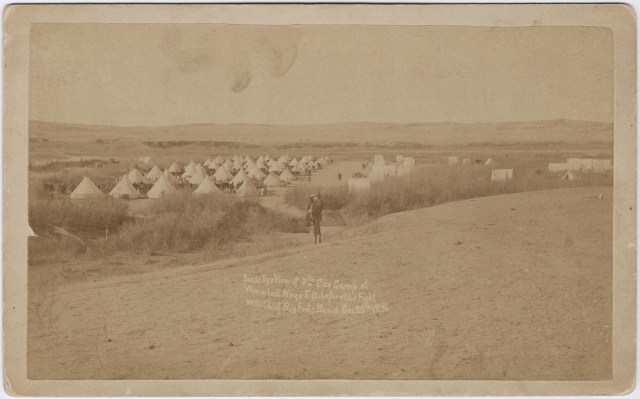
George E. Trager and the Northwestern Photographic Co., dated 29 Dec. 1890, titled “Birds eye view of 7th Cav Camp at Wounded Knee S.D. before the fight with Chief Big Foots Band.”
Friday, January 2nd, 1891
Yesterday General Brook, his staff, the 2nd Infantry, one Battalion 9th Cavalry and two small Mountain guns left here about 9 A.M. for active service in the field, with a view of getting in rear of the hostile Indians. General [Eugene A.] Carr with his Command is moving up on their right, the troops from Rose Bud are in position the troops now here–1st Infantry and my regiment, with four guns under Capt. [Allyn] Caperon [sic: Capron] will advance direct on the Red Skins and a demand will be made on them to surrender and return to the Agency with the promise that they will receive good, kind treatment. Should they disregard the demand to surrender and fire on our men, why of course a bloody battle will ensue and again the Indians will get the worst of it. I firmly believe, however, the whole difficulty will be adjusted by General Miles without another shot being fired. He is working day and night to induce the head men now out to come in and have a talk and arrange terms with them, for them to come in and behave themselves. General Miles is terribly worked up over the battle with Big Foot as it was his desire to settle matters without the loss of life. I guess from what I hear that he is dissatisfied with Brook’s management of affairs and as soon as he reached here, he ordered Brooks to take the field; so as to get him away from the Agency. We are in readiness to leave here on an hour’s notice and if we go at all, I feel it will be our last campaign, as with the large number of troops on horse the work should be settled either by peace or war. I hope the end may be reached before you receive this paper, or letter I should have said. The wounded are all improving and appear cheerful. No provision had been made by the Medical Department to provide for so many wounded men and of course there must be discomforts. This time of the year is recognized as the season of abundant merriment and genuine good fellowship. The good fellowship can be found here but all luxuries are not with us.
Monday, January 5th, ‘91
At midnight Friday, I received instructions to proceed at day light Saturday A.M. with a burial party to the battle ground of Wounded Knee for the purpose of assisting in making a complete map of the ground locating thereon the exact position the Troops occupied from the commencement to the end of the battle. I obeyed the order literally and only returned to my camp here last evening at 8 o’clock pretty badly used up, but a good night’s rest was most refreshing and I am feeling very much improved this morning. Eighty four Buck Indians were buried yesterday, ten are wounded in the hospital and nine were taken away and buried by friendly Indians. 8 are at the Catholic Mission wounded. So out of 120 present at the beginning of the fight we know of 111 that were either killed or wounded, leaving nine unaccounted for. On my arrival here I find General F. has been relieved from Command of his regiment and a Board of Officers ordered to investigate what brought on the fight, whether it could not have been avoided and whether a proper disposition of the troops was made for disarming and fighting. The settlement of the Indian trouble has been a failure according to the plans arranged by Gen. Miles, and now some one must shoulder the responsibility and be sacrificed and from appearances Gen. F. is the man selected, for other people to unload on. I regard the management of the Council with the Indians, the disarmament of them as far as it went, and the placing of troops before and during the battle as judicious. Every thing was done to avert an outbreak, considering the circumstances and our position that mortal man can do.
The General is terribly worried and distressed over his position as he says, although he may be fully exonerated from all blame, the great harm has been done his record which can never be erased. I am willing to shoulder all the responsibility of the affair, as I really managed the whole business. The Inspector General was with me on the battle field yesterday and he was perfectly satisfied with every thing done and will so report to General Miles. I have just been sent for by General Miles to report to him in person.
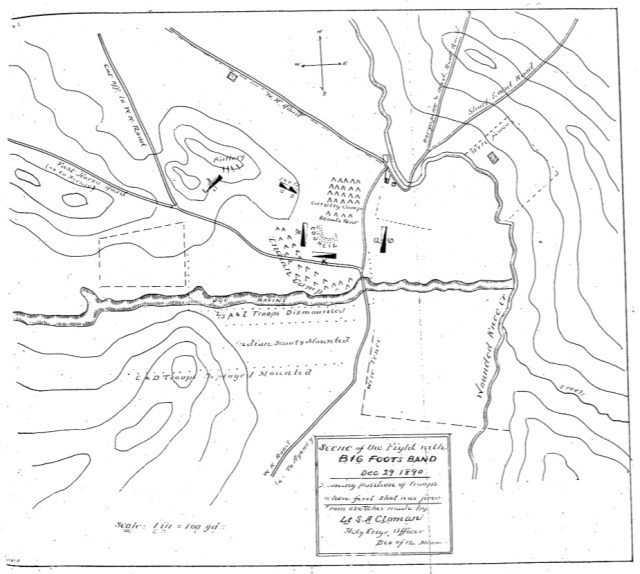
Lieutenant Sydney A. Cloman’s original map of the Wounded Knee Battlefield.
Wednesday
January 7th ‘91
I have been before the Board of Officers investigating our Wounded Knee Battle all the morning and it is within a few minutes of mail time so I can only say that everything remains quiet at Pine Ridge. There has been no movement of Troops since I wrote you yesterday as we are all waiting to see how many hostiles will come into the Agency and surrender as they have been invited to do.
All evidence offered so far has been based on facts as they occurred on the battle field, that every precaution was taken to guard against an accident and the whole affair reflects great credit on each and everyman connected with the capture and management of those Indians.
Tell Miss Bessie to cheer up as the daughter of a soldier who did his whole duty and did it well and he will come out of it without a stain on his fair name and the report of the Board will be that the 7th Cavalry should have commendation of the War Dept. and no praise is too great to bestow on us.
The Indians are coming in slowly and there is great prospects of the trouble ending without any further fighting.
Lt. [J. Franklin] Bell joined us yesterday direct from Mexico. We are all well.
Bessie, or Elizabeth, was Forsyth’s eldest daughter. Within a year of the campaign, she married Lt. Col. Dallas Bache, making him the son-in-law of Forsyth and the brother-in-law of Bacon, and from his first marriage, the brother-in-law of Whitside.
Thursday 10 A.M.
Camp at Pine Ridge So. Dakota
January 15th 1891
Another day has gone and the military situation at the seat of War remains unchanged. Yesterday was spent by the Commanding General in holding councils with a number of the head men of the hostiles in which the subject of surrendering their arms was fully discussed, and I understand the Indians agreed to bring in their arms today, turn them over to the Agent and receive his receipt for the same–the arms to be returned to them at some future time, or the money value therefore. It remains to be seen whether the hostiles, young and old will comply with the arrangements made by their representative men, as the Indian values his gun more highly then any of his belongings. We are evidently held here waiting the result of the disarmament. As soon as the matter is settled we will be told to go home and the Indians will be sent to their farms.
A military officer has been sent here, to set an Agent in place of the imbecile just relieved and who in a measure is responsible for all of the trouble at this place.
This is a cold foggy day and if all weather signs do not fail, we will be visited by a blinding snow storm and a Northern blizzard within the next seventy four hours. I pity our poor horses as they stand at the picket line on the side of the hill exposed to the wind and cold.
Gen. Forsyth has just come into my tent with a telegram from Hare, saying [First Lieut. James D.] Mann died yesterday. I am shocked and distressed beyond expression to hear such sad news. The information is such a surprise as the Medical officers here did not regard his wound as in any way serious, and his sudden ending must be the result of blood poisoning. Mann was a fine brave and gallant officer, always ready and willing for service and did his duty cheerfully. There is many a sad heart here to day among the officers and especially among the enlisted, as he was a great favorite of the men, as he always treated them kindly. I will miss poor Mann as I have always been very fond of him and appreciated his many good qualities. Gen. Forsyth’s status remains unchanged. –he is more cheerful and is becoming reconciled to the unfortunate position in which he is placed. The investigation developed nothing to his discredit but as one of the officers of the Board [Capt. Frank D. Baldwin] was the confidential advisor of Gen. Miles, the report of the Board will probably be in accordance with the will or desires of Gen M. instead of the facts in the case as shown by the evidence adduced. As soon as the report of the Board is made public, Gen. F. will demand a Court of Inquiry, when I am confident he will be exonerated. The Court will be composed of officers of high rank who are not under Miles’ Command, and therefore not afraid to express their opinion. Mr. Hermann Dennison, a brother-in-law of Gen. F. is expected here today. Col. [William R.] Shafter called yesterday.
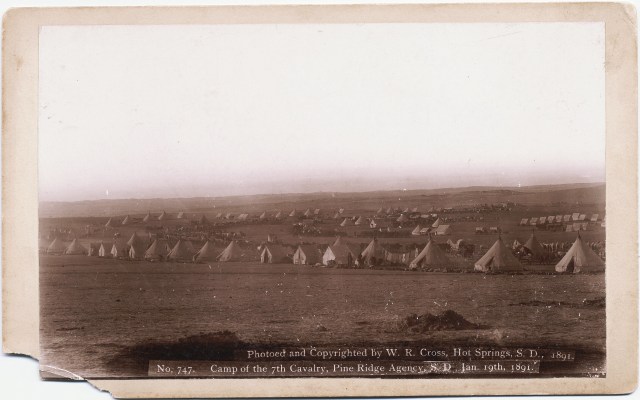
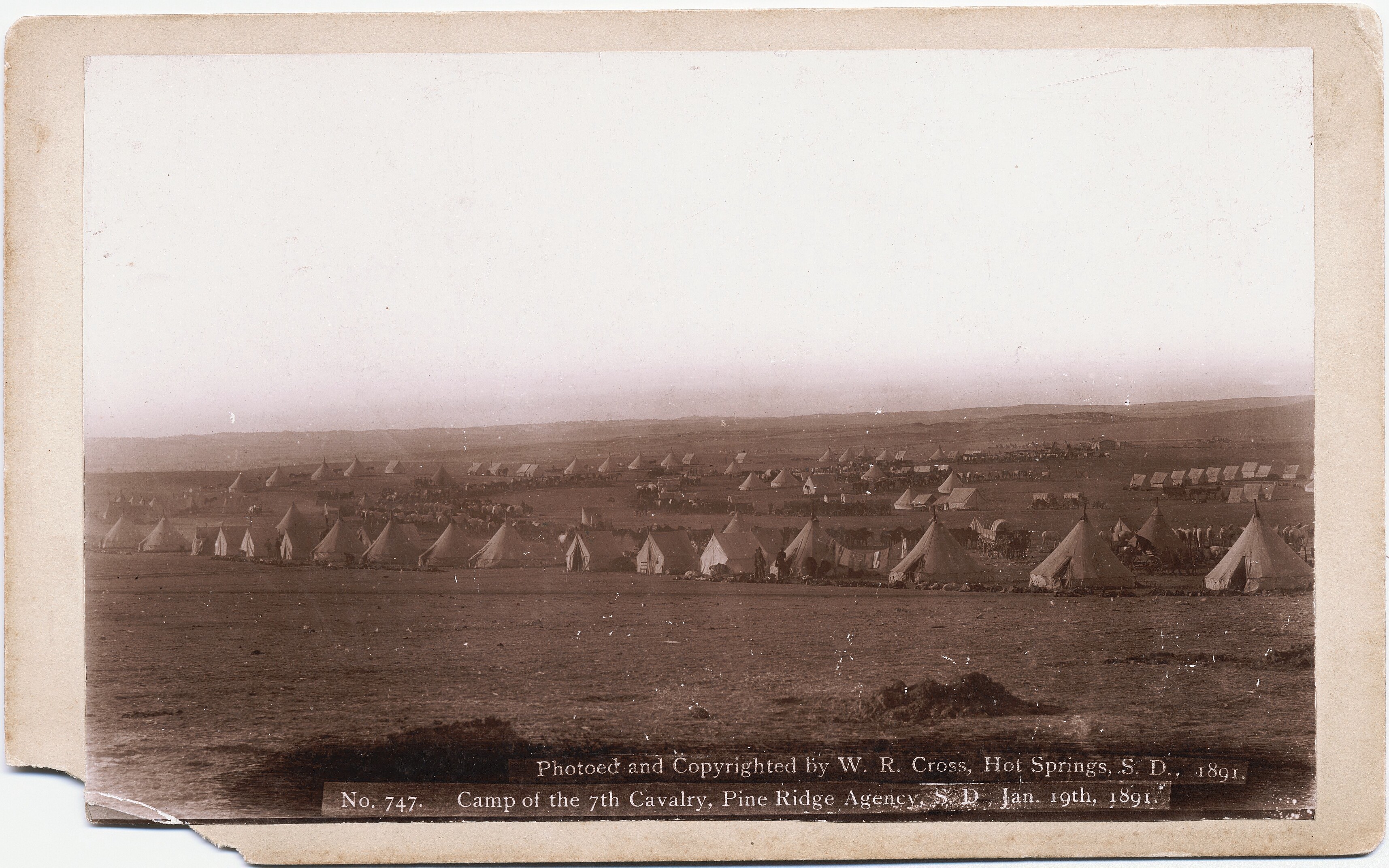
William R. Cross, No. 747. “Camp of the 7th Cavalry, Pine Ridge Agency, S. D. Jan. 19th, 1891. W. R. Cross, 1891. “
Citation for this article: Samuel L. Russell, “Major Samuel Marmaduke Whitside’s Campaign Letters,” Army at Wounded Knee (Sumter, SC: Russell Martial Research, 2013-2014, http://wp.me/p3NoJy-wl), posted 1 August 2014, accessed date __________.


![The Evangelical Parish of Dierdorf, Prussia listing Franz Anton the son of Wilhelm Moritz Reineck and Katharina Heer.[6]](https://armyatwoundedknee.com/wp-content/uploads/2014/08/evangelical-parish-record-of-brith-marriages-and-deaths.jpg)


 Sam Russell





 Army at Wounded Knee