Hunting for Big Foot, part 2: 24 December 1890.


I fear to leave this vicinity in pursuit of Big Foot as he might turn north and commit depredations.
–Maj. Gen. N. A. Miles

This day 125 years ago… the hunt for Big Foot began in earnest as forces were directed to block or intercept the Miniconjou band. (click to open Hunting for Big Foot homepage)

The time displayed, e.g. (9:30 a.m.), at the beginning of each message reflects when that information was sent from or received at General Brooke’s headquarters, unless otherwise indicated.  Most of the messages were transmitted via telegraph. Those messages that were delivered by other means such as couriers or heliograph are so annotated in parenthesis at the end of each respective message.  Hover the mouse over the names displayed in Red to display the full identity of the individual mentioned.  Bold Red will also indicate location of the individual.  Blue underlined texts are hyperlinks to other pages or cites.  Click on photos of individuals to see an enlarged version of the source photograph in a new tab.  Similarly, clicking on maps will open a new tab with an enlarged view of each map that can be zoomed in for greater detail.

Wednesday, Dec. 24, 1890.

(Click to enlarge) Inset depicting approximate location of Lt. Col. Sumner and Col. Carr on the morning of 24 Dec. 1890.
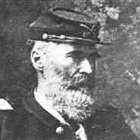
e-a-carr

Carr to Miles (sent 10 a.m.): Respectfully forwarded [Sumner’s message regarding Big Foot’s escape] to General Miles.  I am starting with all troops here to cut the trail.  One troop out patrolling and four troops go with me. {1061}
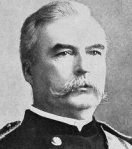
Thomas_H__Ruger

Ruger to Brooke: Colonel Sumner, who reported on the twenty-first the surrender of Big Foot with all his people and others, at this village, some thirty young men from Cherry creek and thirty-eight Sitting Bull refugees, latter mostly women and children, reports, dated yesterday, that Big Foot had slipped off and moved south with ponies and lodge poles, no wagons; that he has notified Colonel Carr, the date not stated, number going with Big Foot, nor whether any women and children. I directed Sumner to pursue, but, of course, much time is lost. {497} Continue reading
Posted in Official Reports | Tagged , , , , , , , , , , , , , | 6 Comments

Captain Joseph Henry Hurst and Lieutenant Harry Clay Hale, 12th Infantry – Courage, Fortitude, Good Judgment, and Tact


The statement of the services immediately performed by Capt. Hurst and Lieut. Hale carries with it so evident a suggestion of every meritorious conduct on their part that special remark thereof would seem superfluous.
–Brigadier General Thomas H. Ruger

Second Lieutenant Harry Clay Hale of the 12th Infantry was twenty-nine years old and seven years out of the United States Military Academy when his duty called him into action during the Sioux campaign.  Captain Joseph Henry Hurst was fifty-four and an emigrant from England who served with the 141st Pennsylvania Volunteers during the Civil War receiving brevet promotions for gallantry at Chancellorsville and Spotsylvania.  Hurst had been a captain with the 12th Infantry since 1886.  If there were only two men in the United States Army that winter of 1890-1891 capable of convincing hundreds of “hostile” Indians to surrender their weapons and submit peacefully to the will of the government, it was Lieutenant Hale and Captain Hurst.  Their accomplishment is singularly extraordinary and came on the heels of Sitting Bull’s death where Captain Fechét had ridden to the rescue of the Standing Rock Agency Indian police on 15 December.  Over two hundred of Sitting Bull’s followers that day fled their camp at Standing Rock, ostensibly to join Big Foot’s band of Miniconjou, wage war on the country side, and seek vengeance for their fallen chief.  In truth, they were terrified, starving, freezing, and understandably distrustful of soldiers, making them potentially dangerous to anyone in uniform.  125 years ago today, Lieutenant Hale rode up by himself to confront this band of fugitive Indians, and see if he could convince them to surrender.  Six days later he filed the following report. Continue reading

Posted in Award Recipients, Officers, Official Reports | Tagged , , , , , , , , , , , | 18 Comments

Captain Edmond Gustave Fechét, 8th Cavalry – Capture and Death of Sitting Bull


The fearless action of Captain Fechet and his command entitles them to great credit and the celerity of his movements showed the true soldierly spirit.
–Major General Nelson A. Miles

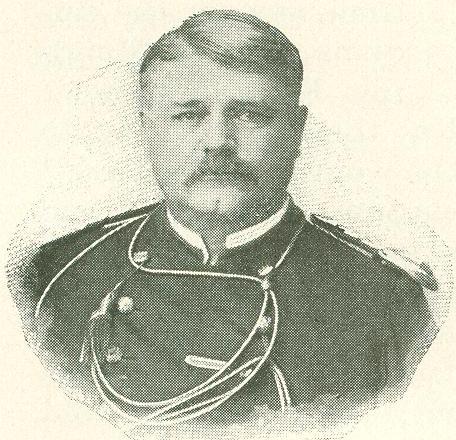
Captain Edmond Gustav Fechét, 8th U.S. Cavalry.  This photograph appeared in Cosmopolitan Magazine in Fechét’s 1896 account of the death of Sitting Bull.

125 years ago today Captain Edmond Gustave Fechét rode to the sounds of the guns in support of the Indian police at the Standing Rock Agency who were attempting to arrest Sitting Bull. At forty-six years of age he was the senior captain in the 8th U.S. Cavalry and commanding a battalion of two troops of that regiment.  Of the sixty-five officers and soldiers from the campaign recognized with medals, certificates of merit, or honorable mention, Captain Fechét’s actions, in the eyes of the commanding general of the Army, did not merit such accolades.

On 14 December 1890 Colonel William F. Drum, through the post adjutant at Fort Yates, North Dakota, issued in part the following order: Continue reading

Posted in Officers, Official Reports | Tagged , , , , , , , , | 3 Comments